
Import Castors from China: A European Buyer’s First Direct Order
Most European equipment builders do not set out to import castors from China. They buy from a local distributor, accept the markup, and move on. The conversation usually starts the other way: the distributor raises prices again, or the lead time stretches to eight weeks, or the spec the builder actually needs is not on the distributor’s catalog. At that point someone on the buyer’s side types “caster manufacturer China” into Google and starts comparing factories.
This is the story of one such buyer — a mid-sized equipment builder in Northern Europe — and how they went from “we have never bought directly from China” to a repeat container order. We have kept the details confidential below. The shape of the process, though, is the same one most first-time importers walk through.
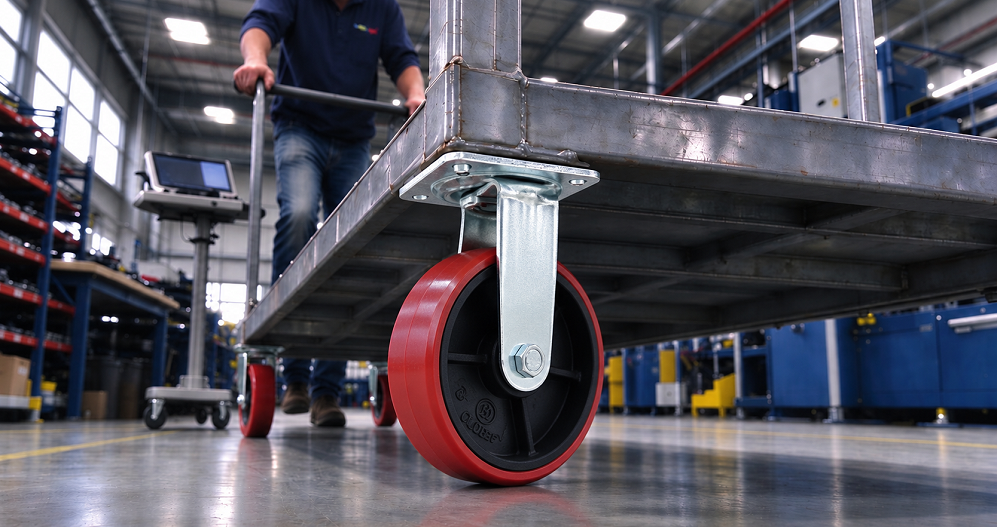
For commercial confidentiality, the customer name, specific country, order quantities and prices are not disclosed. This is a representative account of a real onboarding process, not a named case study.
Who the Buyer Was
The customer builds material-handling equipment for the European market — mobile workstations, assembly carts and custom transport racks. Their annual caster consumption was around 6,000–8,000 wheels a year, all bought from a local distributor who sourced from a known Taiwanese brand. They were not unhappy with the quality. They were unhappy with the price and the lead time, and they could not get the distributor to agree to a non-standard bracket bend they wanted for one of their new products.
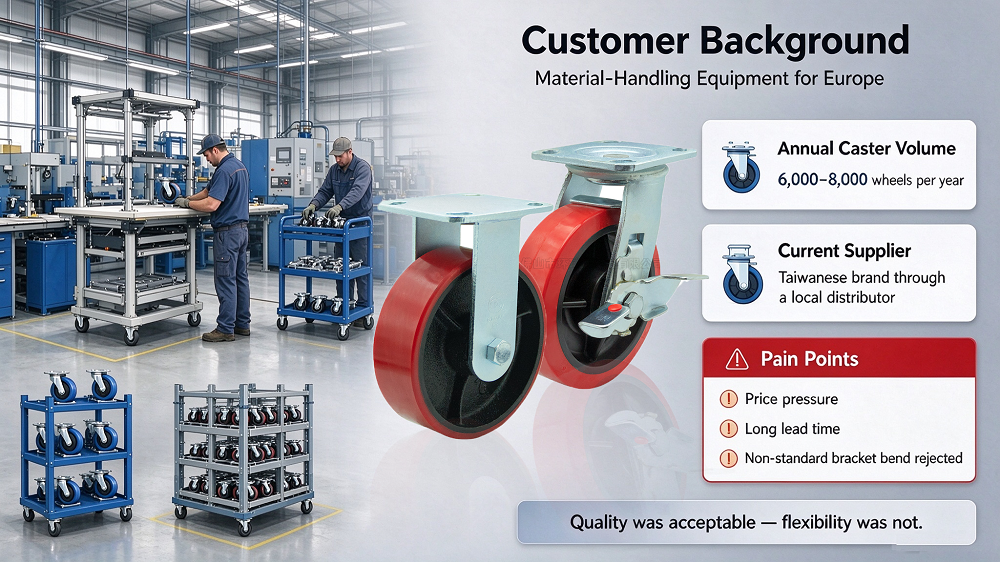
What They Needed
- Quality Parity:Same build quality they were used to from the Taiwanese brand — they had been burned by a cheap Chinese supplier ten years earlier and were wary.
- Engineering Engagement:A factory that would answer engineering questions, not just send a price list.
- Flexible MOQ:Flexible small first order — they did not want to commit a full container on day one.
- Predictable Lead Time:Reliable lead time they could plan around, not “maybe 30 days, maybe 60.”
How We First Spoke
The enquiry came through our website contact form, not a trade show. The buyer wrote a short, technical message: what they currently used, what load their carts carried, and a question about whether we could match a specific Taiwanese bracket dimension.
We did not quote on the first reply. We asked three questions back:
- what floor material the cart rolled on
- what brake type their operators preferred
- what mounting hole pattern they were drilling.
That reply, more than anything else, is what kept the conversation going — they told us later that other Chinese suppliers had quoted within two hours and had not asked a single engineering question.
The Sample Stage — Why We Did Not Just Send Catalog Stock
We sent four sample wheels, not one. The four were:
| Sample | What We Wanted to Test |
|---|---|
| Iron-core PU swivel, ball bearing (our standard) | Whether the buyer’s operators found the roll acceptable compared to the Taiwanese brand |
| Same wheel with a side brake instead of total lock | Whether the lower pedal height worked for their cart design |
| TPR tread, same bracket | Quiet alternative for a customer site with noise complaints |
| Nylon tread, same bracket | Cheaper fallback for their dry-zone carts |
Samples went by express courier, not sea, because the buyer had a design review coming up and needed them in hand before it. We did not charge for the samples themselves — the buyer paid the courier. That is a standard arrangement for us on genuine production-enquiry samples.
What Happened in Their Test Six Weeks
The buyer tested the samples on one of their own carts for six weeks. Their engineers measured roll force, ran the brake pedals through thousands of actuations, and rolled the cart over expansion joints in their test bay.
They came back with one piece of feedback: the side-brake pedal sat 8 mm higher than their current Taiwanese unit, and their operators’ feet kept catching it on the way past.
That is a small stamping change. We adjusted the bracket bend on our stamping die, sent two updated samples, and did not charge for the die tweak. The buyer told us later that this moment was the deciding factor — not the price, but the fact that a Chinese factory was willing to bend a pedal 8 mm for them instead of telling them to adapt their cart.
The First Order — A Half Container, Not a Full One
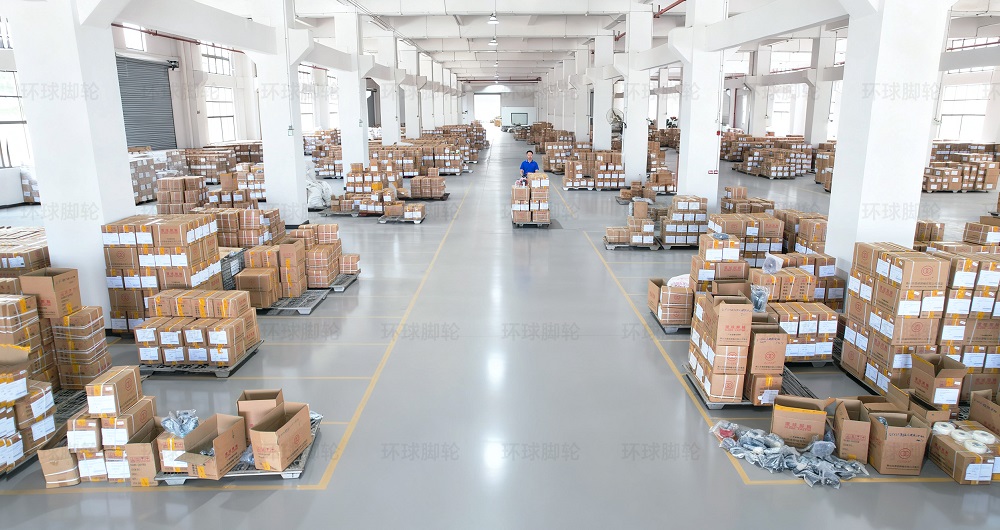
The first order was deliberately small. We agreed on a mixed order — three SKUs on the same EH8 plate layout, so the buyer could test our stability across their range without committing a full container. We packed cartons by SKU, marked every box with the buyer’s internal part number, and sent packing photos and a pre-shipment inspection report before the container left. The buyer had never seen pre-shipment photos from the Taiwanese brand — that level of visibility was new to them.
Customs and Quality on Arrival
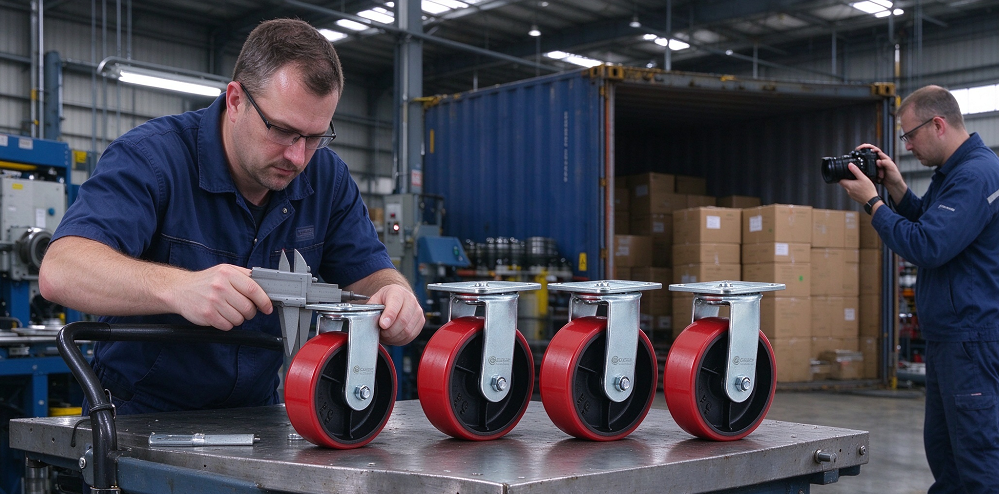
The buyer handled their own import documentation through a freight forwarder they already used. We provided the commercial invoice, packing list and certificate of origin, and we declared the correct HS code for caster wheels. When the container arrived, the buyer’s warehouse checked the goods against the packing list, weighed a sample of cartons, and ran a quick roll test on ten random wheels. They reported zero discrepancies. The pre-shipment photos meant they knew exactly what to expect when they opened the cartons.
Price Was Important, But Not the Only Factor
We did not offer the cheapest price. The buyer compared us against three other Chinese factories and one Turkish supplier. We were not the lowest. The reasons they gave for choosing us, after the order was running, were:
- The sample stage was honest — we sent four wheels to test, not just the one we wanted to sell.
- The 8 mm pedal adjustment was handled without argument and without charge.
- Pre-shipment photos and inspection report gave them confidence before the container left.
- Engineering replies came within one business day, in technical English, not marketing English.
From First Order to Repeat Business
The first order was a trial. The second order was the same three SKUs plus two more. By the third order, the buyer had removed the Taiwanese brand from their approved-vendor list for these cart models and was re-specifying their new product line around our bracket dimensions. We do not claim they “saved 30%” or “grew 200%” — those numbers are theirs to keep internal. What we can say is that the relationship moved from samples to a standing order inside one production season.
What Other First-Time Importers Can Learn
- Do not start with a full container. Start with samples, then a mixed small order. A half-container trial tells you more than a factory tour.
- Ask engineering questions back. If a supplier quotes within two hours without asking about your load, floor or brake needs, treat that as a warning, not a service.
- Require pre-shipment photos. A factory willing to photograph the packed cartons before loading is a factory you can trust at distance.
- Budget for one small non-standard tweak. The first order almost always has one bracket bend, one pedal height or one box marking that needs adjusting. Pick a supplier that will handle that gracefully.
- Keep your freight forwarder. You do not need the Chinese factory to handle your import clearance. Your own forwarder knows your customs regime; we just need to give them clean documents.
About Globe Caster
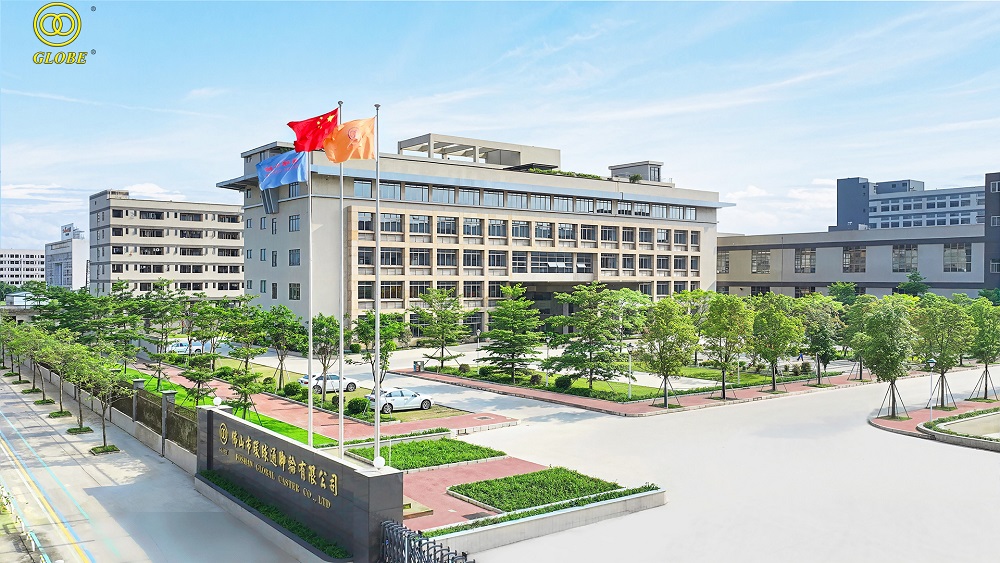
Globe Caster — Foshan Global Caster Co., Ltd, Guangdong, China — has manufactured casters and castors since 1988. Our 156,000 m² facility runs in-house stamping, injection molding and PU pouring. 600+ standard SKUs in stock, 21,000+ catalog models, ISO 9001 and ISO 14001 certified, exporting to North America, Europe, Southeast Asia and the Middle East. 12-month warranty, 30-day lead time, OEM and private label welcome.
Thinking About Importing Castors Directly from China?
Send us your current competitor spec (or a photo of the wheel you are replacing), your loaded cart weight, and your mounting hole pattern. We will reply within one business day with sample recommendations, a rough EXW price, and a sample plan — no commitment to a container. First-time importers and European equipment builders welcome.
Post time: Oct-24-2026