
A trolley rolling across an electronics shop floor picks up charge from contact, friction and air motion. On an ordinary cart that charge stays on the frame, the PCB rack and the components sitting on it, until something nearby grounds the gap. The discharge can punch through a part, or leave a damage that shows up as a failure weeks later in the field.
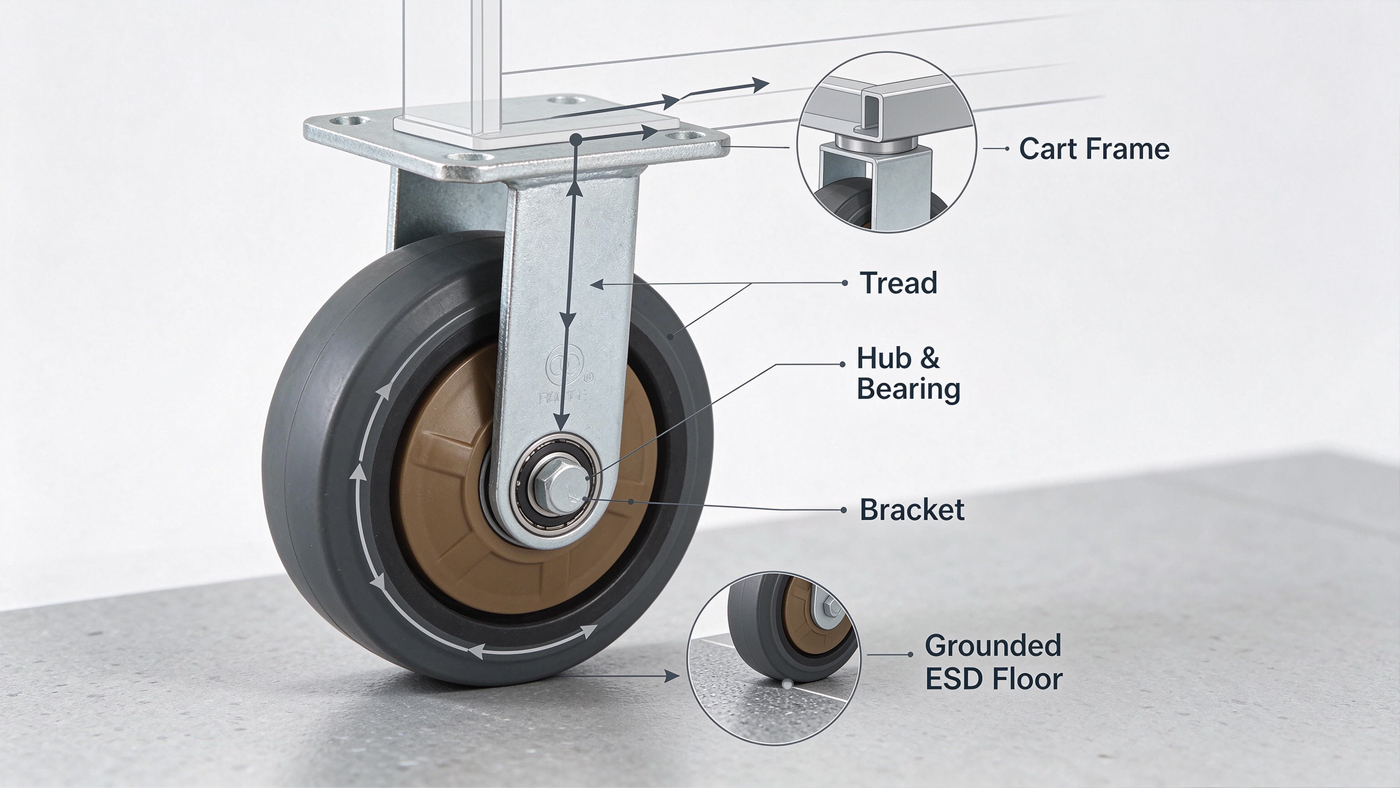
Anti static castors, also called ESD wheels or esd caster wheels, are selected to keep that charge from building up. The tread, hub, bearing and bracket are chosen so the charge has a path to leave the cart instead of sitting on it. Where that path breaks, and which conductive or dissipative option fits the cell, decides whether the wheel actually protects the parts.
What Are Anti Static Castors?
An anti-static caster wheel is built for an ESD-controlled environment: an electronics assembly line, a PCB turnaround cart, a component rack, a display-module or battery-cell handling trolley, or a clean-room station. The running material and the wheel hardware conduct or bleed off the static charge generated while rolling, so the cart frame and the goods on it do not hold a high charge level.
The ESD rating belongs to the whole leg, not only to the colour of the tread. A conductive-looking outer ring on an insulating hub, an insulating bushing or a plastic bearing can break the path before the charge reaches the frame.
ISO 22883 (current edition) sets the requirements and tests for industrial castors and wheels, and the ANSI/ICWM terminology standards define the names the industry uses. Static-control performance itself is checked under the plant’s own ESD programme, usually by measuring the assembled wheel-to-ground resistance rather than trusting the tread name alone.
Conductive, Dissipative and Insulative Wheels
Buyers write anti-static, ESD and static dissipative as if they were the same label. They describe three different positions on the resistance scale.
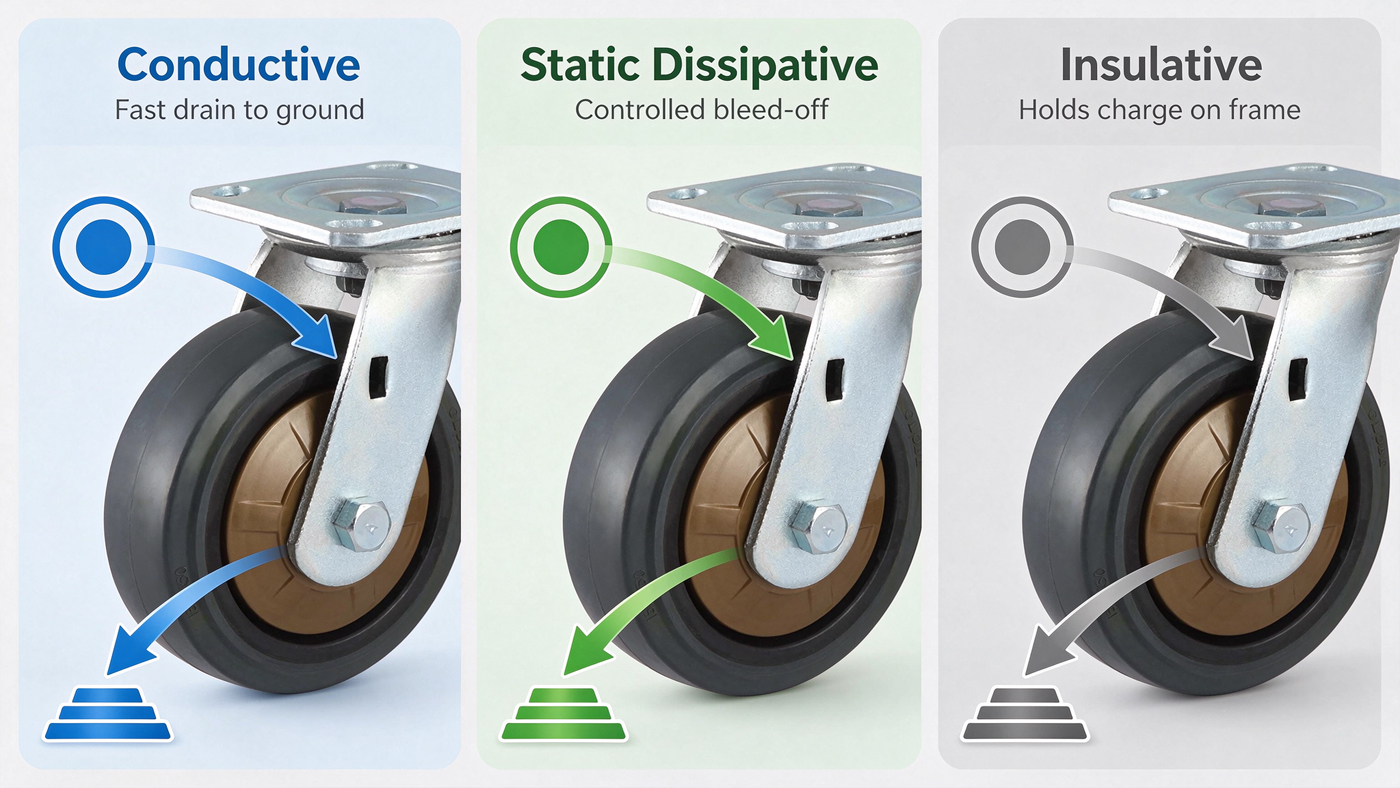
- Conductive wheels. The running material sits at the low-resistance end. Charge moves off the cart close to a direct path. These are used where the work cell is grounded and a fast drain is required.
- Static dissipative wheels. The material bleeds charge at a controlled, higher resistance rather than passing it straight through. This is the middle position between conductor and insulator, common on carts that move through controlled work areas.
- Insulative wheels. Ordinary nylon, PP and most standard polyurethane wheels hold charge on the wheel and frame. They are not ESD wheels, even if the roll is quiet and the floor stays clean.
The exact resistance bands for conductive, dissipative and insulative classes are set by the plant ESD programme and the referenced ESD standards it follows. When you quote, ask for the resistance class the workstation requires, not just the word “anti-static” on the catalogue page.
Why the Charge Path Matters
A caster only drains charge if every part in the chain passes it along. The path runs from the tread touching the floor, through the hub and bearing, up the bracket to the cart frame, and from the frame to a grounded ESD floor or work surface.
- Tread. The outer ring must be a conductive or dissipative elastomer, or a modified polymer compound chosen for static control.
- Hub and bearing. The wheel centre and the axle bearing keep the electrical connection through the wheel. A plastic bushing or an insulating bearing insert can open the circuit even on a conductive tread.
- Bracket and frame. The fork and top plate carry the connection to the cart. The frame itself must be connected to the ground path; a painted or plastic-isolated frame does not complete it.
- Floor. The wheel can only drain to a floor that is itself an ESD-rated, grounded surface. On an ordinary sealed epoxy or PVC floor the chain stops at the tread.
One broken link in this chain and the cart behaves like an insulator, no matter what the tread name says.
Tread Options at a Glance
| Tread family | Static behaviour | Roll / noise | Floor marking | ESD role |
|---|---|---|---|---|
| Nylon (PA) | Insulative; holds charge on wheel and frame | Stiff roll, harder noise over joints | Can scuff soft floors | Not for ESD workstations |
| PP / polyolefin | Insulative; light-duty plastic wheel | Light roll, moderate noise | Low marking on hard floors | Not for ESD workstations |
| Standard polyurethane (PU) | Most standard PU compounds are insulative unless modified for static control | Resilient, quiet, low push force | Generally non-marking | Use a static-control modified PU only for ESD duty |
| Conductive / dissipative elastomer | Drains or bleeds charge by compound design; resistance class confirmed by test | Elastomer roll, usually quieter than hard plastic | Marking behaviour checked against the actual floor | Main tread family for ESD carts and racks |
| Cast iron / cast steel | Metal itself conducts, but the contact and bearing path still has to be checked | Hard, loud, low give | Marks polished and sealed floors | Heavy-duty metal floors and rails; not a soft clean-room tread |
Within one ESD job the tread compound and the bearing can be selected separately. The static class and the load rating are two different lines on the specification; one does not cover the other.
What Changes the Static Performance
- Tread compound. Whether the ring is conductive, dissipative or insulative is set by the formulation, not the colour. Black rubber does not mean conductive.
- Hub, bearing and bushing. A plastic insert or an insulating bearing can stop the path at the axle. Confirm the whole wheel conducts, not only the outer ring.
- Ground floor or mat. ESD wheels discharge into a controlled, grounded surface. An ordinary non-ESD floor leaves the charge with nowhere to go.
- Humidity. Dry air raises the surface resistance of insulating materials and makes static build-up more noticeable. Winter and air-conditioned dry rooms show this more than damp ones.
- Load and contact area. The tread flattens under the cart weight, which changes how much of the ring touches the floor. A lightly loaded wheel can sit on a smaller contact patch.
- Oil, dust and surface coating. Grease, released agents, trapped fibres or a floor coating can insulate the contact patch over time. The contact surface has to stay clean enough to conduct.
Common Mistakes
- Believing the ESD wheel solves the whole problem. If the floor is not a grounded ESD surface, the cart still holds charge. The wheel is one link in a system that includes flooring, mats and workstation grounding.
- Checking the tread but not the assembled wheel. The right outer ring on an insulating hub or bushing still leaves an open path. Test the wheel-to-ground resistance of the assembled caster, not a loose ring.
- Choosing conductive when the cell needs dissipation, or the reverse. Some work cells require a controlled bleed rather than a direct connection. Match the class to the plant ESD plan instead of picking the lowest resistance available.
- Treating black rubber as conductive. Colour is a visual cue only. The compound and a resistance reading decide the class.
- Mixing conductive and standard casters on one ESD cart. The four legs should follow the same static plan. A standard wheel on one corner breaks the consistent path the cell expects.
- Buying ESD wheels for a dry warehouse with no static-sensitive goods. A standard PU or nylon wheel covers ordinary storage and handling. The static-control tread adds cost for a risk that never arrives.
Where Anti Static Castors Belong
- SMT and PCB line-side carts, PCBA turnaround racks and component storage trolleys.
- Display module, semiconductor and battery-cell handling equipment in controlled assembly areas.
- Clean-room and test-station carts that move between grounded work cells.
- Material-handling racks where sensitive parts sit on the frame during the move.
Worked Selection Example
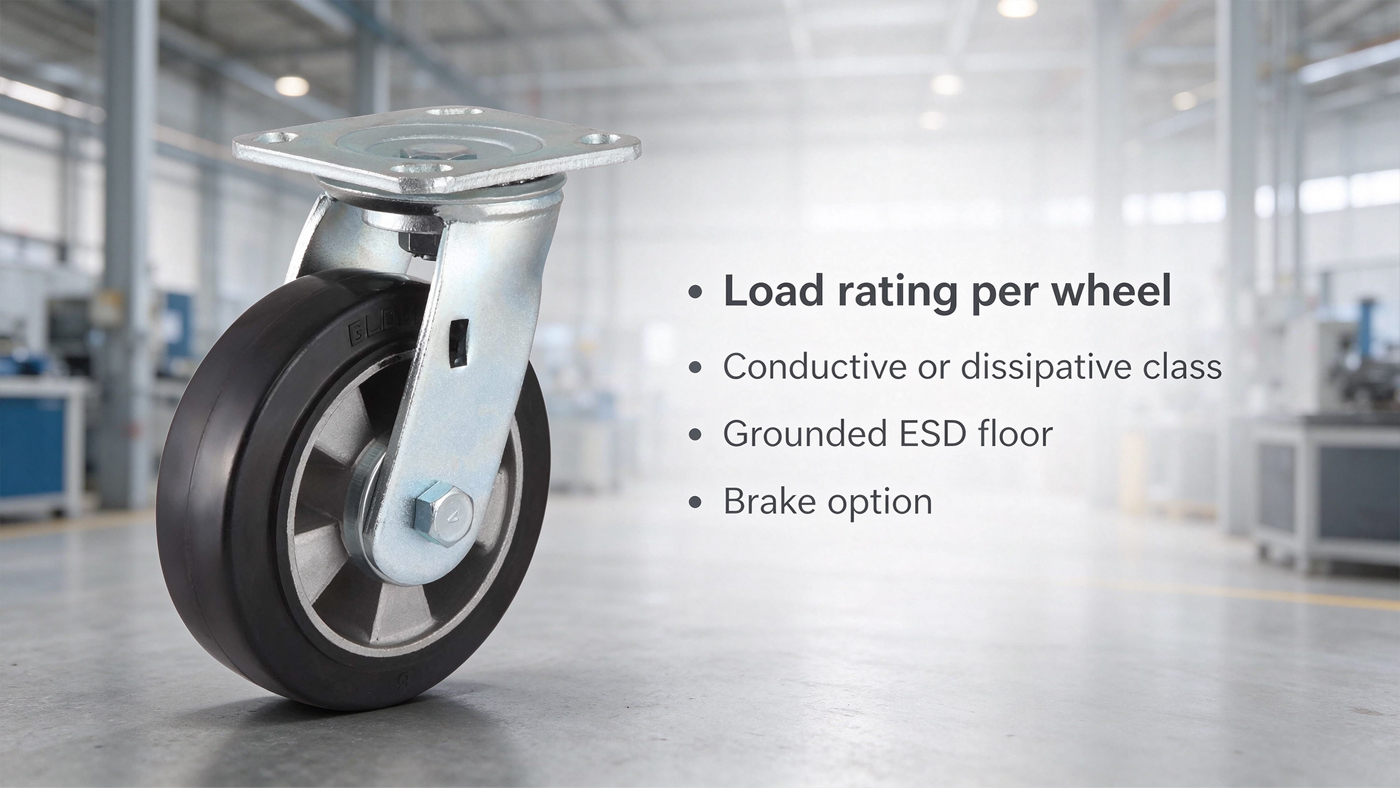
A line-side trolley carries 240 kg loaded, on four castors. Per wheel: 240 ÷ 4 = 60 kg. The first selection line is the load: bracket family, wheel diameter and bearing have to cover 60 kg per wheel with the usual safety margin. The second selection line is static control: the tread has to be the conductive or dissipative class the workstation specifies, the hub and bearing keep the path open, and the assembled wheel-to-ground resistance is measured against the plant ESD requirement.
If the floor under the trolley is an ordinary sealed floor without ESD grounding, an ESD tread alone will not drain the charge. Fix the floor and the workstation grounding first, then size the wheels.
If the cart only stores and moves packaged goods with no exposed electronics, anti-static castors are the wrong expense. A standard medium-duty tread rolls quieter on a clean finished floor and costs less.
What Buyers Usually Ask
What is the difference between ESD wheels and anti static castors?
ESD describes the overall electrostatic-discharge protection concept. Anti-static, conductive and static dissipative describe how the wheel material handles the charge. The terms overlap in catalogue listings; the resistance class from the plant ESD plan is what should go on the order.
Are black rubber wheels automatically conductive?
No. Colour does not indicate conductivity. The compound formulation and a measured resistance reading decide whether a wheel is conductive, dissipative or insulative.
Do ESD castors work on a normal concrete floor?
Only if that floor is part of a grounded ESD system. On an ordinary sealed or coated concrete floor the charge has no drain, and the wheel tread cannot complete the path by itself.
Can one cart mix ESD and standard wheels?
Not on an ESD workstation. The four legs should follow the same static plan; a standard wheel on one corner leaves an inconsistent path. Confirm the arrangement with the site ESD procedure.
What does an ESD caster quote need?
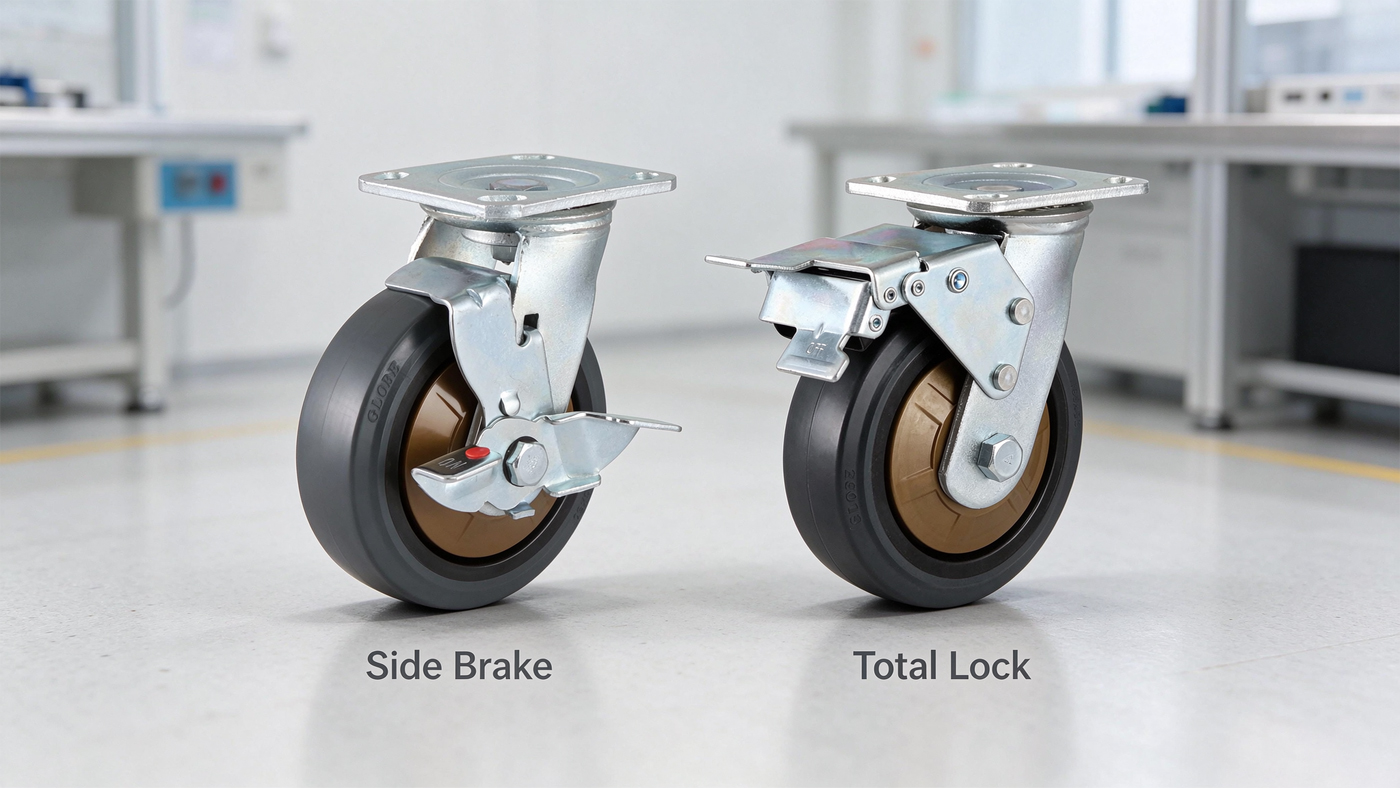
Loaded weight, wheel diameter or mounting style, floor material and whether it is an ESD floor, the required conductive or dissipative class, humidity level, brake requirement, and the assembled wheel-to-ground resistance the cell expects.
Are anti-static wheels quieter than standard ones?
Not by default. Noise comes from tread elasticity, diameter and floor joints, while static control comes from the compound. A static-control elastomer can be quiet, but the two properties are selected separately.
How Globe Caster Matches the Static-Control Duty
Foshan Global Caster Co., Ltd, Guangdong, China has manufactured casters and wheels since 1988. The plant covers about 156,000 m² with 500-plus staff and in-house stamping, injection moulding and PU pouring, outputting roughly ten million casters a year. The catalogue holds 21,000-plus models, 600-plus of them as standing stock, certified to ISO 9001 and ISO 14001, with over 100 patents. Standard PU, nylon, rubber, artificial rubber, iron-core PU and metal treads are offered across the bracket families, and the bearing, bracket and mount can be matched to one duty rather than sold as a fixed combo. For an ESD application, the tread class, bearing path and mounting are confirmed against the workstation requirement before samples are sent.
Send the Floor and ESD Requirement, We Match the Wheel
Tell us the loaded weight, floor material and whether it is a grounded ESD surface, the required conductive or dissipative class, mounting style, humidity and whether you need a brake. We reply with the tread family, the per-wheel load figure and sample options to trial on one cart. If a standard wheel covers the job, we say so.
Post time: Nov-24-2026