
A bed that rolls out to make the room easier to clean should still sit square and steady when you sleep on it. The castors decide whether the frame glides on the floor or drags, and whether the wheel leaves a mark on a wooden or laminate surface. Pick a loud, hard wheel and the complaint comes from the bedroom; pick a bracket that will not stay put and the frame shifts under load. Either problem lands on the bed maker, not on the wheel supplier they ordered once.
This account follows how an overseas bed frame and bedstead manufacturer built a repeatable set of bed castors for its own product range, from enquiry through factory visit, sample fitting, local testing and SKU-level confirmation. The same process applies to trundle beds, divan bases, sofa beds and bed frames that ship flat-packed.
About the Customer
The customer makes wooden and metal bed frames, trundle beds and divan bases, sold under its own brand to retail chains, interior distributors and end consumers. The wheels are fitted to the frame before it leaves the factory, or packed alongside for final assembly at retail. A consistent fit and feel across every unit in a production run matters as much as the caster’s own rating. Most frames move only a few times a year, for cleaning or repositioning; a smaller range of guest and sofa beds moves more often.
What They Needed
The opening request covered a small family of fittings rather than one model. They wanted:
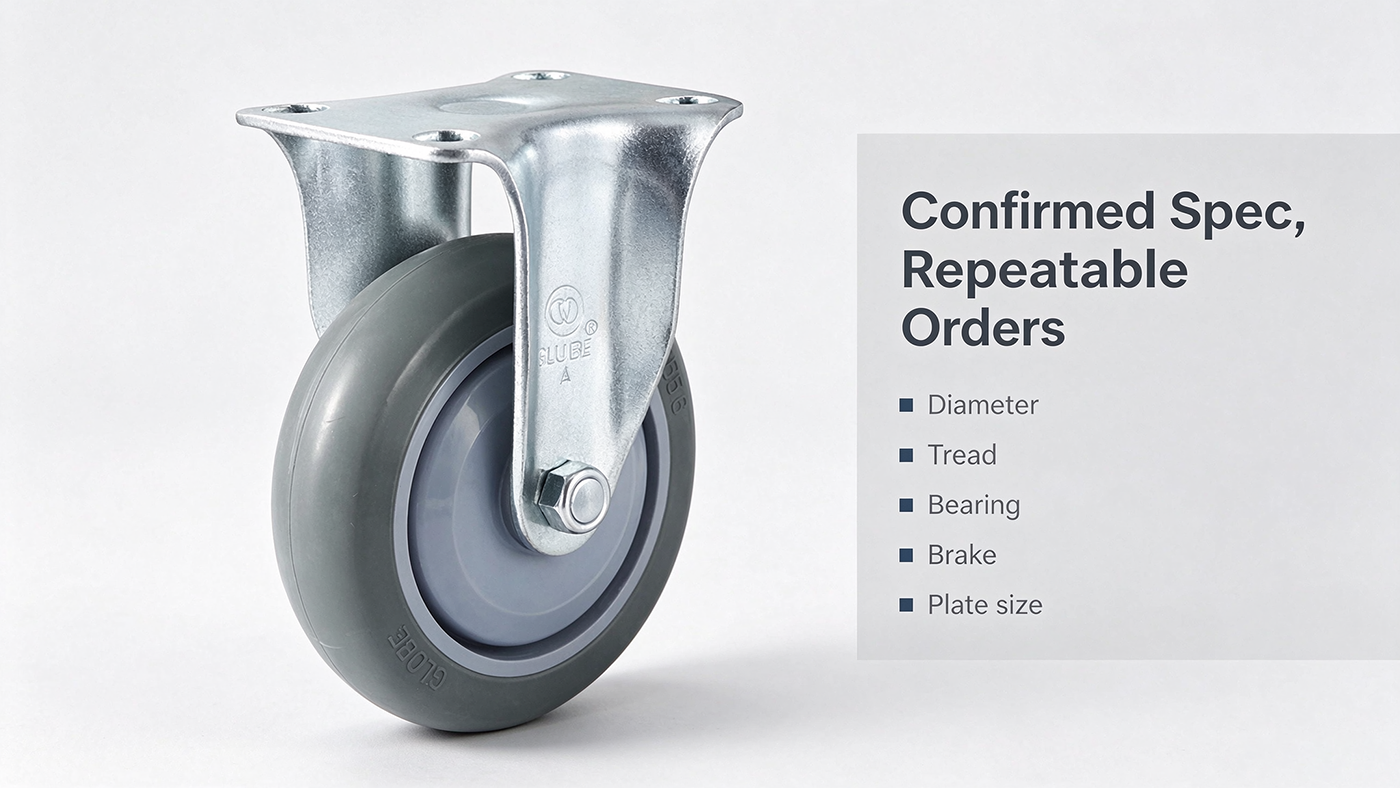
- Mounting that matches the frame their own drilling and assembly line produces — a threaded stem, an insert or grip-neck fitting to the leg size they use, or a small top plate where the frame is welded or screwed.
- Per-wheel ratings sized to each bed’s loaded weight, with margin for the mattress, bedding and an uneven corner, on wooden, laminate or tiled indoor floors.
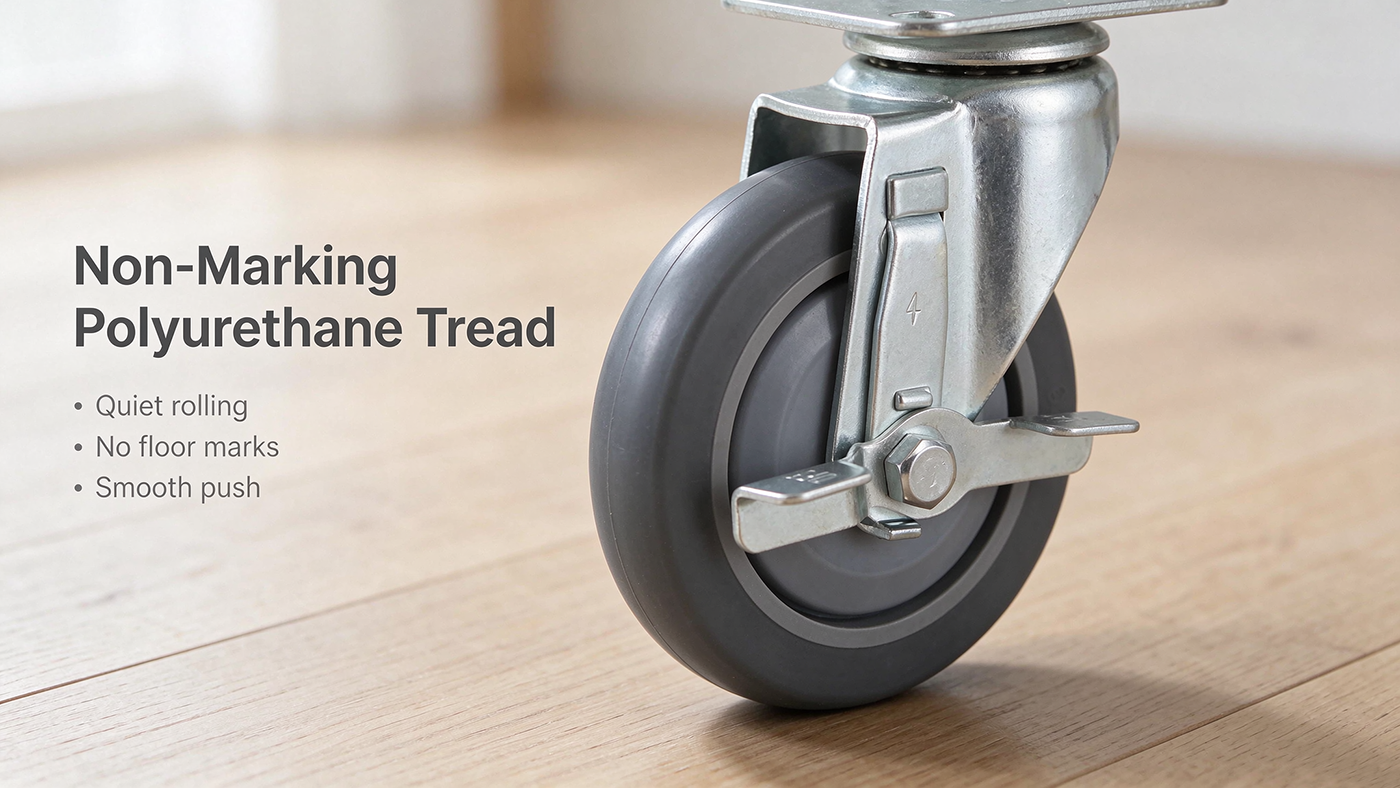
- A tread that does not mark the finished floor and keeps roll noise down, because these wheels move inside a home rather than a warehouse aisle.
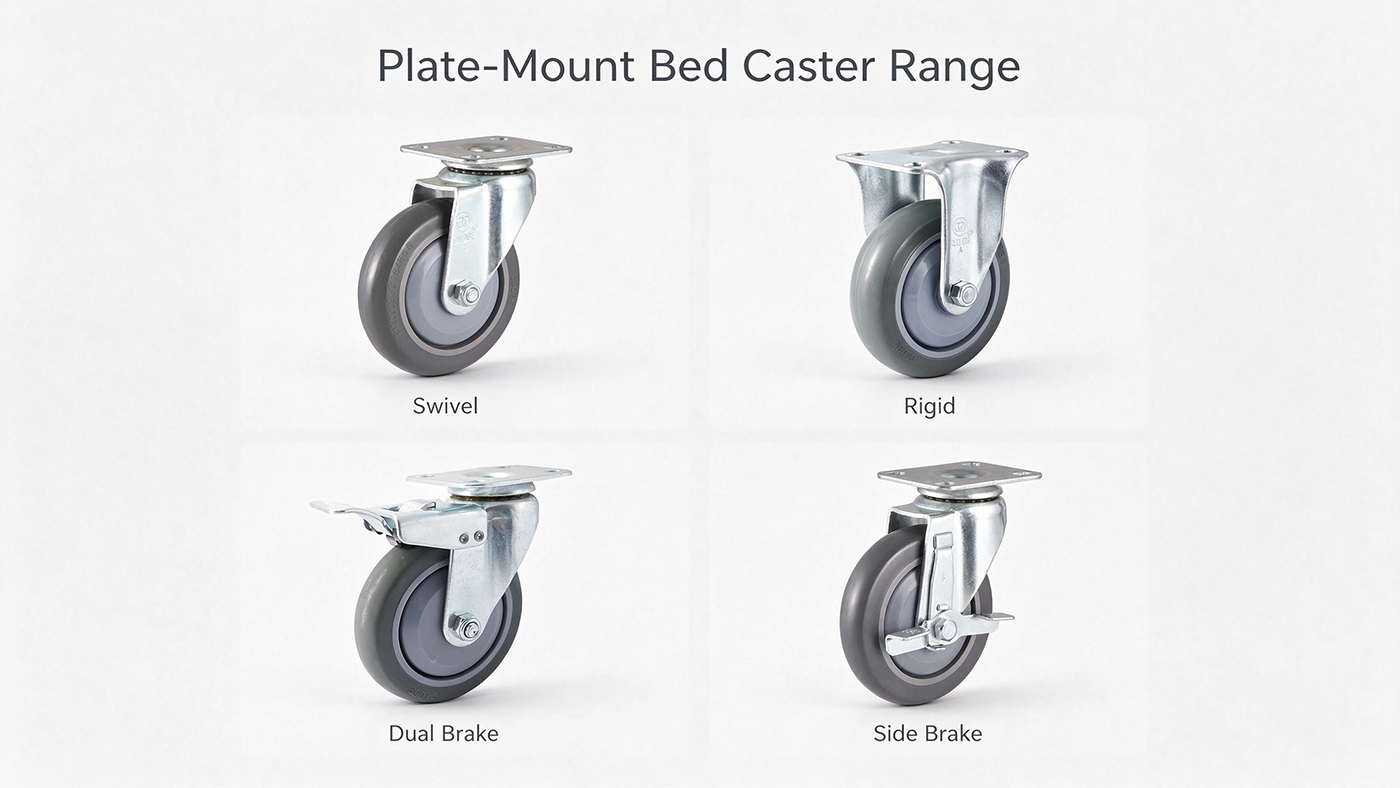
- A stable swivel under a low, wide frame, and a brake on selected corners where the bed has to stay in position once set.
- Batch-to-batch consistency and packing that fits their own assembly flow and export carton, including flat-packed kits.
How We Met
The enquiry came through our export channel after the manufacturer compared several suppliers. The first exchange was load and duty information, not a unit price. We asked what the frame carried, how often it moved, the floor surface, the mounting on the leg, the wheel diameter the design allowed, and whether any corner needed to lock. A bed caster chosen on price alone can leave the frame under-bracketed, and a rating on paper does not help if the stem or plate does not fit the leg.
Factory Visit
On the factory visit they walked the internal flow: bracket stamping, injection moulding for nylon and polyolefin wheels, PU pouring and tread bonding, bearing and raceway assembly, final inspection and packing. They could see how a small plate is formed, how a resilient tread bonds to its core, and how a finished leg is checked before it goes into a carton.
Foshan Global Caster Co., Ltd, Guangdong, China has manufactured casters and wheels since 1988. The plant covers about 156,000 m² with 500-plus staff and in-house stamping, injection moulding and PU pouring, outputting roughly ten million casters a year. The catalogue holds 21,000-plus models, 600-plus of them as standing stock, certified to ISO 9001 and ISO 14001, with over 100 patents. Wheel and bracket testing follows the basis set out in ISO 22883 (current edition) and the ANSI/ICWM terminology and test framework; these are industry references, not a claim that either standard certifies any single bed frame.
Choosing Samples
We did not send the widest catalogue. From their frame list we shortlisted swivel and rigid legs for the different models, brake variants where the bed has to hold position, and treads matched to each floor condition. Heavier double frames took a stronger bearing; lighter single and trundle beds ran a lighter leg. Each sample carton carried the diameter, tread, fitting type, bracket finish and brake type, so their engineering team could match it to the frame drawing later.
Testing Locally
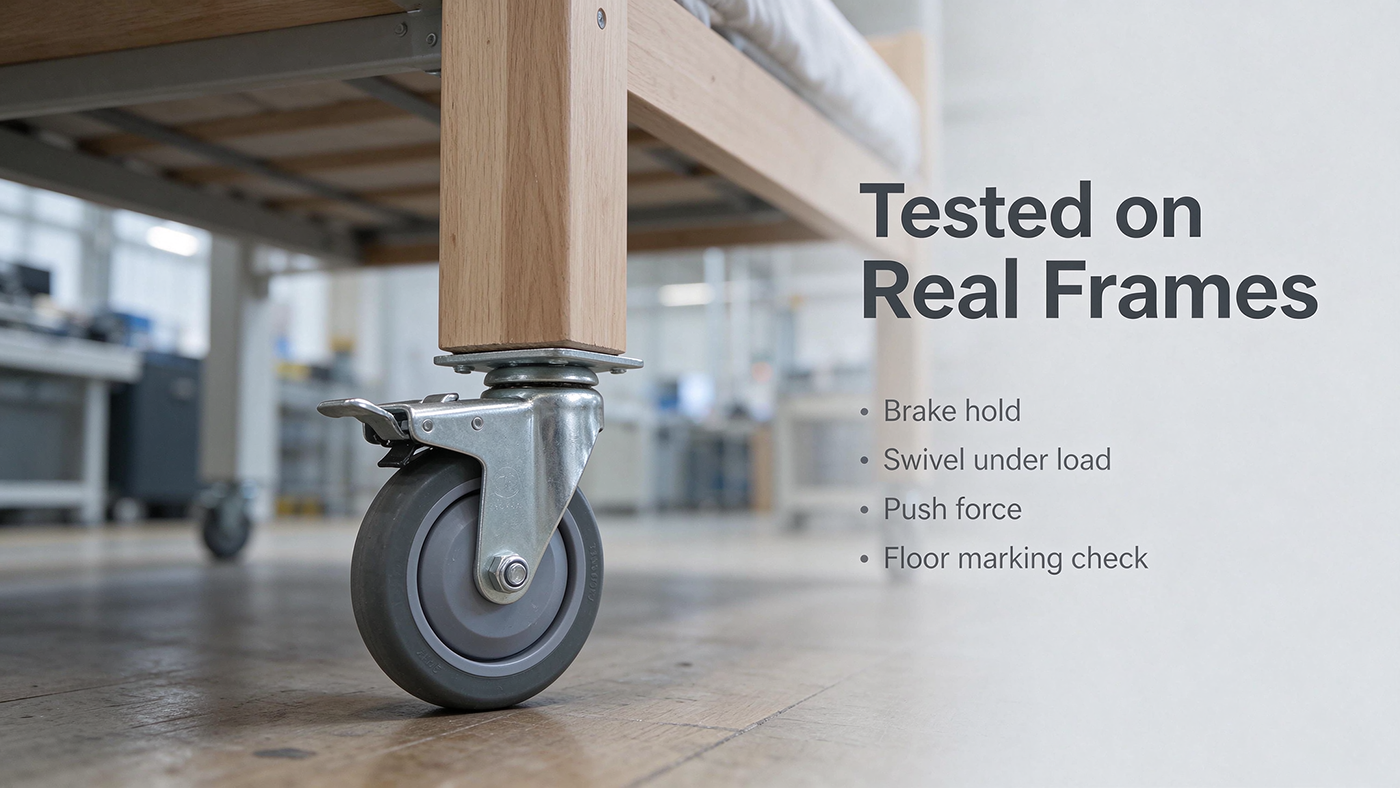
Samples went onto their own production line before any bulk order. Their staff mounted each leg onto a real frame, loaded it to working weight, and rolled it on the actual indoor floor type. They checked the brake holding, the swivel under load, any floor marking, the push force over the bed’s normal route, and whether the frame rocked after the brake was pressed. That feedback narrowed the shortlist before production quantities were quoted.
SKU-Level Detail Before the First Order
Once samples passed, the details were fixed line by line: wheel diameter and width, tread material, bearing type, bracket finish, swivel or rigid, brake type, plate size and hole spacing, stem diameter and length where a stem fitting is used, axle bore and carton quantity. For an OEM fit the mounting dimensions matter as much as the load rating, because a leg that cannot be fixed to the frame cannot be assembled. Container loading was worked out from the packed carton size, not the bare wheel. Both sides confirmed the written spec and any drawing before production started.
Price Was Important, Not the Only Factor
The manufacturer compared landed cost, not unit price alone. Batch consistency, replenishment lead time and how a shortage on one fitting is handled all feed the real cost of running a furniture line. A cheaper leg that arrives with the wrong stem size, or that varies in swivel feel between lots, costs more over the program. We quoted the spec we could repeat, and left room to change tread or bracket rather than compete on the lightest frame.
Why They Kept Buying
Repeat orders came down to three points: the first production lot matched the approved samples, the packing matched their assembly and distribution flow, and the next order could be placed against the same confirmed fitting list without rebuilding the details from scratch. The range then extended to additional frame sizes as their line grew.
What Other Buyers Can Learn
- Rate the wheel to the worst corner. Per-wheel load is not always the total bed weight divided by four. A heavy mattress, a storage drawer or an overhanging headboard puts more on one corner; check that corner before setting the rating. As a starting arithmetic check, a loaded double frame of 280 kg across four legs works out to 70 kg per wheel before any margin is added; a lighter single bed near 200 kg works out to 50 kg per wheel.
- Fix the mounting before the tread. Plate size, hole spacing and stem diameter decide whether the leg can be assembled. Confirm these against the frame drawing before comparing tread or price.
- Specify the tread for the floor, not just the bed. A hard nylon wheel that rolls easily on tile can scratch or mark a wooden floor. Where the bed sits on a finished indoor surface, a resilient, non-marking tread is the safer choice.
- Sample onto a real frame. A caster tested loose on the bench does not show swivel feel under the actual loaded weight or the real mounting angle. Trial on one production unit before bulk.
- Keep a written spec record. A SKU-level list of diameter, tread, bearing, bracket, brake and fitting keeps repeat orders consistent, which is what an OEM product line depends on.
FAQ
Can one bed range mix swivel, rigid and braked castors?
Yes. A frame commonly runs swivel legs where it turns and rigid legs where it tracks straight, with brakes on the corners that need positioning. Each line is confirmed to its own spec before production.
Do you supply bed castors under our own label?
We support OEM and private-label packing and marking where required. The caster itself, its bracket and its spec remain the confirmed engineering choice; the house label is applied at packing stage.
What information do you need to quote bed castors?
Loaded frame weight, how often the bed moves, floor surface, mounting type and plate or stem dimensions, available wheel diameter, and any brake or finish requirement. A photo or drawing of the current leg helps.
Which tread is best for wooden floors?
A resilient polyurethane or rubber-type tread is the usual choice on finished wood, laminate or tile, because it rolls quietly and leaves less marking than a hard nylon surface. The exact tread depends on the floor and the load; send the floor type and we shortlist it.
What is the lead time and warranty?
Standard lead time is around 30 days and the warranty is one year; stock models can move faster than a built-to-spec line.
Send Us Your Frame and Leg Details
List the bed types, loaded weight, floor surface, mounting dimensions and brake requirement. We reply with a sample shortlist, a spec sheet after fitting review and packing options. If a standard off-the-shelf leg covers the job, we say so rather than push a custom build.
Post time: Nov-28-2026