
On a rough concrete yard with slag, grit and a loaded cart, a polyurethane tread flats or chips off the core within months. A nylon wheel cracks at the edge. The wheel that keeps rolling in that dirt is often a cast iron caster wheel — hard, dense and abrasive-resistant, but a poor fit in the wrong room.
Cast iron wheels are a tread material choice, not a bracket type. The same heavy fork can carry iron, PU, nylon or rubber, and the floor, load and duty decide which one belongs there. This page covers what the material is, where it earns its keep, and where buyers order it by mistake.
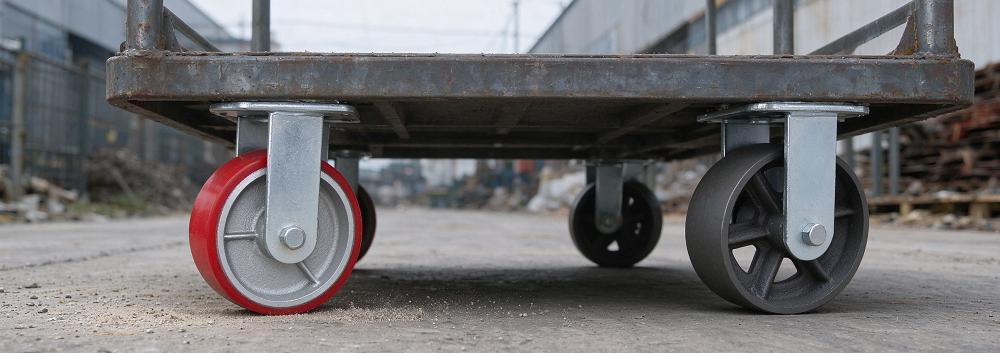
What Are Cast Iron Wheels?
A cast iron wheel is cast from iron alloy into a solid tread and hub, machined to size and bored for the axle. The running surface is the iron itself: hard, stiff and largely unaffected by oil, grease, chips and coarse debris. It rolls on rough concrete, stone plate, steel rails and packed yards where softer treads wear away fast.
Do not read “cast iron” as the whole bracket being iron. The wheel is the iron part; the fork, plate and raceway are pressed or welded steel, chosen to carry the rated load. The material code in a caster catalogue marks the tread, not the frame.
○ ISO 22883 (current edition) sets the requirements and tests for industrial castors and wheels;
○ The ANSI/ICWM terminology standards define the names the industry uses.
○ Material comparisons below follow the engineering behaviour of each tread family; confirm the tested rating with the supplier before sizing a cart.
Cast Iron vs Cast Steel vs Iron-Core PU
Three terms get mixed up on quotation requests. They are not the same wheel.
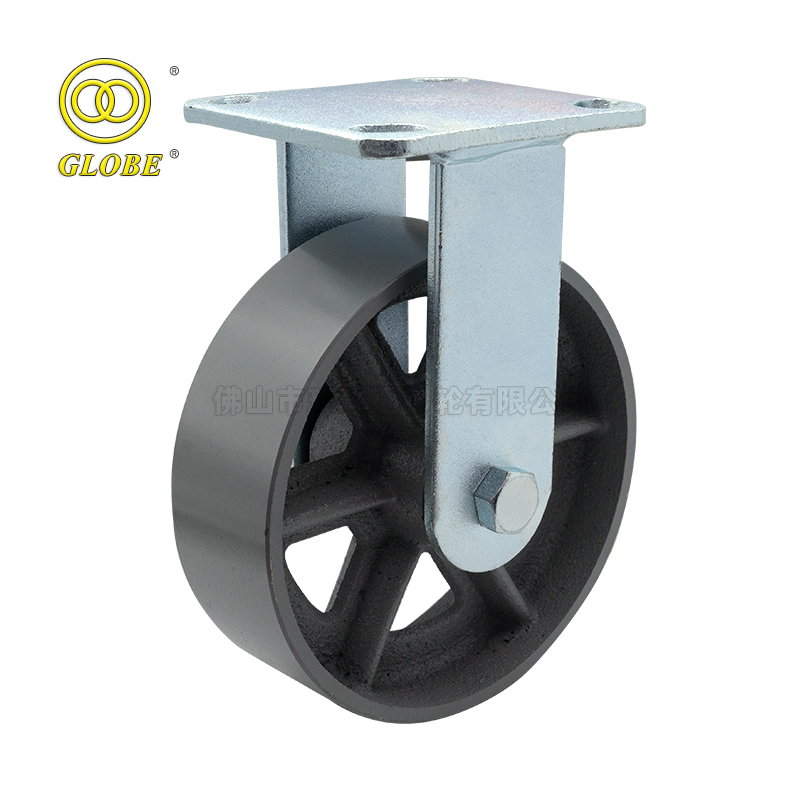
● Cast iron wheel — the running surface is iron throughout. High hardness, high abrasion resistance, little give under the load.
● Cast steel wheel — cast from steel rather than iron. Tougher and more impact-resistant than cast iron, less prone to a brittle break under a sharp drop; usually a step up in price and weight.
● Iron-core polyurethane (iron-core PU) wheel — an iron or steel hub with a PU tread bonded over it. The core carries the load; the resilient PU outer ring protects the floor and rolls quieter. It is not a cast iron wheel, even though the centre is metal.
 |
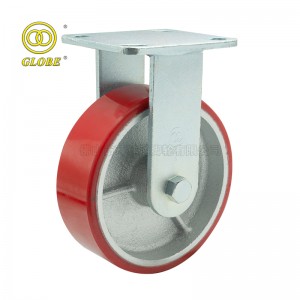 |
| EH04-11-150R-701 | EH01-11-150R-402 |
| Cast iron wheel | Iron-core polyurethane (iron-core PU) wheel |
The difference that matters on the floor: cast iron has no resilient layer. Whatever the iron meets, the iron meets it directly.
Why the Tread Choice Matters
Pick the wrong tread and the failure shows up early. A soft PU wheel on a gritty yard wears down to the core. A cast iron wheel on smooth epoxy leaves dark marks and transmits every bump straight up into the cart and the load. The tread sets rolling resistance, noise, floor protection, abrasion life and how the load rides — the bracket can only hold what the wheel asks of it.
Material Comparison at a Glance
| Tread | Hardness / give | Abrasion on rough floor | Noise | Floor marking | Rolling force | Best floor |
|---|---|---|---|---|---|---|
| Cast iron | Very hard, little cushion | Excellent | Loud | Marks polished or soft floors | Low on smooth hard floor; higher over debris | Rough concrete, stone, steel plate, rails |
| Cast steel | Hard, tougher than iron | Excellent, impact-resistant | Loud | Marks soft floors | Similar to iron | Heavy rough duty, shock loads |
| Iron-core PU | Hard core with resilient PU ring | Good on concrete | Quieter | Generally non-marking | Low, cushioned roll | Warehouse concrete, steel plate, smooth shop floors |
| Nylon | Hard plastic, stiff | Good, lighter load | Moderate | Can scuff soft epoxy | Low | Dry indoor floors, light to medium duty |
| Rubber / artificial rubber | Soft, high cushion | Wears faster on grit | Quietest | Non-marking | Higher push force | Finished floors, fragile surfaces, noise-sensitive areas |
What Changes How a Cast Iron Wheel Performs
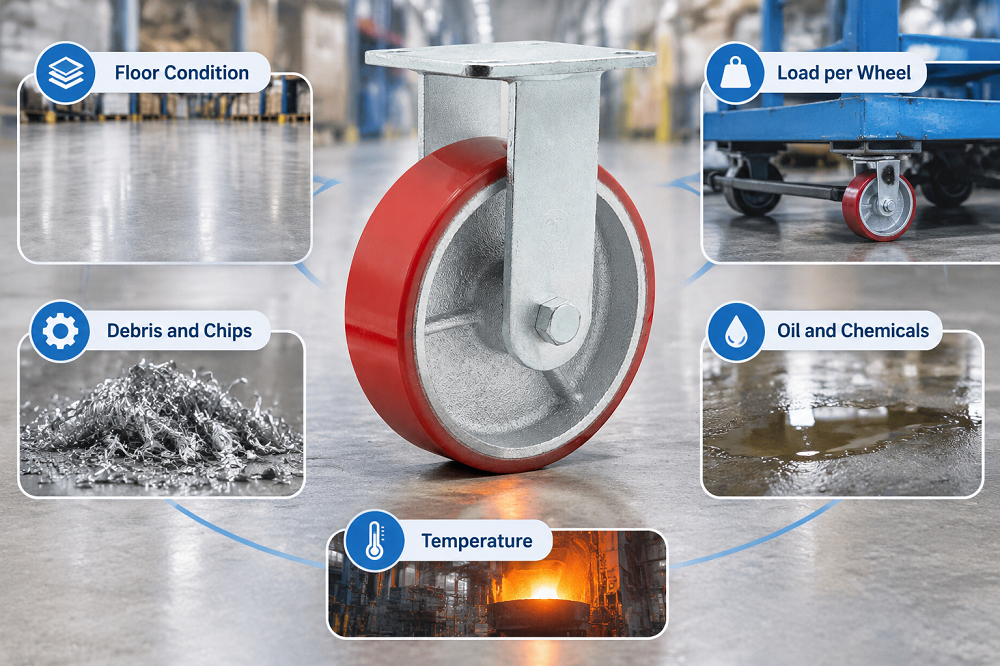
● Floor condition. Smooth, level concrete lets iron roll freely; rough expansion joints, gravel or broken slabs raise push force and send impact into the axle.
● Load per wheel. Iron handles high static and rolling loads, but an overloaded hard wheel does not flex — a sharp drop can chip or crack the rim instead of absorbing the shock.
● Debris and chips. Metal swarf, wood offcuts and casting sand sit between iron and floor and score both. Iron tolerates this better than PU, but still expects a swept or solid floor.
● Oil and chemicals. Iron stands up to oil and grease that would soften or swell rubber and some plastics; rust exposure in washdown or damp areas is a separate question for the bracket finish.
● Temperature. PU treads have a limited working range; iron keeps its form at higher heat, but the bearing and lubrication next to it are the part to check before a hot-duty application.
Common Mistakes
▲ Ordering cast iron for a finished-floor shop. Iron on epoxy, tile or sealed concrete leaves marks and dents. If the floor must stay clean, an iron-core PU or non-marking tread is the safer call.
▲ Assuming iron always means the highest capacity. Capacity comes from the bracket, bearing and wheel diameter together, not the metal alone. A hard brittle tread can crack under impact even when the published load looks high.
▲ Calling an iron-core PU wheel cast iron. The metal hub inside does not make the tread iron. Check the outer ring material on the SKU, not the centre.
▲ Running light loads on heavy iron wheels. A hard solid wheel on a light cart transmits vibration and noise for no load benefit. Match the tread to the duty, not to the heaviest option in the catalogue.
▲ Ignoring the V-groove option. Where the cart follows an embedded rail, a grooved iron wheel tracks the rail; a flat iron wheel on the same track will not guide itself.
Where Cast Iron Wheels Belong
○ Foundries, steel yards and slag areas with coarse debris and heavy loads.
○ Timber, brick and masonry yards on rough outdoor ground.
○ Heavy platform trucks and machine-moving dollies on solid concrete or steel plate.
○ Rail-guided carts that need a grooved metal wheel.
Worked Selection Example
A heavy yard cart carries 1,000 kg loaded, on four casters.
△ Per wheel: 1,000 ÷ 4 = 250 kg.
△ The floor is rough outdoor concrete with grit and occasional metal offcuts, and the cart moves all day.
A cast iron or cast steel tread fits this duty; the per-wheel rating must sit above 250 kg with margin for an uneven corner.
Move that same cart indoors onto sealed epoxy in an assembly plant, and the answer changes. The floor can be marked and the noise carries into the work area, so an iron-core PU tread on the same heavy bracket protects the surface and rolls quieter. The load rating stays with the bracket; the tread is swapped to the room.
If your load sits below 150 kg per wheel on a smooth indoor floor, cast iron is overkill. A nylon or PU wheel covers it with less noise and less floor risk.
What Buyers Usually Ask
Are cast iron wheels non-marking?
No. A metal running surface can leave marks on polished, sealed or soft floors. Non-marking behaviour comes from a resilient PU, rubber or nylon tread.
Which lasts longer, iron or PU?
On gritty rough ground, iron usually outlasts PU by a wide margin. On clean smooth concrete, a good PU tread lasts well and rolls with less noise and floor damage. The floor decides.
Can a cast iron wheel run on a rail?
Flat wheels roll along a rail but do not follow it on their own. A V-groove or grooved iron wheel is the variant for guided tracks; tell us the rail profile when you ask.
Does cast iron resist oil?
The iron tread itself stands up to oil and grease. Check the bracket finish and bearing sealing separately, since those parts sit next to the oil rather than in it.
What temperature can an iron wheel take?
The metal wheel holds its form at heat that softens elastomer treads, but the bearing, seals and lubricant have their own limits. For an oven, kiln or drying-line application, name the air and wheel temperature so the whole leg, not just the tread, is sized for it.
How Globe Caster Builds These Options
Foshan Global Caster Co., Ltd, Guangdong, China has manufactured casters and wheels since 1988. The plant covers about 156,000 m² with 500-plus staff and in-house stamping, injection moulding and PU pouring, outputting roughly ten million casters a year. The catalogue holds 21,000-plus models, 600-plus of them as standing stock, certified to ISO 9001 and ISO 14001, with over 100 patents. Iron, steel, PU-core, nylon and rubber treads are offered across the heavy and medium bracket families, so the bracket and tread can be matched to one floor and one duty rather than sold as a fixed combo.

Send the Floor and Load, We Match the Tread
Tell us the loaded weight, floor material, whether the cart is indoors or out, and any rail or debris condition. We reply with the tread family, the per-wheel rating after margin, and sample SKUs to trial on one cart. If a lighter tread covers the job, we say so.For more information, please click here to contact us.
Post time: Nov-17-2026