
Caster Wheels Wholesale: When Batch Four Stops Matching Batch One
The first container arrives and everything is right. Second one, still right. By the fourth, your accounts start calling: carts pull to one side, the swivel feels loose out of the box, and one SKU’s bracket does not look like the sample you signed off two years ago.
Nothing failed at the port. Nothing failed at your incoming check either, because your incoming check measured the three things that never drift. The problem was not the first batch. It was that nobody locked the specification between batch one and batch four.
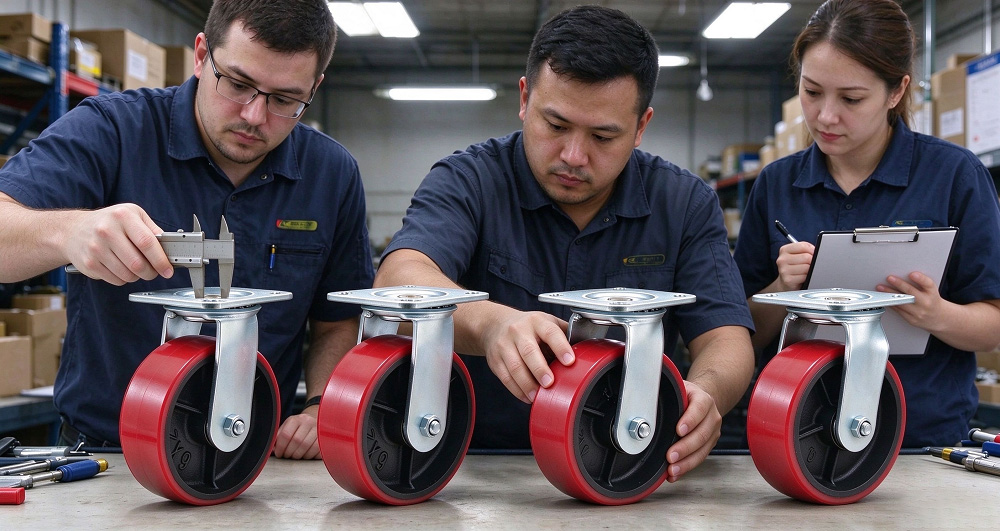
What a Wholesale Buyer Actually Needs
A distributor selling caster wheels wholesale to MRO accounts, repair shops and small OEMs has a different problem from a machine builder. The machine builder buys one size in volume and fits it once. The distributor buys four to eight SKUs in one container and sells them into carts that were designed years ago.
Some accounts write castor wheels on the purchase order, others write caster. Same part, same measurement sheet.
So the requirement is not “the best caster.” It is the same caster, every quarter, with a paper trail the distributor can hand to their own customer’s QA when something is questioned.
How the Sample Came Back
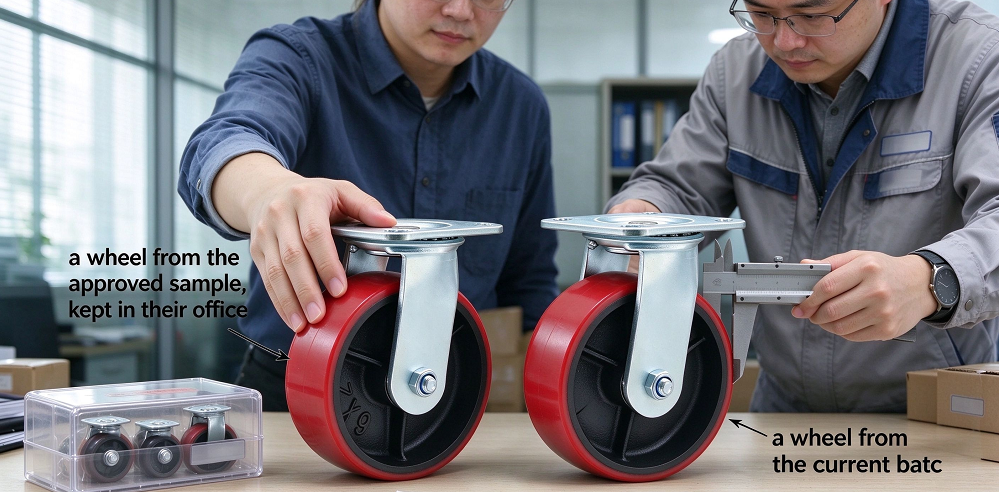
The buyer sent us two pieces: a wheel from the approved sample, kept in their office, and a wheel from the current batch. Same part number on both cartons. They asked for a quote on the same item, and for an opinion on why the two did not feel the same.
That pair is the whole case. Without the retained sample there is nothing to compare, and the conversation turns into one supplier’s word against another’s.
What We Measure on a Returned Sample
Six measurements settle most of these arguments. None of them need a lab.
- Wheel width at the tread. A millimetre or two narrow changes floor pressure and how the wheel tracks. It also tells you the mould or the trim tool changed.
- Fork leg thickness at three points. Top, middle, bottom. A thinner gauge is the most common silent downgrade in a pressed bracket, and it shows up as a swivel that flexes under load.
- Bearing type and shield. Ball, roller, plain bore or polymer bushing. Then whether the shield is metal or plastic, and whether there is a maker’s mark at all. No mark usually means the bearing source changed.
- Tread hardness. A Shore A reading on the tread face. Same material should read within a couple of points across batches.
- Plate flatness and hole spacing. Place on a surface plate. Rocking means the plate was pressed from thinner stock or was not flattened after stamping.
- Swivel raceway finish. Look for the grease pattern and for any step between the two rows of balls. A different raceway finish means a different supplier, even when the outside looks identical.
One of those drifting is a supply chain event. Three of them drifting is a different factory.
Where the Drift Comes From
Most of it starts before production, in how the order travels.
- The drawing lives in an email thread. A PDF attachment from two years ago, forwarded four times. Nobody re-signs it per order.
- The trading company owns the relationship, not the specification. They quote what the factory quoted them. If the factory changes a sub-supplier, the buyer learns about it in the field.
- Sub-tier substitution. Bearings, zinc plating and PU compound are the three easiest things to swap for a cheaper equivalent. All three look the same from outside.
- No retained sample. If neither side keeps a sealed piece from the approved run, “same as before” is a memory, not a specification.
What a Locked Spec Looks Like
Not a 12-page quality manual. One page, eight fields, signed by both sides, re-signed whenever anything changes.
| Field | What gets written down | What drifts without it |
|---|---|---|
| Wheel diameter | Nominal plus tolerance | Mounting height changes, cart sits at a different height |
| Wheel width | Nominal plus tolerance | Floor pressure, noise, and fit inside the fork |
| Tread material | Code plus hardness range | Marking, load rating, roll resistance |
| Bearing | Type, shield, maker or approved equivalent | Push force, noise, life under load |
| Bracket steel gauge | Millimetres, measured at the fork leg | Swivel stiffness, fatigue at the bend |
| Plate and hole pattern | Plate size, hole spacing, hole diameter | Bolts will not line up on the customer’s frame |
| Surface treatment | Process and coating thickness | Rust in the first damp season |
| Sealed sample | One piece per SKU, dated, held by both sides | There is no baseline to argue against |
Take the five-inch iron-core PU swivel we build, EH08-11-125S-402, as an example of what “written down” means: 125 mm diameter, 45 mm width, 250 kg per wheel, 165 mm mounting height, 96 mm swivel radius, 114 × 100 mm plate, 84 × 71 mm hole spacing, 11 mm holes, blue zinc bracket, ball bearing. Ten numbers. If a quote cannot carry those ten, it is not a specification, it is a description.
The Trial Release and the Incoming Check
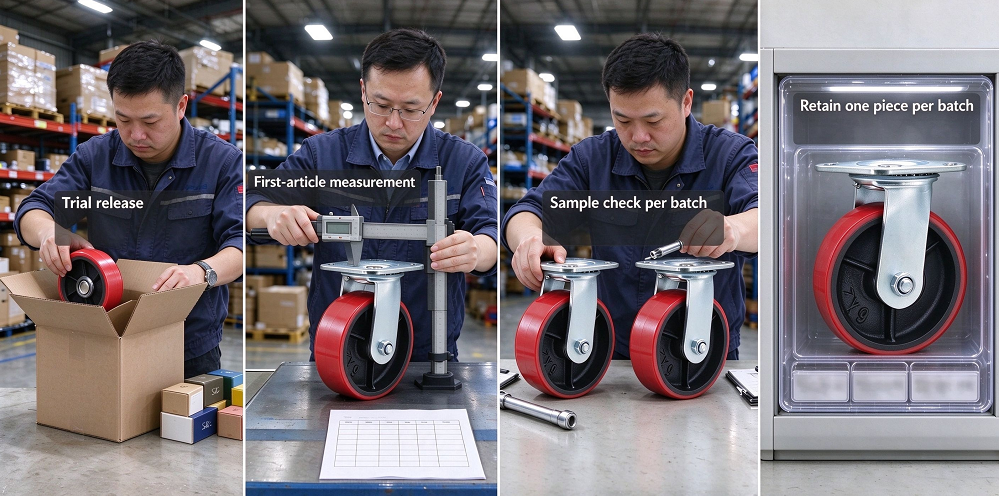
A buyer switching wholesale suppliers should not start with a full container. Start with a trial release across the SKUs that generate the most complaints, and check three things on arrival:
- First-article measurement against the locked spec, on one piece per SKU, recorded with the gauge used.
- Sample check per batch after that. Two pieces per SKU is enough to catch a gauge change or a bearing swap.
- Retain one piece per batch, dated. This is the only defence you have two years later.
If you cannot measure a field yourself, ask the supplier to photograph the measurement with the gauge in frame. A number with a photo behind it is auditable. A number typed into a spreadsheet is not.
Cartons, Labels and the Mixed Container
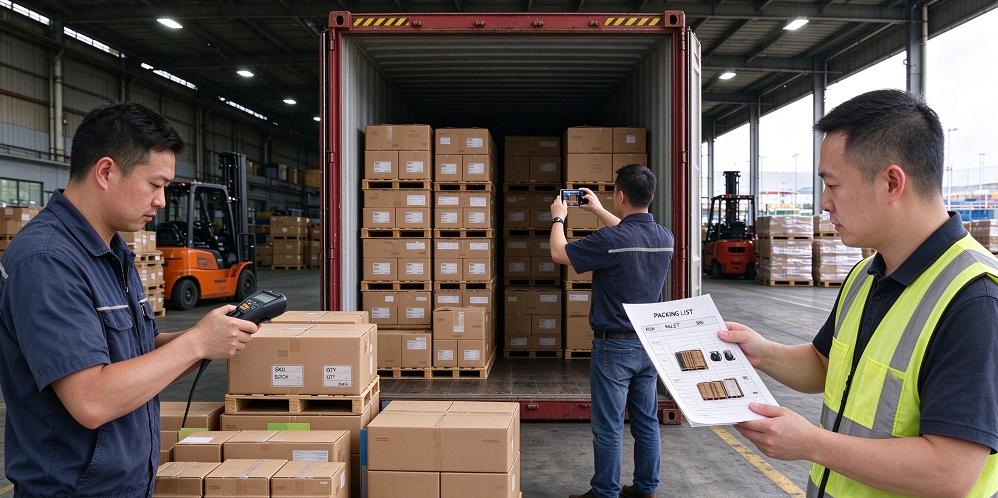
Wholesale orders fall apart at the warehouse, not the factory. A six-SKU castor order with no per-carton marking costs your team a day of sorting, and mis-picks turn into returns.
Minimum marking: SKU, batch number, quantity, production date, on every carton, printed not handwritten. Loading photos per row. A packing list that matches the container sequence, so the last pallet out is the first one your warehouse needs.
None of this is difficult. It just has to be agreed before the deposit, not after the container is on the water.
Price Per Piece Versus Cost Per Complaint
The quote that wins on unit price often loses on the third shipment. Work out what a single field failure costs you: collection, replacement, labour to swap the caster, the credit note, and the account that stops calling for six months. Then compare that against a few cents per wheel.
We are not arguing that the cheapest quote is always wrong. For a buyer who inspects every batch and holds samples, a lower price with a tight incoming check can be the right call. That is a decision about your inspection capacity, not about the factory.
What Changed for This Buyer
The part number stayed the same. What changed underneath it: a one-page spec sheet with tolerances, a sealed sample held on both sides, batch numbers on cartons, and a measurement photo per batch. The next three releases came in within tolerance, and the arguments stopped being about memory.
No dramatic saving to report. The value was in not repeating a bad quarter.
Five Things Wholesale Buyers Should Take From This
- Keep a sealed sample of every SKU you approve. Dated, in a bag, in your office. Not a photo on a phone.
- Put tolerances in the spec, not just nominal sizes. “45 mm” is not a spec. “45 ± 0.5 mm” is.
- Name the bearing and allow an approved equivalent in writing. Otherwise the equivalent is chosen for you.
- Buy the trial release, not the container, from a new source. Then scale on evidence.
- Ask who actually presses the bracket. If the answer is a trading company with no workshop, the specification is being managed by someone who cannot see the press.
When You Should Not Switch
If your current supplier’s batch four still measures the same as batch one, and you have the samples to prove it, stay. Switching suppliers costs real money in tooling checks, sample rounds and staff time, and a good existing relationship is worth more than a small price difference. This article is for the buyer whose batches have already drifted, not for one who is merely curious about pricing.
About Globe Caster
Globe Caster — Foshan Global Caster Co., Ltd, Guangdong, China — has made casters and castors since 1988. 156,000 m², 500+ people, stamping, injection molding and PU pouring in-house. 600+ SKUs on the shelf, 21,000+ in the catalog, ISO 9001 and ISO 14001. We ship to North America, Europe, Southeast Asia and the Middle East. One-year warranty, 30-day lead time on standard stock.

Send the Drawing and the Sample
If a batch has drifted, send the current piece and the sample you approved, plus the drawing you are working from. We will measure both, tell you which fields moved, and quote against the locked specification. Mixed SKUs in one container are normal for wholesale orders.
Post time: Oct-28-2026