
Castor Swivel Radius: What It Is and How It Sets Your Aisle Width
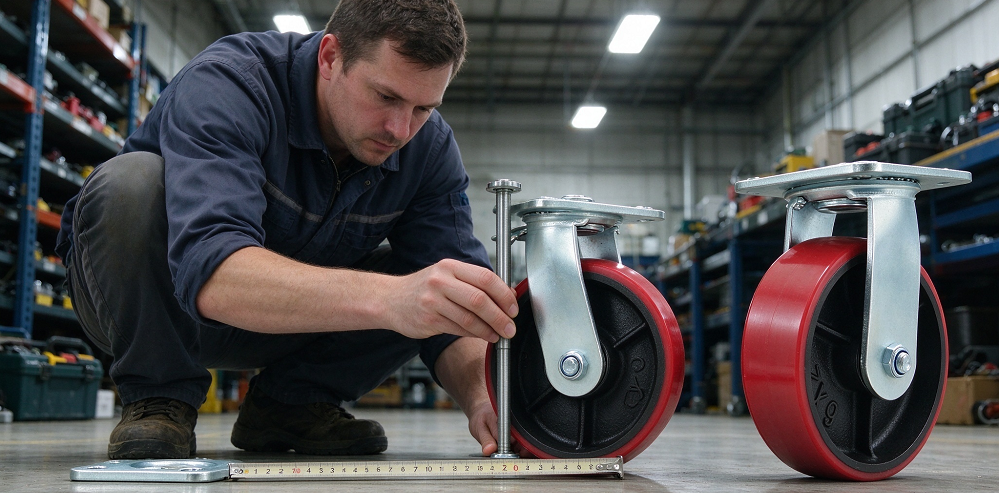
A cart that won’t turn in a narrow aisle usually gets blamed on the wheels. Most of the time the wheel is fine. The problem is the swivel radius — the circle the tread swings through when the fork rotates. Two castors with the same 125 mm wheel can need very different aisle widths, because one bracket carries the wheel further behind the swivel axis than the other.
Buyers check wheel diameter and load. Almost nobody checks swivel radius until the cart is built and hits a rack end.
What the Number Actually Measures
Put the top plate on the floor. Find the centre of the swivel — the vertical axis the fork turns around. Now swing the fork until the wheel trails out as far as it will go, and measure horizontally from that axis to the outside edge of the tread. That distance is the swivel radius.
It is not the wheel size. It is not the plate size. It is the horizontal reach of the wheel when the castor is rolling behind the load, which is how it spends most of its working life.
Four Numbers Buyers Mix Up
| Term | What it measures | Where you find it |
|---|---|---|
| Wheel radius | Half the wheel diameter. Vertical height, nothing to do with the swing. | Wheel size on the spec sheet |
| Swivel radius | Horizontal axis-to-tread-edge reach with the wheel trailing | Per bracket, on the spec sheet or drawing |
| Brake radius | Same measurement with the brake pedal fitted — almost always bigger | Drawing; not always printed on a catalogue page |
| Turning circle | The whole cart’s swept envelope, including frame and handle | Your CAD model, not the castor datasheet |
On a 125 mm wheel the wheel radius is 62.5 mm. On our EH8 five-inch swivel the swivel radius is 96 mm. Every corner reaches 33.5 mm further out than the number most people grab first. Left and right together, the cart is 67 mm wider than the drawing said.
Why It Decides Whether the Cart Fits
A swivel castor does not pivot on the plate. It pivots around a point behind the plate, and the wheel swings out from there. In a tight aisle that swing is the first thing that touches the racking, the wall, or the operator’s ankle.
It also sets the pinch points. A caster with a long swivel radius sweeps a wider arc at floor level, which matters on loading docks and in walk-in freezers where the gap between cart and wall is already tight.
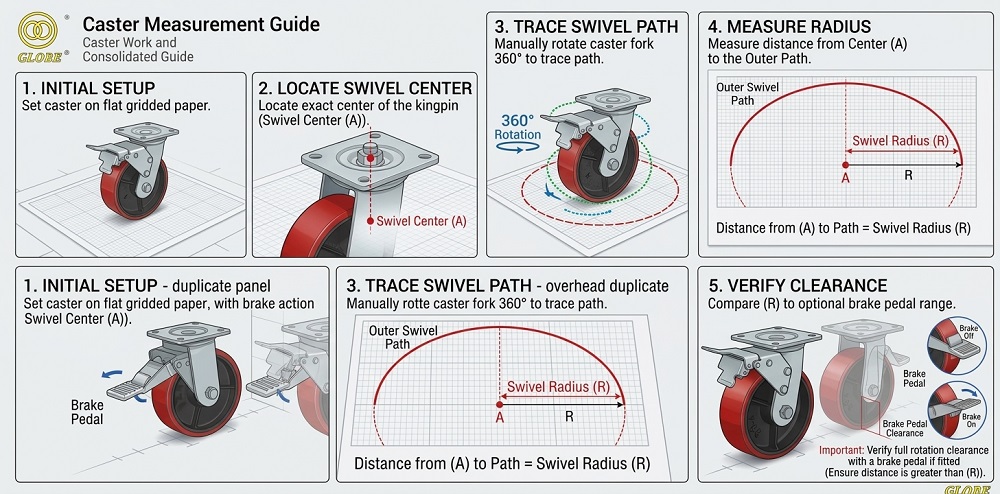
How to Check It Yourself, in Five Minutes
- Set the castor on a sheet of paper, plate down, as it would sit on the cart.
- Mark the centre of the swivel axis. On a top-plate castor this is the centre of the kingpin, roughly the middle of the plate.
- Swing the fork slowly through a full turn and mark the outermost point the tread edge reaches.
- Measure axis to that mark. That is your swivel radius, measured, not assumed.
- Repeat with the brake pedal fitted if you have one. The pedal often reaches further than the wheel.
What the Standards Do and Don’t Tell You
- ISO 22883 covers industrial castors and wheels — requirements and tests for units used in manual or powered movement at roughly walking speed.
- ANSI/ICWM publishes the vocabulary and performance framework most North American buyers work from. Both are useful for how a castor is built and tested.
Neither one hands you an aisle width. That number comes out of your building and your cart, not out of a standard.
What Moves the Number
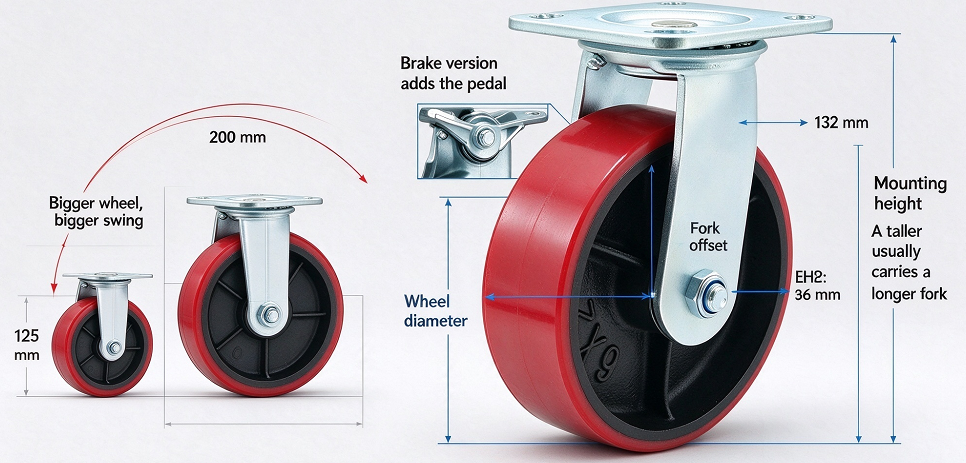
- Wheel diameter. Bigger wheel, bigger swing. A 200 mm wheel on the same style of bracket reaches noticeably further than a 125 mm.
- Fork offset. The distance between the swivel axis and the wheel centre. More offset tracks better at speed and costs you aisle width.
- Bracket style. A brake version adds the pedal. That is where 96 mm becomes 132 mm on our EH8.
- Mounting height and plate. A taller bracket usually carries a longer fork.
Our EH8 Five-Inch Numbers
| Parameter | EH08-11-125S-402 (swivel) | EH08-11-125SB-402 (swivel, total lock) |
|---|---|---|
| Wheel diameter | 125 mm (5″) | 125 mm (5″) |
| Wheel width | 45 mm | 45 mm |
| Tread | Iron-core PU, red, ~95 Shore A | Iron-core PU, red, ~95 Shore A |
| Swivel radius, free | 96 mm | 96 mm |
| Swivel radius, brake engaged | — | 132 mm |
| Mounting height | 165 mm | 165 mm |
| Top plate | 114 × 100 mm | 114 × 100 mm |
| Hole spacing (centre-to-centre) | 84 × 71 mm | 84 × 71 mm |
| Hole diameter | 11 mm | 11 mm |
| Load per wheel | 250 kg | 250 kg |
| picture |  |
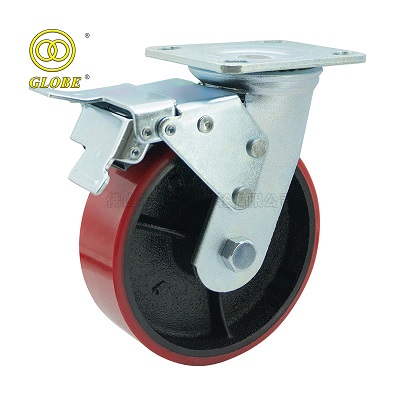 |
The 36 mm difference between 96 and 132 is the brake pedal. If your aisle was sized on the free-swivel number and you fit the brake version, you lose 36 mm per corner — 72 mm across the cart. That is enough to start clipping racking.
Five Ways Buyers Get This Wrong
- Using the wheel radius. 62.5 mm is not the swing. On our EH8 the real number is 96 mm.
- Sizing on the free-swivel figure. Then the brake version arrives and the cart no longer fits.
- Measuring to the plate edge instead of the tread edge. The tread is what hits the wall.
- Forgetting the frame. The castor’s swing starts from the plate, but your cart’s overhang and handle add to the envelope.
- Assuming bigger is better. A bigger wheel rolls better over joints and thresholds. It also needs a wider aisle. Those two facts fight each other.
Working Out Your Aisle
The rough method we use on the floor, not a standard: take the cart body width, add twice the swivel radius, then add your handling clearance on each side.
Example. Cart body 800 mm wide, four EH8 swivel castors at 96 mm.
- 800 + (2 × 96) = 992 mm swept width.
- Add 100 mm clearance each side → 1192 mm.
- Build the aisle at 1200 mm.
Same cart with the brake version at 132 mm:
- 800 + (2 × 132) = 1064 mm.
- Add 100 mm each side → 1264 mm.
- Build at 1300 mm, not 1200.
If the aisle is fixed and cannot be changed, the calculation runs backwards: subtract clearance from the aisle, then see what swivel radius you can afford, then pick the wheel that carries the load inside that radius. Sometimes that means a smaller wheel and more of them. Sometimes it means the aisle has to change. Cheaper to find that out before the racking goes in.
When None of This Matters
If your aisle is 1500 mm and the cart is 700 mm wide, stop reading. You have 800 mm of slack and swivel radius will never be the constraint. Buy on load and floor condition instead.
This number only starts to bite in warehouses under about 1200 mm, in walk-in coolers, and on machine-mounted carts where the castor sits inside a footprint.
About Globe Caster
Globe Caster — Foshan Global Caster Co., Ltd, Guangdong, China — has made casters and castors since 1988. 156,000 m², 500+ people, stamping, injection molding and PU pouring in-house. 600+ SKUs on the shelf, 21,000+ in the catalog, ISO 9001 and ISO 14001. We ship to North America, Europe, Southeast Asia and the Middle East. One-year warranty, 30-day lead time on standard stock.

Give Us Four Numbers
Cart body width, aisle width, load per wheel, and how many castors swivel. We will come back with the bracket that fits and a 2D drawing showing the swivel radius and brake radius on your plate. If nothing in our standard range fits your aisle, the reply will say so.
Post time: Oct-27-2026