
Castor Wheels Distributor: When a Trading Company Stopped Ordering Project by Project
The customer was a small trading company. They sold casters and small material handling parts to equipment builders in their region, one order at a time. A machine builder needed four swivel and two rigid, they ordered six wheels. Next month, a different builder needed eight braked. They ordered eight. Every order took 30 days on the water plus three weeks of email back-and-forth, and by the time the wheels landed, the builder had bought from a local stockist.
They came to us because they were losing repeat orders to a distributor who could deliver next day. They wanted to know whether stocking a small range from China was even workable. It was, but not in the way they first imagined.
What They Were Doing Wrong
First, they bought exactly what the builder asked for that week — which meant every order was a new SKU, a new price negotiation, and a new 30-day lead time.
Second, they assumed “stocking” meant a full container of one item. They could not sell a full container of one SKU in a year.
What They Actually Needed
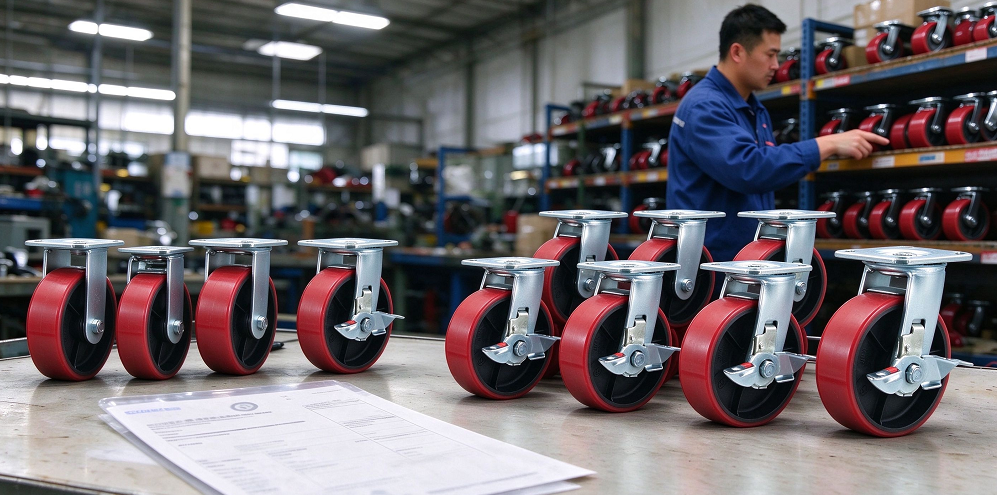
A short list of SKUs that covered most of the calls they were getting. On their calls, the common pattern was 125 mm and 150 mm wheels, swivel with and without brake, on a standard 114 × 100 mm plate. The builders were not asking for exotic sizes; they were asking for delivery.
We looked at the calls they had taken in the previous six months. Out of roughly 40 inquiries, about 30 clustered around four SKUs:
| SKU | What it is | Why it comes up | Picture |
|---|---|---|---|
| EH08-11-125S-402 | 125 mm swivel, iron-core PU, ball bearing, blue zinc | The default replacement wheel on small machine carts. | 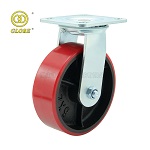 |
| EH08-11-125SB-402 | Same, swivel with dual brake | Carts that sit on a slight slope or on a lift. | 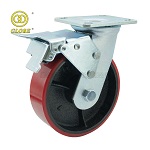 |
| EH08-11-150S-402 | 150 mm swivel, iron-core PU, ball bearing | The next size up when the cart is loaded past 700 kg. | |
| EH08-11-125R-402 | 125 mm rigid, iron-core PU | Paired with swivel on the handle end. | 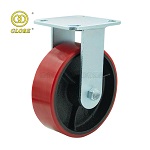 |
These four cover a cart from about 200 kg to 900 kg, on a standard plate, indoors, on epoxy or sealed concrete.
They do not cover washdown, they do not cover outdoor rough floors, and they do not cover 1000 kg carts. We told them that. The remaining 25% of calls would still be project orders, and that was fine.
The First Container Was Not a Container
The mistake most new distributors make is ordering a full container on day one. We did not let them. A mixed carton — a few hundred pieces across the four SKUs — went by sea LCL. It was more expensive per wheel than a full container, but it tested whether their builders would actually buy the stocked sizes before they committed a year’s cash.
The carton mix was set from their inquiry log: more 125S than 125SB, a smaller slice of 150S, and a handful of rigid. If the ratio were wrong, they would find out with a carton, not a container.
Samples First
Before the LCL, four samples went by express. They took them to their three biggest builder customers and let them roll the wheels on their own floors. One builder had been running a cheaper nylon wheel that marked the epoxy floor; the iron-core PU sample stopped the marking. That builder became the anchor account for the stocked range.
Price Was Not the Main Thing They Compared
They had three Chinese suppliers quoting the same four SKUs. The lowest quote was about 8% below ours. They did not pick the lowest. Two reasons came up over the months of discussion:
- Transparency in Dimensions:The lowest supplier quoted one price for swivel and a different price when they asked for the braked version, and the brake pedal dimensions were not on the drawing. Our quotation sheet listed swivel radius 96 mm and braked radius 132 mm on the same page, so they could tell their builders the aisle requirement up front.
- Mixed-SKU Minimum Order Quantity (MOQ):The lowest supplier wanted a one-SKU minimum per order. We would mix the four SKUs in one carton. For a distributor building stock, the mix mattered more than the 8%.
How the Stock Worked Once It Landed
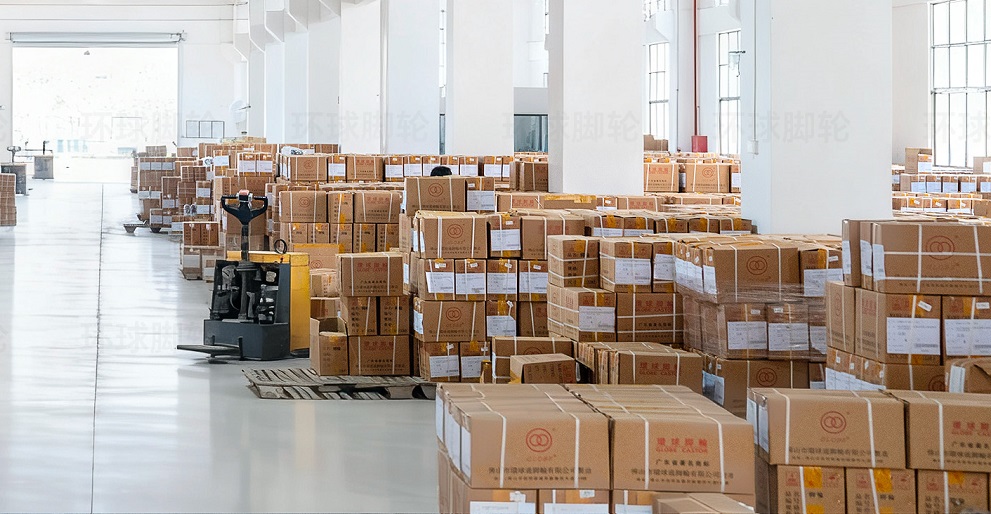
The LCL arrived in about five weeks. They put 20 pieces of each SKU on a shelf in their warehouse. When a builder called, they could ship next day. Builders stopped asking “can you deliver this week” — they stopped asking, because the answer was already yes.
The replenishment rule we agreed was simple: when a SKU dropped below ten pieces, they sent a replenishment order. We held the same four SKUs on our own stock shelf — 600+ SKUs on the shelf is what we keep — so a replenishment carton went out within days, not within weeks.
Twelve months in, the four-SKU stock covered most of their repeat calls. The project orders for odd sizes still came through us on the 30-day lead time. That division was the whole point: stock the 80% that repeats, quote the 20% that does not.
What Other Distributors Can Take From It
- Start with a carton, not a container. You do not know your real SKU ratio until your builders buy it.
- Stock the common plate size. The 114 × 100 mm plate with 84 × 71 mm holes and 11 mm bolts is the one most equipment builders already drill to. One plate pattern covers more calls than one wheel size.
- Quote the braked radius, not just the wheel size. Builders care whether the cart still turns in their aisle. The 125 mm swivel turns in 96 mm; the dual-brake version needs 132 mm. That is a spec you should give your customers, not something they discover after assembly.
- Do not chase the lowest unit price. Mixed-SKU packing, a drawing with the brake radius on it, and a supplier who holds stock matter more when you are the one holding inventory.
- Know what you are not stocking. Washdown, outdoor rough floors, loads over 900 kg — these are project orders. Do not buy stock for them.
Who This Is Not For
If you sell fewer than a few dozen casters a month, a stocked range will tie up cash on a shelf. Buy project by project until your repeat pattern shows itself. And if your market is mostly washdown or outdoor equipment, the four SKUs above are the wrong starting set — tell us what your builders actually run and we will say so, rather than sell you our best-selling line.
About Globe Caster
Foshan Global Caster Co., Ltd, Guangdong, China. Casters since 1988, 156,000 m², 500+ employees, stamping, injection and PU pouring in-house. 600+ SKUs on the shelf, ISO 9001 and ISO 14001. Exports to North America, Europe, Southeast Asia and the Middle East. Standard lead time 30 days, warranty one year.

If You Are Building a Stocked Range
Send us the three sizes your own customers call for most. We will tell you whether they cluster on one plate, what a mixed carton costs, and what the replenishment minimum looks like. We reply within one business day with a quotation and a 2D drawing of the bracket and brake envelope.For more information, please click here to contact us.
Post time: Oct-31-2026