
Non-Marking Casters: What They Are, Why Floors Matter, and How to Choose
You have probably seen it: a newly cleaned epoxy floor in a warehouse, a polished tile floor in a hospital corridor, or a finished concrete floor in a showroom — and three days later it is streaked with black lines following every push of a cart. Those lines are not dirt. They are rubber tread being left behind on the floor, one tiny abrasion at a time. Buyers in food plants, hospitals, hotels and cleanrooms know exactly what this is, and they will reject a caster that marks the floor on sight.
This article explains what “non-marking” actually means on a caster, why some treads leave streaks and others do not, how the different non-marking materials compare, and how to choose the right wheel without overpaying.
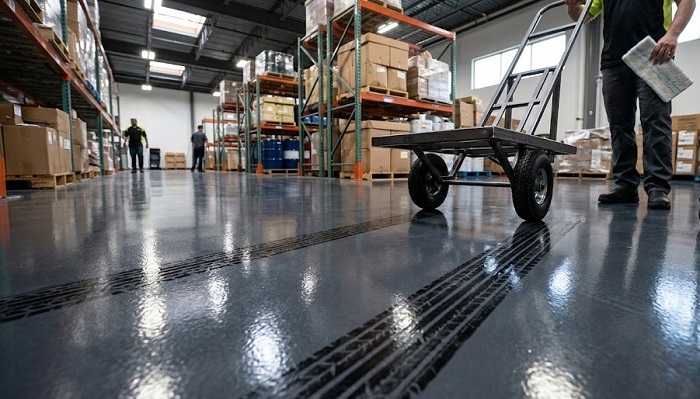
What Is a Non-Marking Caster?
A non-marking caster is a wheel designed so that, when rolled back and forth under load on a finished floor, it does not transfer visible material onto that floor. The definition is deliberately practical: nobody grades non-marking in a lab, they grade it by pushing a loaded cart across the floor and looking at the result.
Under load and with turns, the tread abrades against the floor. On a soft black rubber wheel, that abraded material is dark — and it leaves a visible black streak. On a light-colored PU, TPR or nylon tread, the abraded material is pale and blends into the floor, so the streak is invisible. “Non-marking” is not a magic coating; it is a choice of tread color and tread chemistry that does not show up on the floor.
Marking vs Non-Marking — The Confusion Buyers Run Into
| Term | What People Mean | What It Actually Is |
|---|---|---|
| “Black rubber caster” | Cheap, industrial, marks floors | Natural or SBR rubber, carbon-black filled — the black color itself is what marks |
| “Grey rubber caster” | Assumed non-marking | Often a grey-colored rubber that still leaves a grey scuff — better than black, not truly invisible |
| “TPR caster” | Non-marking, quiet | Thermoplastic rubber, usually light grey or beige — genuinely low marking, but can flatten under long static load |
| “PU caster” | Non-marking, heavy duty | Polyurethane, often red or amber — the standard heavy-duty non-marking choice |
| “Nylon caster” | Non-marking, hard | Off-white polyamide — no marks, but noisy and scratches soft floors |
The key point: “non-marking” is not the same as “soft.” A soft wheel marks less because it abrades less — but a soft wheel also flats under long stationary load. The art is picking a tread that is hard enough to carry the load, pale enough not to show, and elastic enough not to scuff.
Why It Matters — What Happens When the Wrong Wheel Marks the Floor
- Epoxy factory floors are re-coated every few years; black rubber scuffs cannot be cleaned off and get embedded in the epoxy.
- Food and pharma cleanrooms treat dark scuffs as a contamination risk — a marked floor can fail a hygiene audit.
- Showrooms and hotels reject carts that leave lines on polished stone or tile.
- Hospital corridors run over sheet vinyl; black rubber wheels scuff it permanently.
The cost of a marked floor is not the wheel. It is the re-coating, the re-cleaning, and the customer that refuses the machine because it left a mark on their floor.
How Non-Marking Is Tested
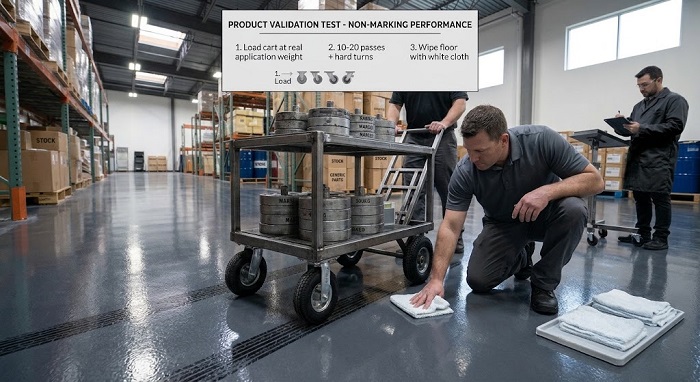
There is no single international standard that certifies a caster as “non-marking.” What buyers and floor specifiers actually do is a simple walk test:
- Bolt the test caster onto a loaded cart at the real application weight.
- Push the cart back and forth across a clean, finished floor for 10–20 passes, including hard turns.
- Wipe the floor with a clean white cloth. If the cloth stays clean, the wheel passes. If it picks up black or grey residue, the wheel marks.
Some floor manufacturers (epoxy and vinyl resin suppliers) publish their own wheel-type guidance in floor installation manuals. Ask your floor supplier for their approved wheel list before you specify — they have already tested what works on their resin.
The Four Common Non-Marking Treads, Compared
| Tread | Typical Color | Marking on Epoxy | Load Capacity | Noise | Static Flatting |
|---|---|---|---|---|---|
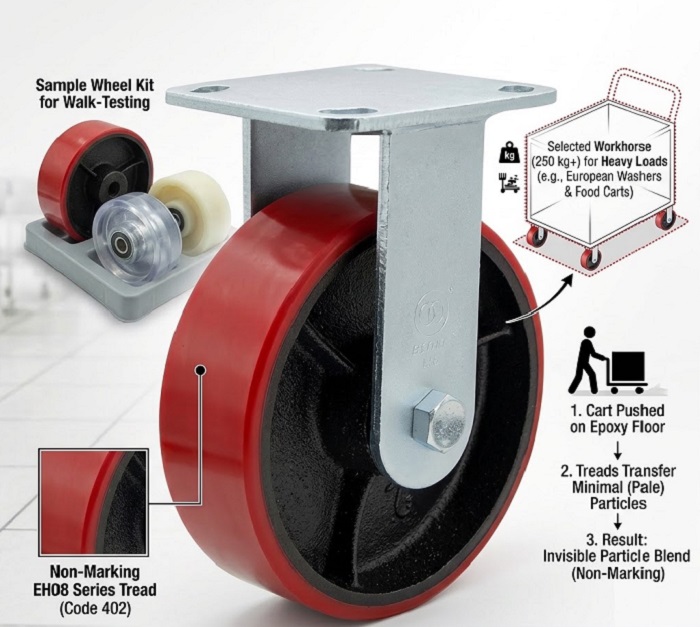
| Iron-core PU (our EH08-402) | Red / amber | None | 250 kg/wheel and up | Low | Resistant |
| TPR (thermoplastic rubber) | Light grey / beige | Very light | 50–150 kg/wheel | Very low (quietest) | Can flatten after days parked |
| Nylon (PA) | Off-white | None | 150–300 kg/wheel | Loud (clicks on joints) | No flattening |
| Grey rubber | Grey | Light scuff on white floors | 100–200 kg/wheel | Low | Some flattening |
Common Mistakes Buyers Make
- Buying a “grey rubber” wheel assuming it is non-marking. Grey rubber scuffs lighter than black rubber, but it still leaves a grey haze on white epoxy. Test on your own floor before ordering 200 units.
- Buying the cheapest PU wheel for a heavy load. A cheap PU wheel with a plastic core can delaminate under load. The iron-core PU (like our 402 tread) keeps the tread bonded to the hub — that is what you want for 200+ kg per wheel.
- Putting a hard nylon wheel on a polished soft floor. Nylon does not mark, but it scratches and clicks on sheet vinyl. It belongs on concrete, not on a hospital corridor.
- Choosing TPR for a machine that sits still for weeks. TPR is quiet and non-marking, but under long static load it develops a flat spot. For machines that stay parked, move up to iron-core PU.
- Ignoring the swivel raceway. The tread is only half the story. A cheap zinc-plated bracket that rusts onto the floor is its own kind of marking — a rusty bracket leaves orange stains. For washdown floors, pair a non-marking tread with a blue-zinc or stainless bracket.
How to Choose a Non-Marking Caster — A Worked Example
Say you are building a 700 kg washing machine that rolls across a white epoxy food-plant floor. You need non-marking wheels, and the machine sits still for 40 minutes between cleaning cycles.
- Load per wheel: 700 kg ÷ 4 = 175 kg per wheel. With the 1.3 safety factor: 175 × 1.3 ≈ 228 kg per wheel.
- TPR tops out around 150 kg per wheel and flats under long static load — ruled out.
- Nylon carries the load but clicks on epoxy and can scratch — ruled out for a food-plant floor.
- Grey rubber scuffs on white epoxy — ruled out.
- Iron-core PU (our EH08-11-125S-402) carries 250 kg per wheel, leaves no marks, does not flat under 40-minute parking cycles. That is the pick.
How Globe Caster Helps
Our EH08 heavy-duty series ships with the red iron-core PU tread (code 402) as standard — the non-marking, heavy-duty workhorse you see on European washing machines and food-plant carts. We also stock TPR and nylon wheels for lighter duty. If you are specifying a machine for a marked-floor environment, send us your floor type and loaded weight and we will send you sample wheels to walk-test before you commit to a production order.
Need a Non-Marking Caster Sample for Your Floor?
Tell us your loaded weight per wheel, floor material (epoxy / tile / vinyl / concrete), and whether the machine moves daily or sits for days. We will recommend the tread and send samples for on-floor testing. B2B OEM and sample orders welcome.
Post time: Oct-23-2026