
Push a four-wheel cart that wanders to one side no matter how you steer it, and the problem is usually the brackets, not the wheels. The corners that should hold a straight line are swivelling, and the corners that should turn are locked rigid.
Fixed caster wheels — also called rigid casters or non-swivel castors — sit in a fork that points one direction and never turns around the kingpin. They are the half of a cart that goes straight. Understanding what they do, and what they do not, keeps you from ordering four of the wrong leg.
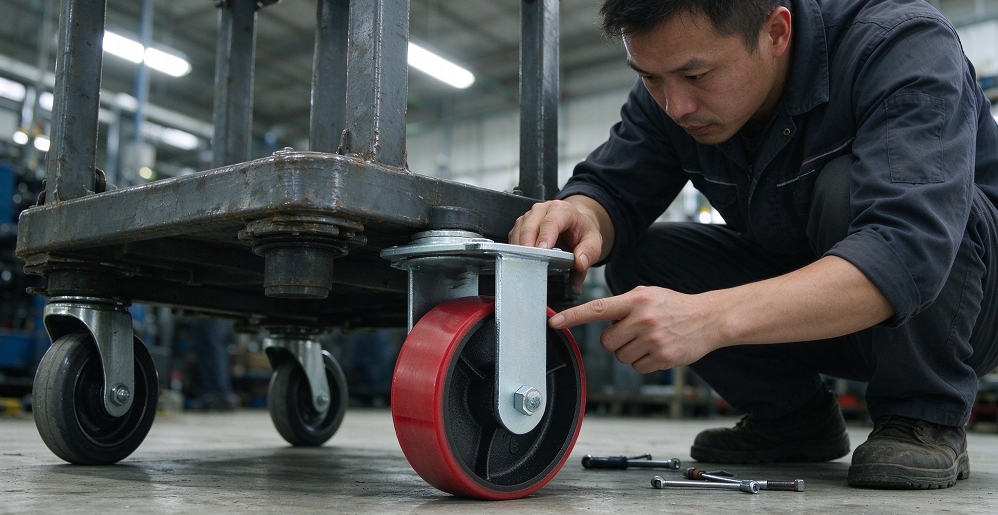
What Is a Fixed (Rigid) Caster Wheel?
A fixed caster has a wheel that rolls around its axle, but the fork itself is welded or pressed to a fixed angle on the plate. There is no swivel raceway under the kingpin, so the leg cannot rotate in plan view. The wheel follows a single straight track in the direction the fork is aimed.
That fixed direction is the whole point. On a cart pushed or towed along a straight aisle, rigid legs resist the side-to-side wander that free-swivelling forks produce. They also carry side loads more honestly, because the bracket does not have to steer while it holds the weight.
▲ ISO 22883 (current edition) sets the requirements and tests for industrial castors and wheels;
▲ The ANSI/ICWM terminology standards define the names the industry uses.
“Fixed”, “rigid” and “non-swivel” all describe the same leg in those standards; the supplier you order from should confirm which term their catalogue uses.
Fixed vs Swivel: What Each One Does
| Dimension | Fixed / rigid caster | Swivel caster |
|---|---|---|
| Steering | Fork points one way, cannot turn | Fork rotates on the kingpin raceway |
| Straight-line travel | Holds a straight track, resists wander | Can wander or “crash-steer” under tow |
| Turning | Cannot pivot the leg; the cart turns only by dragging | Pivots in place, lets the cart corner |
| Side load | Bracket built to hold a fixed direction under side force | Side load goes through the swivel raceway |
| Typical corner | Trailing end of a push/tow cart | Steering end of a push cart |
| Cost and wear | Fewer moving parts, no raceway to loosen | More parts; the raceway is where wear shows first |
| Picture | 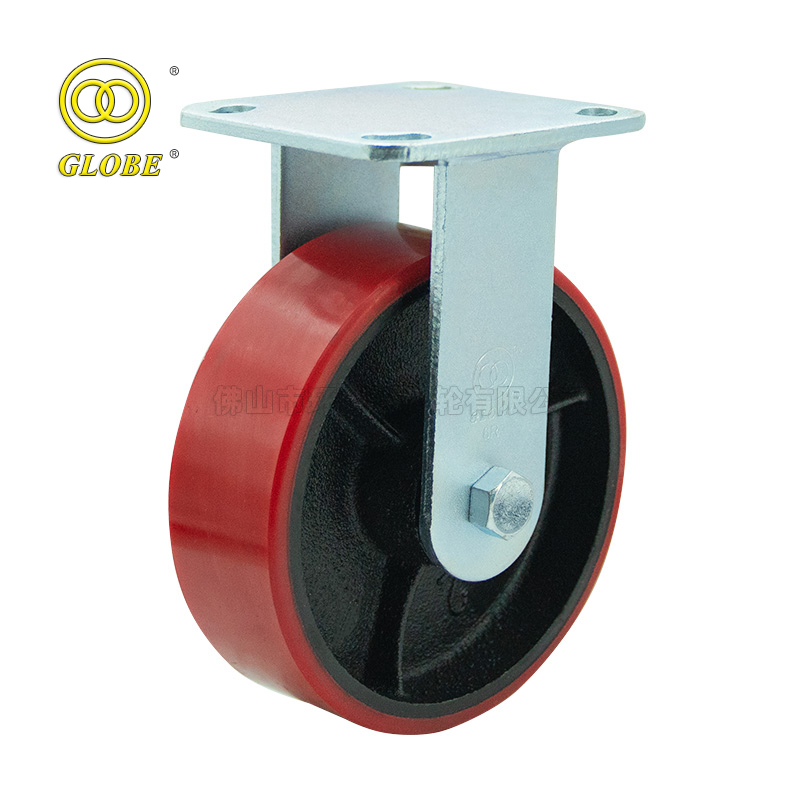 |
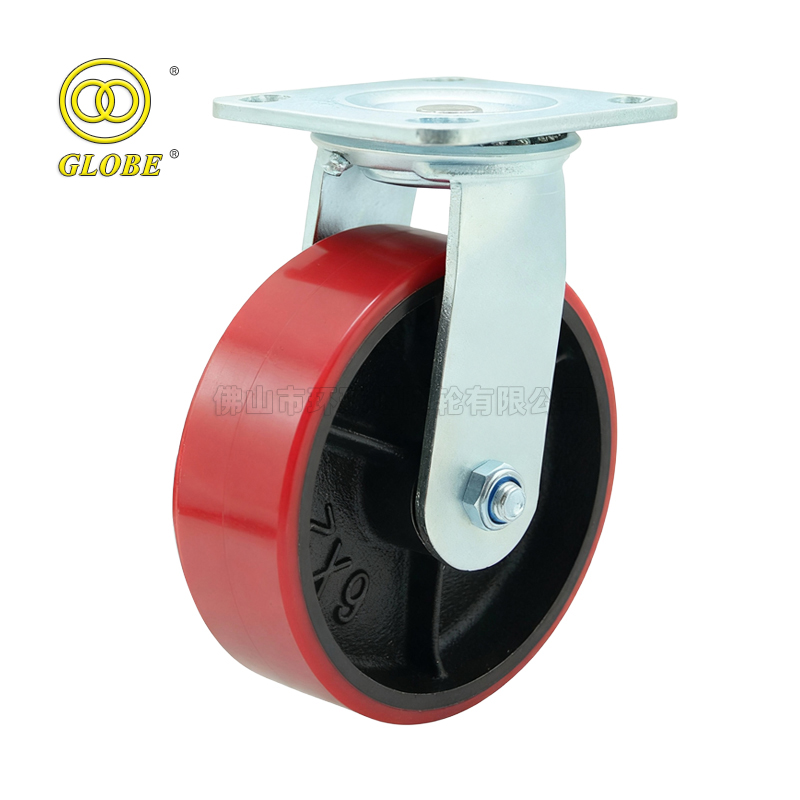 |
| SKU | EH08-11-150R-402 | EH08-11-150S-402 |
Why Most Carts Run Two of Each
Put four rigid casters on a cart and it will roll straight, but turning it means dragging two legs sideways across the floor. The wheels scuff, the push force jumps, and the floor marks. Put four swivels on it and it turns easily, but under tow or on a long aisle it crabs and drifts because every free fork chases the easiest angle.
The standard compromise is two swivels at the steering end and two rigid casters at the trailing end. The swivels handle the corners; the rigid legs hold the line once the cart is moving straight. This 2+2 layout is what most platform trucks, hand-pushed carts and line-side racks use.
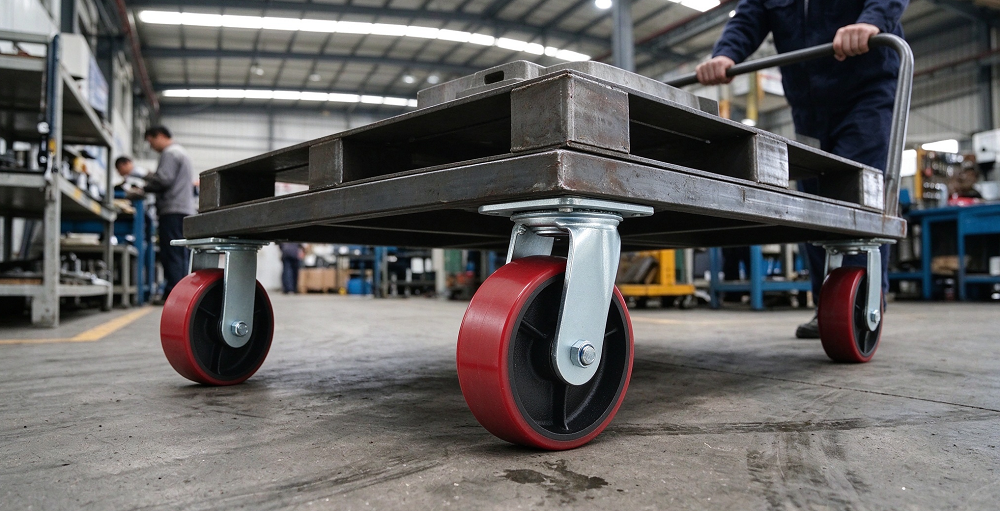
When To Run Rigid-Only
● Carts that travel a fixed straight rail or aisle and never need to turn in place.
● Trailing dollies towed behind a powered unit, where the front unit steers.
● Equipment on a fixed machine base that rarely moves, only shifted for maintenance.
● Long conveyors or gates where the load must follow one track.
When To Run All Swivel
○ Carts repositioned in tight cells where a 2+2 layout cannot turn around.
○ Work tables and stands pushed short distances in multiple directions.
○ Loads whose centre of gravity shifts between trips, so the steering end changes.
Common Mistakes
▲ Four rigid casters on a hand-pushed cart. Turning drags the wheels sideways. If the cart corners often, it needs swivels at the steering end.
▲ Four swivels on a towed line. Free forks wander under pull. Towed carts want the trailing legs rigid, or swivels locked straight with a directional lock.
▲ Matching rigid and swivel wheels of different diameters. If the trailing rigid wheel sits higher or lower than the swivel, the load rides on two legs. Keep the wheel diameter and mounting height matched across the cart.
▲ Reading the per-wheel rating as the cart rating. The caster number is per wheel. A four-leg cart divides its total load by four, and uneven floors mean some legs carry more than their share.
Worked Load Example
A platform cart carries 600 kg loaded, on four casters.
Per wheel: 600 ÷ 4 = 150 kg.
On an uneven concrete floor, uneven loading means one leg can carry more than the average, so pick a per-wheel rating above 150 kg rather than exactly at it.
○ The cart runs a straight aisle but turns at the end of each shift: two swivels at the steering end, two rigid fixed casters at the trailing end.
○ If the aisle were fully straight and the cart only towed, rigid-only would hold the line better.
If your cart lands above the rating of the wheels you are looking at, do not solve it by stiffening the brackets — step up to a larger wheel or a heavier-duty bracket family.
What Buyers Usually Ask Us
Are fixed and rigid casters the same thing?
Yes. Fixed, rigid and non-swivel all describe a leg whose fork does not rotate on a kingpin. The wording varies by catalogue.
Which corners get the rigid casters?
The trailing end, opposite the steering end. On a hand-pushed cart, the rigid legs follow; the swivels at the front steer.
Can I mix rigid and swivel on the same cart?
That is the normal layout. Match wheel diameter, tread and mounting height between the two types so the cart sits level.
Do rigid casters need brakes?
A brake on a rigid leg stops the roll but does nothing for steering, because the leg already cannot turn. Brakes matter on the swivel corners where positioning control is needed.
What floor do rigid casters mark?
Marking depends on the tread, not on fixed versus swivel. A hard nylon tread can scuff soft epoxy; a non-marking polyurethane tread protects the floor regardless of bracket type.
How Globe Caster Builds This Line
Foshan Global Caster Co., Ltd, Guangdong, China has manufactured casters and wheels since 1988. The plant covers about 156,000 m² with 500-plus staff and in-house stamping, injection moulding and PU pouring, outputting roughly ten million casters a year. The catalogue holds 21,000-plus models, 600-plus of them as standing stock, certified to ISO 9001 and ISO 14001, with over 100 patents. Swivel, rigid and braked variants are built on the same bracket footprint so a 2+2 cart mixes types without changing the hole pattern.

Send the Cart and Aisle, We Specify the Layout
Tell us the loaded weight, floor material, wheel diameter you have room for, and whether the cart is pushed, towed or repositioned in a tight cell. We reply with which corners take rigid legs, the per-wheel rating after margin, and sample SKUs to trial on one cart. If a simpler layout covers the job, we say so.
Post time: Nov-13-2026