
Furniture castors fail for reasons that look small on paper. The stem slips out of the leg because the diameter was wrong. The plate holes do not line up with the frame. A hard tread leaves black marks on a laminated floor. Each complaint comes back to the importer, even though the wheel itself rolled fine.
This account follows how an overseas furniture-hardware importer built a mixed, repeatable range of furniture castors with our factory. It is written from the order-processing and engineering side, not as a product pitch. The same process applies to casters for sofas, bed frames, stands and occasional tables.
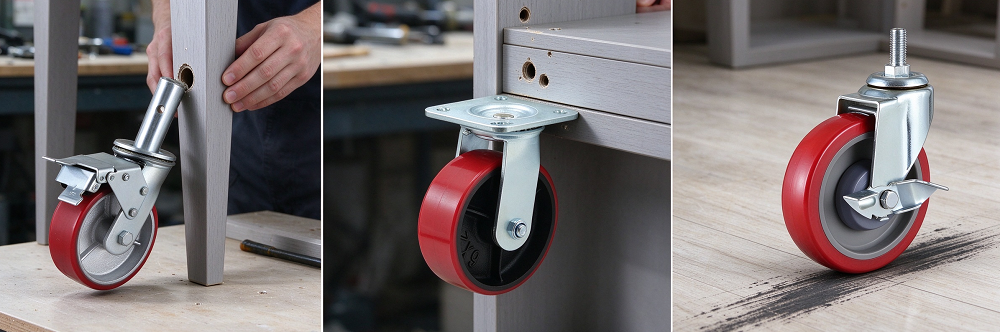
About the Customer
The customer is an importer and wholesaler of furniture hardware, supplying local furniture makers and retail-assembly brands in its home market. Its range covers replacement and original-fit castors for seating, storage and display furniture, under its own house label.
What They Needed
Their opening request was a range rather than one model. They wanted:
● Stem diameters and plate hole patterns that match the furniture legs their customers actually drill.
● Soft, non-marking tread for finished wood, laminate and tile floors, with a harder option for industrial display units.
● Consistent bracket finish and swivel feel across several small diameters in the same catalogue.
● Retail-ready carton packing and mixed packing per SKU, so each line can be stocked separately.
How We Met
The enquiry came through our export channel after the importer compared several suppliers. The first exchange was fitting and load information, not a price list. We asked what the furniture piece was, the load it would carry, the floor type, and whether the leg takes a stem, a plate or an insert fitting. A castor chosen on price alone will not fit the leg, and no rating helps if it drops out of the frame.
Factory Visit
On the factory visit they walked the internal flow:
1. Bracket stamping;
2. Injection moulding for nylon and polyolefin wheels;
3. Elastomer tread work;
4. Bearing and raceway assembly;
5. Final inspection and packing.
They could see where the bracket is formed, how a soft tread is bonded to its core, and how a finished leg is checked before it goes into a carton.
Globe Caster has run as a caster manufacturer in Guangdong, China since 1988, with a 156,000 m² plant, 500-plus staff, about 21,000 listed models and 600-plus kept as ready stock. The factory holds ISO 9001 and ISO 14001 and holds over 100 patents. These are registered company facts, not test claims about any single furniture leg.

Choosing Samples
We did not send the widest catalogue. From their furniture list we shortlisted the sample :
○ Light-duty swivel and plate legs for seating and stands;
○ Stem fittings for legs drilled to accept an insert;
○ Softer treads where floor marking was a concern;
○ Twin-wheel versions were considered where a wider stance helps on a light frame.
Each sample carton carried the diameter, tread, fitting type and bracket finish, so their team could match it to the leg later.
Testing Locally
Samples went to their own workshop before any bulk order. Their staff pressed each stem into a real furniture leg, checked the plate against a drilled frame, and rolled the wheel on the actual floor surface. They noted which tread marked the finish, which stem held tight, and how the swivel turned under the piece’s own weight. That feedback narrowed the shortlist before production quantities were quoted.
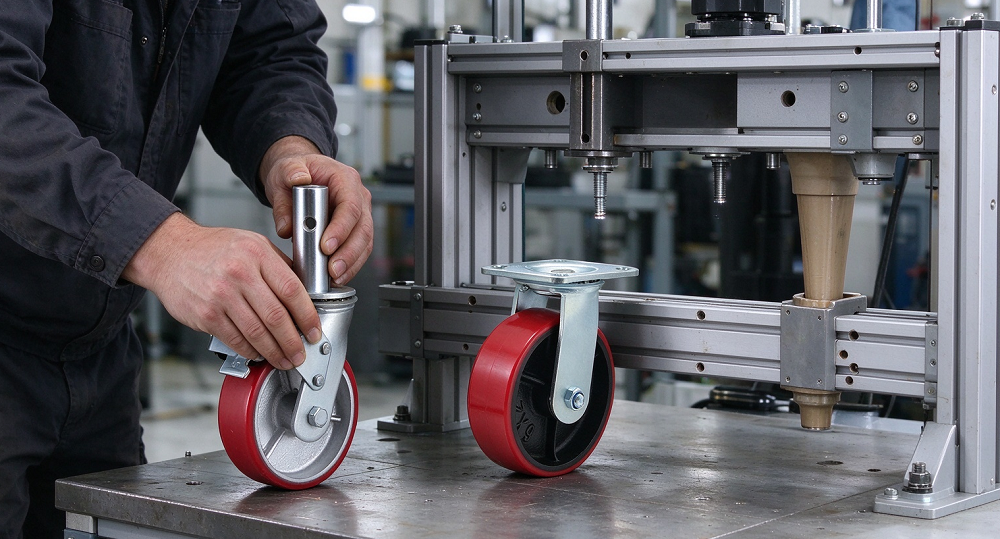
SKU-Level Fitting Detail Before the First Order
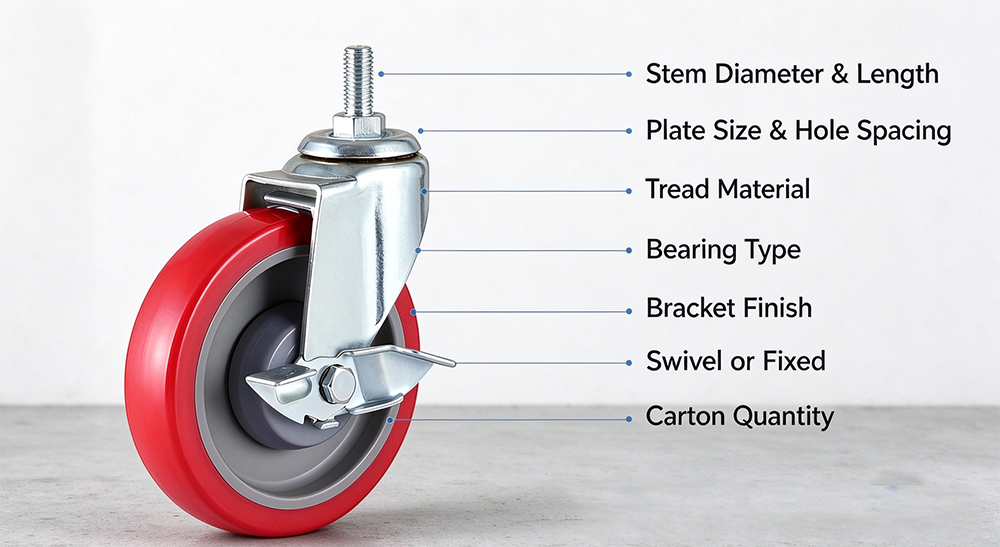
Once samples passed, the details were fixed line by line: stem diameter and length, plate size and hole spacing, tread material, bearing type, bracket finish, swivel or fixed, and carton quantity.
For furniture castors the fitting dimensions matter as much as the wheel, because a leg that cannot be attached cannot be sold. Container loading was worked out from the packed carton size, not the bare wheel. Both sides confirmed the written spec before production started.
Price Was Important, Not the Only Factor
The importer compared landed cost, not unit price alone. Carton standard, replenishment consistency and how a shortage on one fitting is handled all feed the real cost of running a hardware range. A cheaper leg that arrives with the wrong stem diameter, or that marks the customer’s floor, costs more over the program. We quoted the spec we could repeat, and left room to change tread or fitting rather than compete on the lightest bracket.
Why They Kept Buying
Repeat orders came down to three points:
● The first production lot matched the approved samples;
● The packing matched the house-label requirement;
● And the next order could be placed against the same confirmed fitting list without rebuilding the details from scratch.
What Other Buyers Can Learn
1. Measure the leg fitting first. Stem diameter, stem length and plate hole pattern are the reasons furniture castors get returned. Match these before looking at price or appearance.
2. Specify the tread for the floor. A hard wheel that marks laminate or tile will lose the sale regardless of how smooth it rolls. State the floor surface and ask for a non-marking option.
3. Rate by leg, not by furniture piece. The load on each leg is not the whole-piece weight divided by four in every case; a cantilevered arm or a loaded drawer can put more on one corner. Check the worst corner.
4. Sample before bulk. Fit the sample onto a real leg and roll it on a real floor before committing to a container.
5. Keep a written fitting record. A SKU-level list of stem, plate, tread and finish keeps repeat orders consistent, which is what a house-label range depends on.
FAQ
Are furniture castors rated the same as industrial casters?
No. Furniture legs are light-duty; the rating and bracket are sized for seating and stands, not loaded platforms. Use an industrial caster where the piece carries real weight.
Can one order mix stem, plate and insert fittings?
Yes. Mixed fittings are handled as long as each line is confirmed to a SKU-level spec before production.
Do soft treads protect wooden floors?
Soft non-marking treads reduce marks on finished wood, laminate and tile. Hard nylon or steel wheels are the wrong choice for those surfaces.
What information do you need to quote furniture castors?
Furniture type, load per leg, floor surface, mounting fitting (stem, plate or insert), required diameter and any finish requirement. A photo of the current leg helps.
What is the lead time and warranty?
Standard lead time is around 30 days and the warranty is one year; stock models can move faster than a built-to-spec line.
Send Us Your Furniture Fitting List
List the furniture types, load per leg, floors, and stem or plate fittings you need. We reply with a sample shortlist, a fitting spec sheet and packing options. If a standard off-the-shelf leg covers the job, we say so rather than push a custom build.
Post time: Nov-14-2026