
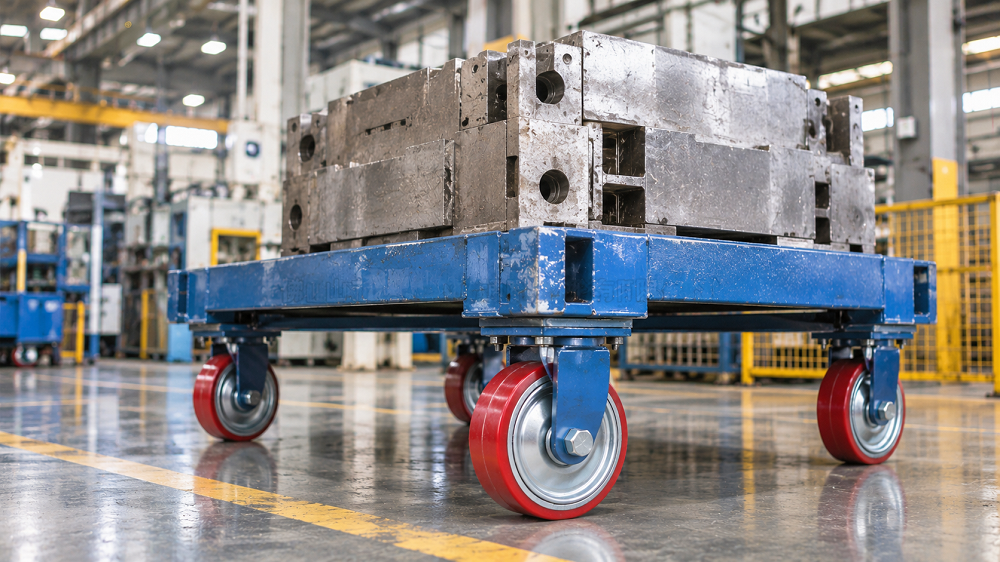
Some carts push the limits of ordinary industrial casters. A die cart loaded to a tonne, a machine base that never leaves the plant, a line-side rack that gets towed eight hours a day — standard brackets deflect, the swivel raceway loosens, and after a year the cart wanders and won’t hold a straight line.
The EK01 series is our extra-heavy plate caster built for that work. Below is the 6-inch iron-core polyurethane swivel as the flagship, with the full 4-to-12-inch size ladder and every mounting dimension we keep in the specification sheet.
Who Makes These
Foshan Global Caster Co., Ltd, Guangdong, China has manufactured casters since 1988. The plant covers about 156,000 m² with 500-plus staff and in-house stamping, injection moulding and PU pouring, outputting roughly ten million casters a year. The catalogue holds 21,000-plus models, 600-plus of them as standing stock, certified to ISO 9001 and ISO 14001, with over 100 patents. The EK01 line is built on that in-house stamping and moulding, not sourced and relabelled.

Flagship Model: EK01-17-150S-402
This is the 6-inch (150 mm) swivel, iron-core polyurethane tread on a ball bearing, blue-zinc welded fork, top-plate mount. It is the size most die carts and heavy machine bases land on.For more information, please click here to contact us.
| Item | Specification | Picture | |
|---|---|---|---|
| Swivel SKU | EK01-17-150S-402 | 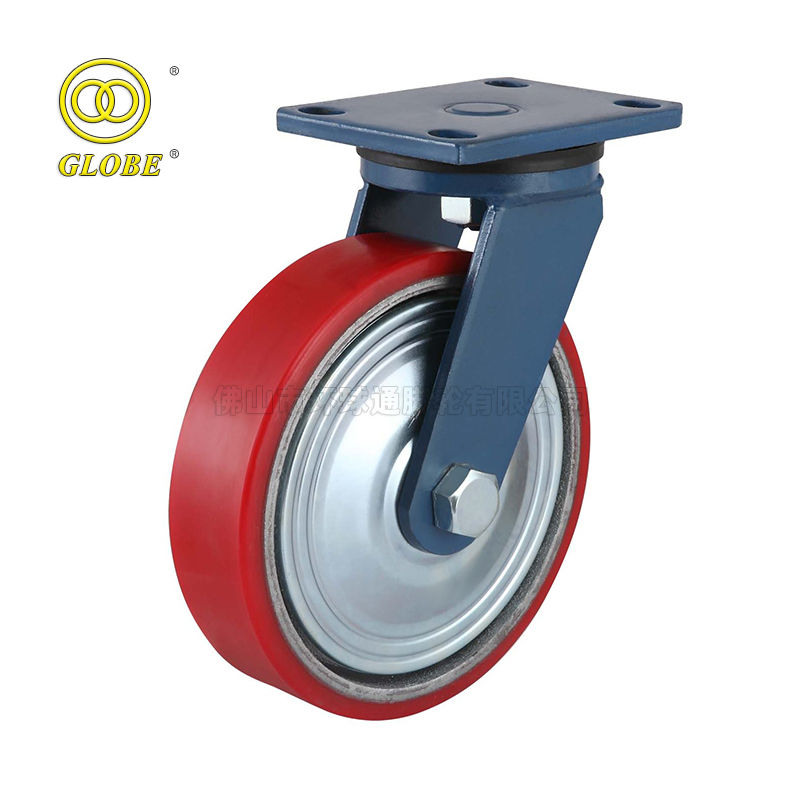 |
|
| Wheel diameter × width | 150 × 50 mm | ||
| Load capacity | 500 kg per wheel | ||
| Tread | Iron-core polyurethane, red bonded-on | ||
| Bearing | Ball bearing, sealed | ||
| Mounting height | 201 mm | ||
| Swivel radius | 113 mm | ||
| Top plate | 140 × 110 mm | ||
| Hole spacing | 110 × 75 mm | ||
| Hole diameter | 13 mm | ||
|
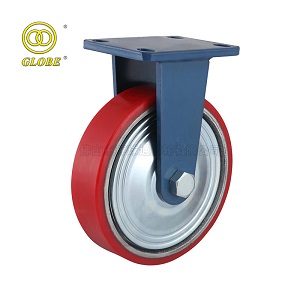
(Rigid counterpart) |
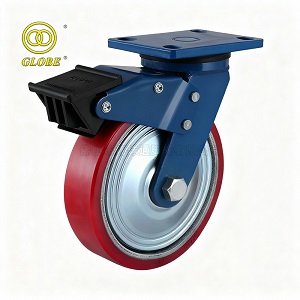
(Dual-brake swivel) |
 |
 |
Full Size Ladder
Same fork family, iron-core PU tread, ball bearing, across the range. The 10 and 12-inch sizes step up to a larger 180 × 140 mm plate with 150 × 100 mm hole spacing. High-strength nylon and cast-iron treads are available at every size on the same bracket where floor protection matters less than raw point-load capacity.
| Wheel | Ø × width (mm) | Load / wheel (kg) | Mounting height (mm) | Swivel radius (mm) | Plate (mm) |
|---|---|---|---|---|---|
| 4 inch | 100 × 50 | 350 | 150 | 82 | 140 × 110 |
| 5 inch | 125 × 50 | 400 | 175 | 98 | 140 × 110 |
| 6 inch | 150 × 50 | 500 | 201 | 113 | 140 × 110 |
| 8 inch | 200 × 50 | 650 | 250 | 147 | 140 × 110 |
| 10 inch | 250 × 64 | 1200 | 303 | 193 | 180 × 140 |
| 12 inch | 300 × 64 | 1500 | 354 | 224 | 180 × 140 |
On nylon or cast-iron treads the per-wheel rating runs higher still — up to 2000 kg per wheel at 12 inch. Those treads are for steel plate and fabrication shops, not finished floors.
What You Are Pay For Under the Skin
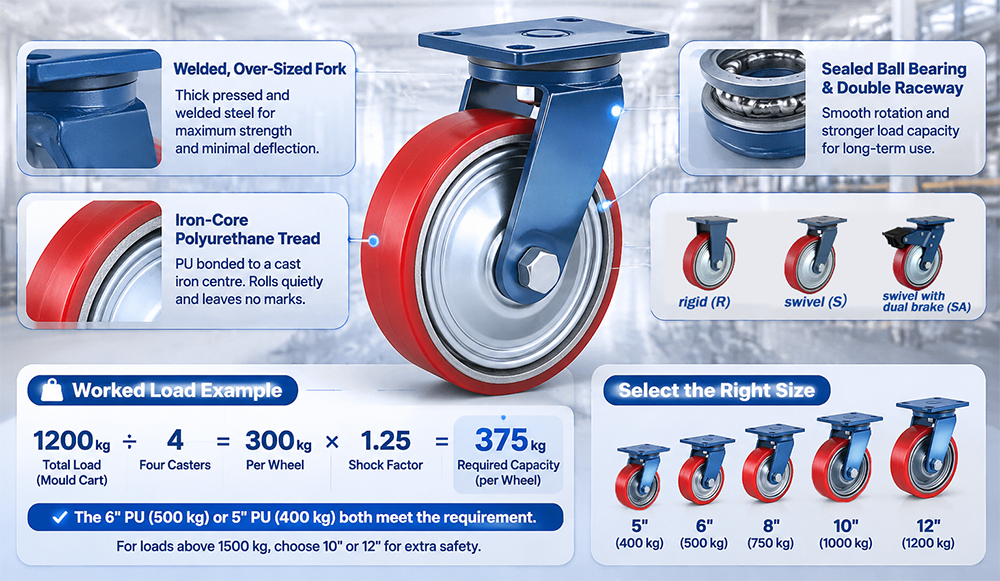
Welded, over-sized fork
Extra-heavy casters bend where light-duty ones fold. The EK01 fork uses thick pressed and welded steel so the bracket deflects little at rated load, which is what keeps the swivel axis true after years of point loads.
Iron-core polyurethane tread
The PU is bonded to a cast iron centre. The core takes the radial load; the tread rolls quiet on epoxy or steel plate and leaves no black marks. Standard PU works about −45 to 90 °C — if your line runs hotter, tell us, this tread is not the answer.
Sealed ball bearing and double-ball swivel raceway
Ball bearing starts rolling with lower force than a plain bore, and the double raceway under the kingpin takes the side load of a swivelling heavy cart without loosening.
Brake and rigid variants on the same plate
Every size ships as swivel (S), rigid (R), or swivel with dual brake (SA), all on the same plate footprint. You can mix 2 swivel + 2 rigid for straight-line towed carts, or run dual brakes on the swivels where the cart must sit still at a work cell.
Worked Load Example
A mould cart carries a 1200 kg die and frame.Four casters: 1200 ÷ 4 = 300 kg per wheel.
Add a 1.25 shock/impact margin for drops over thresholds: 300 × 1.25 = 375 kg per wheel.
○ The 6-inch PU at 500 kg clears it;
○ The 5-inch at 400 kg also clears but with no headroom for a bumped threshold. We would spec the 6-inch and note why.
If your cart lands above 1500 kg total, jump to the 10 or 12-inch plate — do not run four 6-inch casters past their rating to save mounting height.
Where These Belong
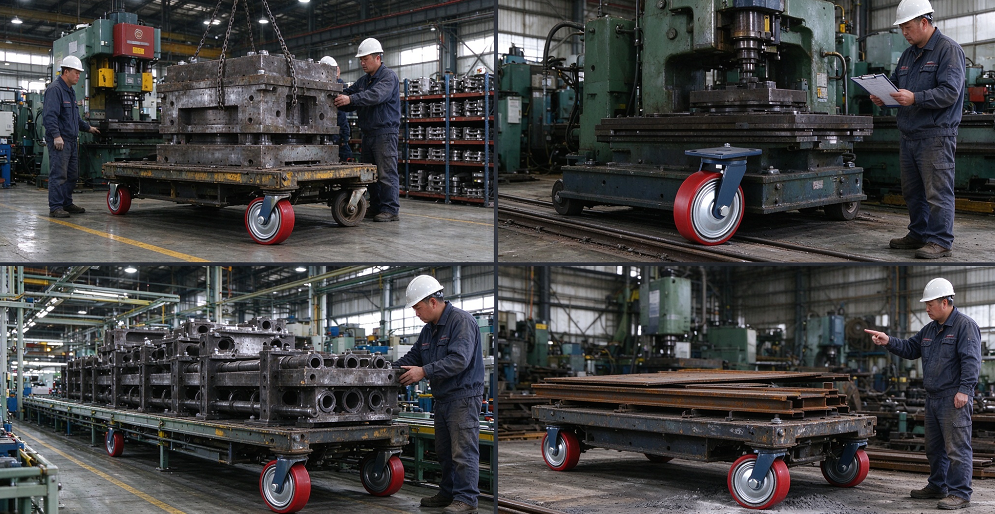
● Mould and die transfer carts in automotive and appliance plants.
● Mobile machine bases for presses and machine tools.
● Line-side heavy component racks on assembly lines.
● Steel and fabrication shop carts moving plate and structural sections.
When To Pick Something Else
▲ If your cart is under 300 kg and runs on smooth office or warehouse floors, EK01 is overkill — a medium-duty plate family costs less and rolls easier.
▲ If your floor is fragile epoxy and the load is light, a softer tread at a lower series makes more sense than the widest hardest wheel.
▲ For washdown lines with daily high-pressure chemical cleaning, this blue-zinc welded fork is not the right bracket. That environment needs a stainless bracket family, which we build separately — ask for it by line, not by this SKU.
FAQ
How many casters should my cart have?
Four for symmetric loads. For long or offset loads, six is safer — uneven floors never load all four wheels evenly.
Swivel or rigid on which corners?
Two swivel at the steering end and two rigid at the trailing end for push/tow carts you steer by hand. Four swivels (with two brakes) for carts you reposition in tight cells.
Does the dual brake lock both wheel swivel and roll?
The SA variant locks the rolling wheel; the swivel raceway is not locked by this brake. For straight-line towed carts that must not wander, pair rigid casters at the trailing end instead.
What floor finish does the iron-core PU mark?
It is non-marking on sealed concrete and epoxy in normal use. Do not run it through fresh uncured floor coatings.
Can you customise the plate or stem?
Plate dimensions above are standard. Other hole patterns or stem mounts go through OEM/ODM; tell us the drawing and we confirm feasibility before quoting.
Lead time and warranty?
One-year warranty under normal use; standard lead time about 30 days, with 600-plus catalogue models held as stock. We reply with a quote and a 2D drawing for the exact SKU you select.
Tell Us the Cart, We Quote the SKU
Send the loaded cart weight, floor material, worst obstacle or threshold, and whether you push or tow. We reply with the wheel size and tread, the per-wheel rating after margin, and sample SKUs you can trial on one cart. If a cheaper series covers the job, we say so.For more information, please click here to contact us.
Post time: Nov-09-2026