
Medium carts and trolleys usually do not need a heavy-duty fork, but they still need a wheel that starts easy, turns cleanly and does not mark the shop floor. A hard solid tyre trades push force and noise for abrasion; a polyurethane tread protects smooth concrete, epoxy and tiled floors while rolling lighter than a cast-iron wheel.
The ED1 family is a medium-duty top-plate castor built around a ball bearing and a pressed steel fork, sized 3 to 5 inches for tool carts, workbench trolleys, material racks and light platform trucks. The 4-inch high-strength polyurethane swivel is the general-purpose model in the range, and the size ladder below carries every mounting dimension from the specification sheet.
Who Makes These
Foshan Global Caster Co., Ltd, Guangdong, China has manufactured casters and wheels since 1988. The plant covers about 156,000 m² with 500-plus staff and in-house stamping, injection moulding and PU pouring, outputting roughly ten million casters a year. The catalogue holds 21,000-plus models, 600-plus of them as standing stock, certified to ISO 9001 and ISO 14001, with over 100 patents. The ED1 line is built on that in-house stamping and moulding, not sourced and relabelled.
Flagship Model: ED01-11-100S-308
This is the 4-inch (100 mm) swivel, high-strength polyurethane tread on a ball bearing, blue-zinc pressed steel fork, top-plate mount. It is the size most medium tool carts, workshop trolleys and light racks land on when the route runs on smooth concrete, epoxy or tiled floors.
| Item | Specification |
|---|---|
| Swivel SKU | ED01-11-100S-308 |
| Wheel diameter × width | 100 × 28 mm |
| Load capacity | 80 kg per wheel |
| Tread | High-strength polyurethane |
| Bearing | Ball bearing |
| Mounting height | 133 mm |
| Swivel radius | 88 mm |
| Dual-brake swivel radius | 120 mm |
| Top plate | 94 × 67 mm |
| Hole spacing | 73 × 45 mm |
| Hole diameter | 9 mm |
| Rigid counterpart | ED01-11-100R-308 |
| Nylon dual-brake swivel | ED01-11-100SA-308 |
| Side-brake swivel | ED01-11-100SC-308 |
Full Size Ladder — Top Plate
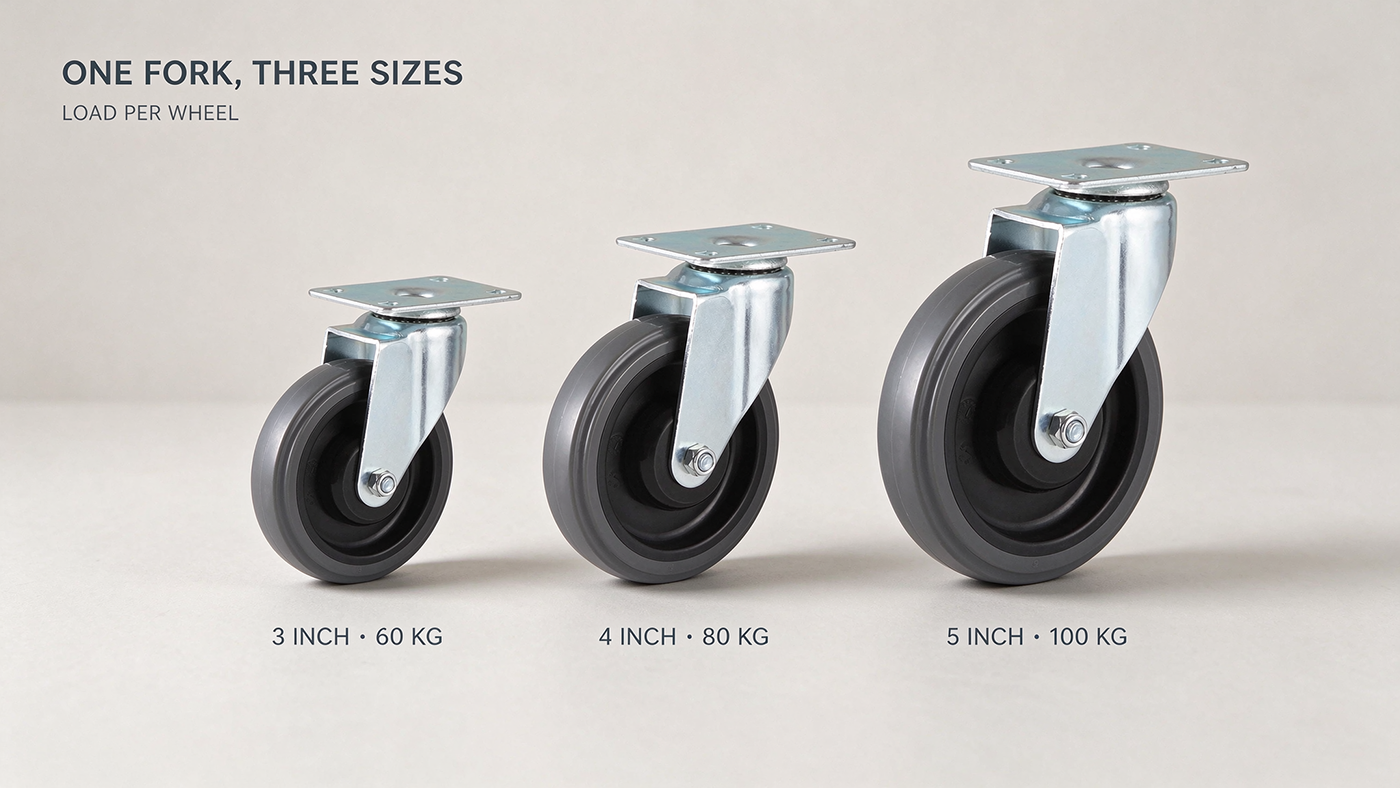
Same medium-duty fork family across the range, ball bearing and blue-zinc finish on every size. Each diameter ships as swivel (S), rigid (R), swivel with nylon dual brake (SA) or swivel with side brake (SC) on the same plate footprint. Load figures below are per wheel; the polyurethane and Meili treads share the rating shown for that diameter.
| Wheel | Ø × width (mm) | Load / wheel (kg) | Bearing | Mounting height (mm) | Swivel radius (mm) | Dual-brake radius (mm) | Plate (mm) | Hole spacing (mm) | Hole dia (mm) |
|---|---|---|---|---|---|---|---|---|---|
| 3 inch | 75 × 28 | 60 | Ball | 108 | 75 | 120 | 94 × 67 | 73 × 45 | 9 |
| 4 inch | 100 × 28 | 80 | Ball | 133 | 88 | 120 | 94 × 67 | 73 × 45 | 9 |
| 5 inch | 125 × 30 | 100 | Ball | 158 | 103 | 120 | 94 × 67 | 73 × 45 | 9 |
Tread Choices at the Same Size
Within each diameter the same fork pairs with four tread families, so the floor and noise duty drive the choice rather than the price of the bracket:
- High-strength polyurethane — resilient roll, protects smooth concrete and epoxy, balances wear and push force. The flagship 4-inch uses this tread.
- Super-quiet polyurethane — softer roll for quieter movement in workshops, showrooms and areas where rolling noise matters.
- Super polyurethane — all-PU wheel with a firm tread for general medium-duty use on level floors.
- Meili tread — solid resilient wheel for standard indoor duty where floor marking is not a primary concern.
What You Are Pay For Under the Skin
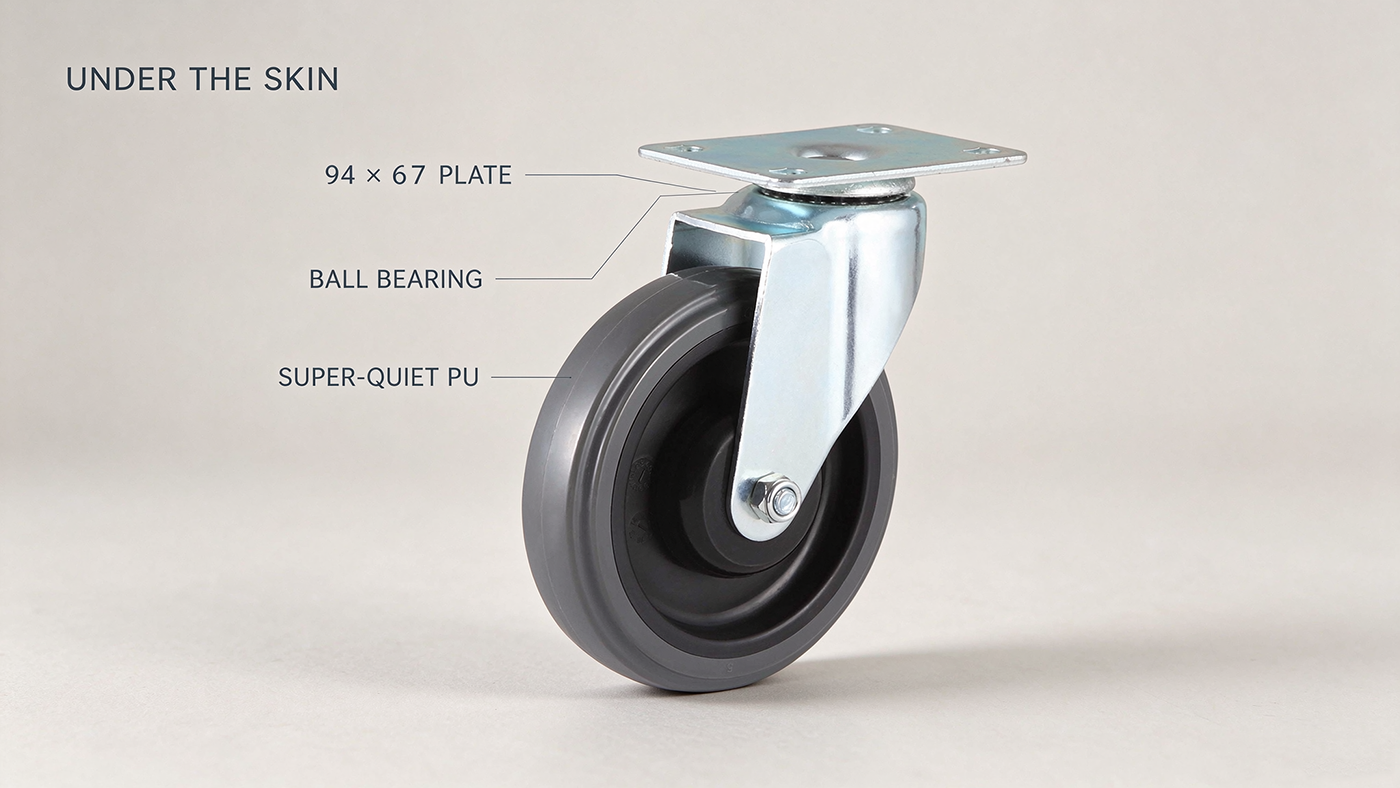
Ball bearing for easy swivel at medium loads
The ED1 uses a ball bearing. At trolley weight a ball race turns smoothly under modest radial load and starts rolling easily at walking pace. For heavier, slower-moving platforms a roller-bearing family carries the load across line contact and suits the higher rating better.
Fork and plate spread the load
The pressed steel fork and the 94 × 67 mm plate spread the point load across the chassis rail. The 73 × 45 mm hole spacing and 9 mm holes match the medium-duty plate pattern; bolt to the frame builder’s tube gauge, not to a tighter torque than the frame itself carries.
Tread matched to the floor
Polyurethane protects smooth concrete, epoxy and tile and rolls with less noise than a hard nylon or cast-iron wheel. On rough slag or heavily grooved concrete the PU tread wears faster than a phenolic or iron tyre. Match the tread to the floor before comparing prices.
Brakes on the steering corners
The SA dual brake locks both the rolling wheel and the swivel raceway, holding the trolley still at a work cell. The SC side brake locks the rolling wheel only and leaves the raceway free to turn. Pair rigid castors at the trailing end when the cart must run a straight line without wandering.
Worked Load Example
A workshop trolley carries 200 kg including its own frame. Four castors: 200 ÷ 4 = 50 kg per wheel under even loading. The 3-inch model at 60 kg per wheel clears it. If the loaded trolley runs to 320 kg, that is 80 kg per wheel; the 4-inch at 80 kg sits right at the line, so we would take the 5-inch at 100 kg to leave headroom for an uneven corner and daily push traffic.
If the worst corner of your cart runs above 100 kg per wheel, this bracket is not the right series — move to a heavy-duty plate family rather than running four 5-inch wheels past their rating.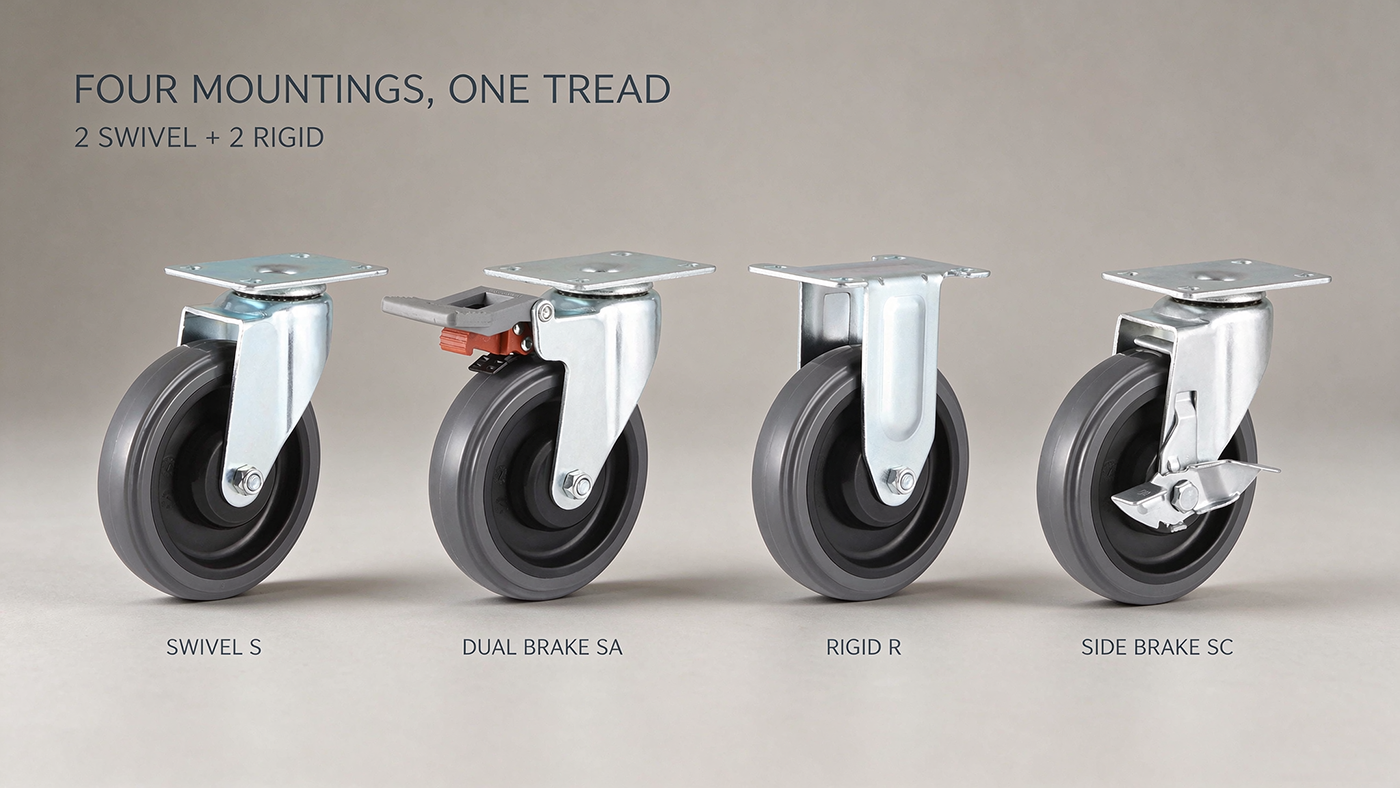
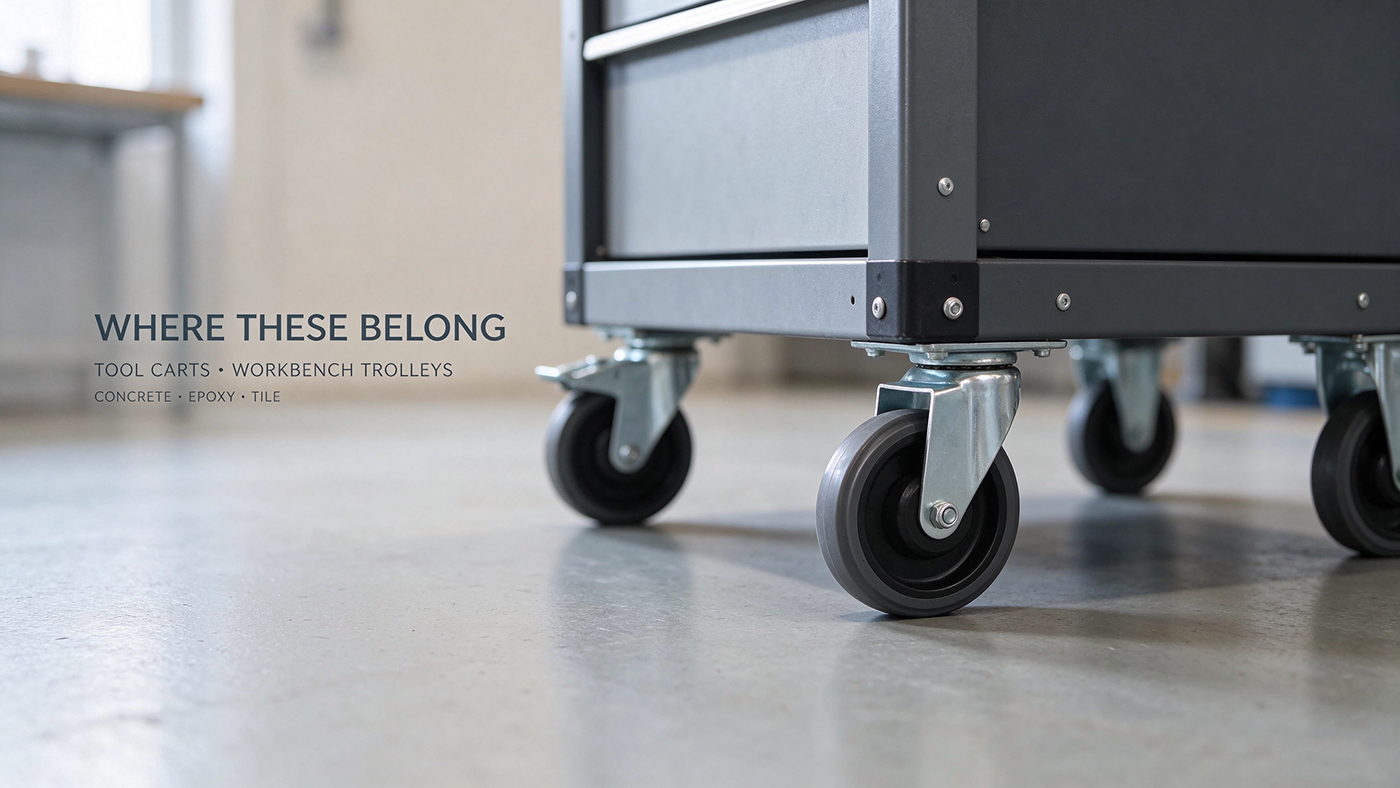
Where These Belong
- Workshop tool carts and parts trolleys on smooth concrete or epoxy.
- Workbench trolleys and light racks repositioned between work cells.
- Display and assembly fixtures on level indoor floors.
- Light platform trucks carrying boxes and components at walking pace.
When To Pick Something Else
If your load is below 50 kg per wheel, a light-duty stem or plate series covers it and the ED1 fork is overbuilt. If the floor is rough slag or oily steel plate, a phenolic or cast-iron tread from a heavier family takes that abrasion better than PU. For washdown or corrosive areas, this blue-zinc line is not the corrosion-resistant answer — a dedicated corrosion-protected family is the right direction.
FAQ
How many castors should a medium trolley use?
Four for symmetric loads. Long, narrow or offset equipment often runs six to spread the load more evenly over uneven floors.
Swivel or rigid on which corners?
Two swivel at the steering end and two rigid at the trailing end for hand-pushed trolleys. Four swivels, braked where needed, for equipment repositioned in tight cells.
What does the ED01-11 bearing code mean?
The first digit after the series is the bearing: 1 is ball bearing. The second digit is the bracket finish: 1 is blue zinc. The trailing three digits are the tread family.
Does the SA dual brake lock the swivel?
Yes. The SA dual brake locks the rolling wheel and the swivel raceway together. The SC side brake locks the rolling wheel only.
Is there a stem version of this series?
The ED1 range also has stem and hollow-rivet mountings on the same tread families. Send the stem diameter and length you need; we match it to a confirmed SKU rather than assume the plate fitting transfers over.
Can the plate hole pattern be changed?
The 94 × 67 mm plate, 73 × 45 mm spacing and 9 mm holes are the standard pattern. Other hole patterns or mounts go through OEM/ODM; send the drawing and we confirm feasibility before quoting.
Lead time and warranty?
One-year warranty under normal use; standard lead time about 30 days, with 600-plus catalogue models held as stock. We reply with a quote and a 2D drawing for the exact SKU you select.
Send Us the Load and Floor, We Quote the SKU
Tell us the loaded weight, floor material, available mounting height, plate or stem, and whether you need a brake. We reply with the wheel size, the per-wheel rating after margin, and sample SKUs to trial on one trolley. If a lighter series covers the job, we say so.
Post time: Nov-19-2026