
A service cart going down a hospital corridor at six in the morning sounds different from the same cart going down a loading dock. One wakes patients. The other is just work. If your caster noise is the first kind, the problem is rarely one part. It is usually three or four choices stacked on top of each other.
This page explains where caster noise actually comes from, which wheel materials cut it, when a bigger wheel helps, and when swapping casters is the wrong fix. Quiet casters are not a marketing label — they are a result of matching tread, bearing, diameter and swivel design to the floor underneath.
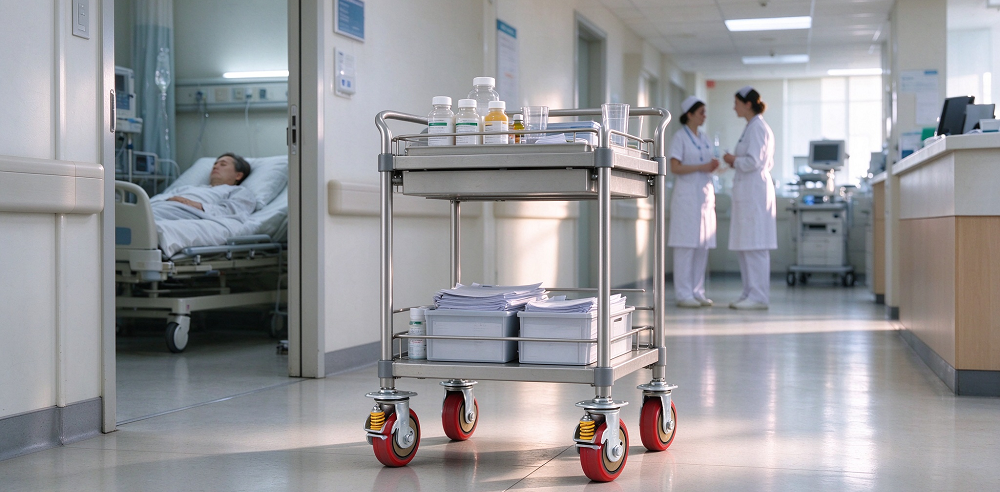
What “Quiet” Actually Means on a Caster
A quiet caster does not mean zero sound. It means no high-frequency squeal, no click-clack over joints, and no ring transmitted up through the frame. Noise on a mobile cart comes from four separate sources, and buyers usually chase the wrong one first:
● Tread contact — the wheel slapping or scrubbing the floor. Hard, narrow treads click over every joint; soft, wide treads roll over them.
● Bearing friction — a dry, rough or undersized bearing whines under load, especially at start-up.
● Swivel raceway — the kingpin raceway squeaks when it dries out or swallows dust and fiber.
● Frame resonance — a thin shelf or cabinet turns one small bump into a ringing panel. The caster only triggers it.
Before you buy new casters, listen once while pushing: is the noise in the wheel, in the swivel, or in the cabinet? Replacing the whole caster because the frame rings wastes money.
Tread Material Is the Biggest Noise Lever
The wheel face touches the floor, and that contact produces most of the audible energy. The same load, the same floor, different treads — very different sound.
| Picture | Tread type | Typical sound | Where it earns its place |
|---|---|---|---|
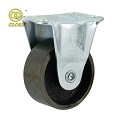 |
Cast iron / forged steel | Ring and clatter on hard joints | Foundry, rough outdoor yard; never on polished indoor floors |
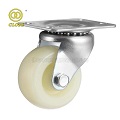 |
Hard nylon / polypropylene | Click-clack, clicks over every seam | Dry light carts where chemical resistance matters; noisy on tile and epoxy |
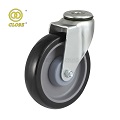 |
Standard polyurethane | Muted hum, clean roll | The default for most indoor carts; protects sealed floors |
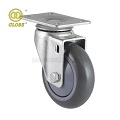 |
Super-quiet polyurethane / soft elastomer | Low roll, almost no click over joints | Corridors, hotels, offices, night shifts; lower load rating than hard treads |
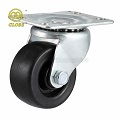 |
Solid rubber / thermoplastic elastomer | Dull thud, absorbs joints well | Outdoor and threshold-heavy paths; heavier roll force indoors |
Softer treads are quieter, but they give up load capacity and wear faster under metal chips. There is no free lunch: a cart that needs to stay quiet in a hospital kitchen is not the same spec as a 400 kg machine dolly on concrete.
Why the Bearing Matters at Start-Up
Rolling noise at speed is mostly the tread. The squeal you notice at the moment you push off is usually the bearing. A plain bore or a dry bushing binds until the cart starts moving, then lets go — that snatch is what people hear as a squeak.
○ Ball bearings start smoothly under load and stay quiet longer.
○ Roller bearings carry more weight but run slightly heavier.
Grease sealed inside a quality raceway lasts years; the noise starts when the seal fails and dust or fiber gets in. In food, textile or packaging areas, contamination is the usual death of a quiet caster, not the bearing itself.
Diameter and Width Also Change the Sound
A small wheel drops into every expansion joint and tile seam. A 75 mm wheel hits a 5 mm crack like a drum. A 150 mm wheel rolls over the same crack you barely feel. If your noise is rhythmic and ties to floor joints, upsizing the wheel diameter often fixes more than changing the tread material.
Width helps the same way. A wide tread spreads impact and smooths joints; a narrow hard tread slaps. On quiet applications, we spec the widest tread the plate will carry rather than the cheapest narrow one.
Swivel Noise Is a Different Problem
If the noise only appears when you turn, the wheel tread is innocent. The swivel raceway is dry or packed with debris. Wash it out, re-lubricate the raceway if the design allows, and watch the brake pedal — a dragging side brake on a dirty fork squeaks even when the wheel rolls free.
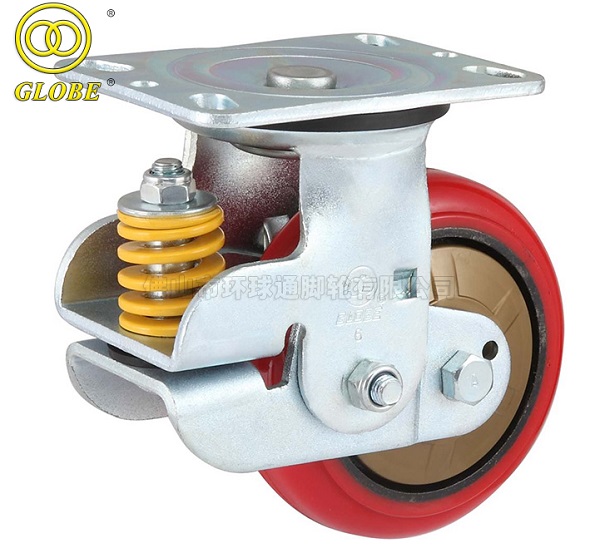
When vibration from a sensitive load is the real worry rather than audible noise, a sprung caster family is the direction. Our EH11 spring-loaded line, for example, uses a 10 mm spring travel in the fork: the EH11-11-125LS-401 runs a 125 × 48 mm wheel at 300 kg per wheel on a 158 × 114 mm plate. It is built for carts crossing pallet edges and dock plates where an unsprung wheel thumps. That is a vibration question first and a noise question second.
Common Misconceptions
● “Any polyurethane wheel is quiet.” Hard, thin, cast PU on a chip-filled floor still clicks. Compound and width matter as much as the material family.
● “Lubrication fixes everything.” Oil on a worn raceway masks it for a week. If the balls are pitted, the caster needs replacing.
● “Bigger wheels are louder.” On smooth floors a bigger, softer wheel is usually quieter; it stops banging joints.
● “Quiet casters carry the same load.” Softer treads trade capacity for noise. Check the per-wheel rating again after you switch compound.
Worked Selection Example
A dietary trolley runs roughly 800 kg loaded at dinner service, on sealed hospital corridor tile, three rounds a night.
○ Four wheels means 200 kg per wheel before margin.800÷4=200Kg
○ With a 1.3 floor and start-up factor, spec for about 260 kg per wheel — not 200.
○ A ball-bearing, soft-PU tread in the 125–150 mm range on a quiet compound clears that rating and drops the joint click.
○ If the route crosses outside asphalt between buildings, step to a rubber tread instead and accept slightly higher push force.
Per-wheel load math always follows the same rule: gross weight divided by four, then a working margin. ISO 22883 describes the industrial caster test framework these ratings sit within as an industry reference; our own held certifications are ISO 9001 and ISO 14001.
How to Specify Quiet Casters Right Now
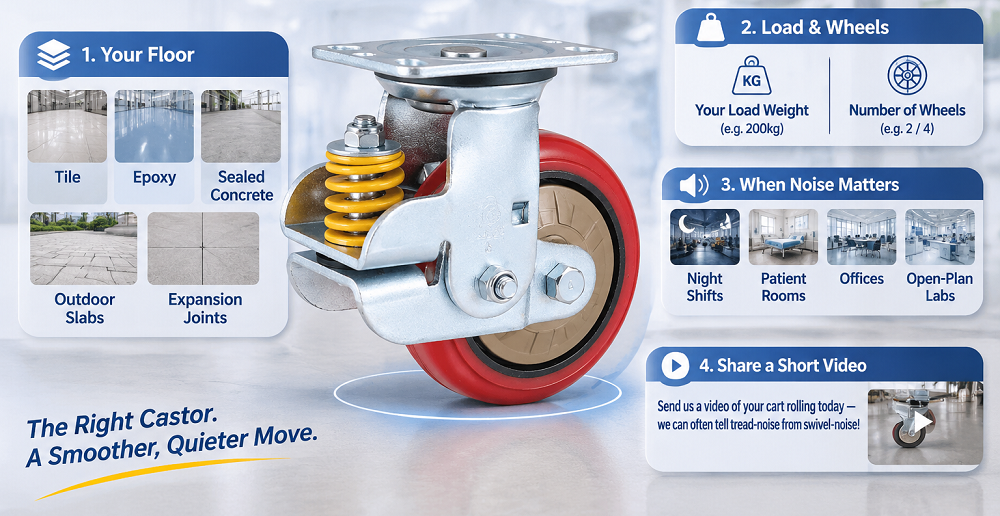
1.List the floor: tile, epoxy, sealed concrete, outdoor slabs, expansion joints.
2.Give the loaded gross weight and how many wheels.
3.State when noise matters: night shifts, patient rooms, offices, open-plan labs.
4.Send one short video of the cart rolling today — we can usually tell tread-noise from swivel-noise from recording alone.
If your existing casters are under two years old and the noise is new, clean and re-lubricate the swivel raceway first. Throwing new quiet casters at a dry raceway is a waste.
How Globe Caster Helps
Foshan Global Caster Co., Ltd, Guangdong, China has built casters since 1988 on about 156,000 m², with 500-plus employees and in-house stamping, injection moulding and PU pouring. We run super-quiet polyurethane tread options across our medium and heavy plate lines, and we ship sample swivel, rigid and braked pairs so you can test on your own corridor before a program order. Mixed SKU shipments, OEM labelling and a one-year warranty under normal use are standard; typical lead time is about 30 days.

Send the Floor, the Load and the Sound
Tell us the loaded cart weight, the floor material, and when the noise happens (start-up, joints, turning, all the time). We reply with the tread compound, wheel diameter and bearing type we would spec, plus the per-wheel rating it clears. If your floor is smooth and the cart is light, we will tell you the cheaper option is enough.For more information, please click here to contact us.
Post time: Nov-06-2026