
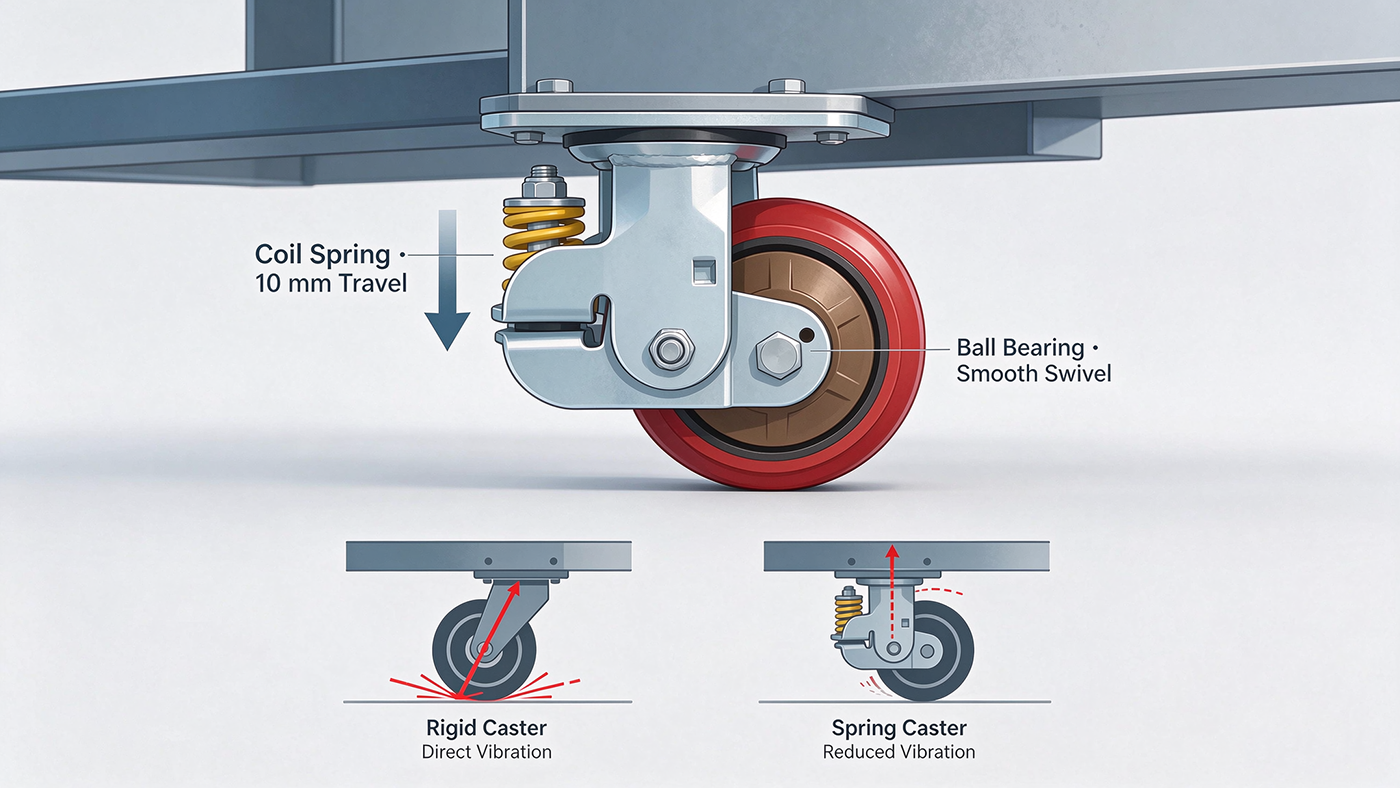
A standard rigid caster transmits every floor seam, threshold and joint straight up into the frame. On an instrument cart, a machine relocation trolley or a packed pallet rack, that vibration shakes loose fasteners, rattles panels and can damage the load. A spring loaded caster puts a coil spring between the wheel and the bracket so the spring compresses over the bump instead of the chassis absorbing it.
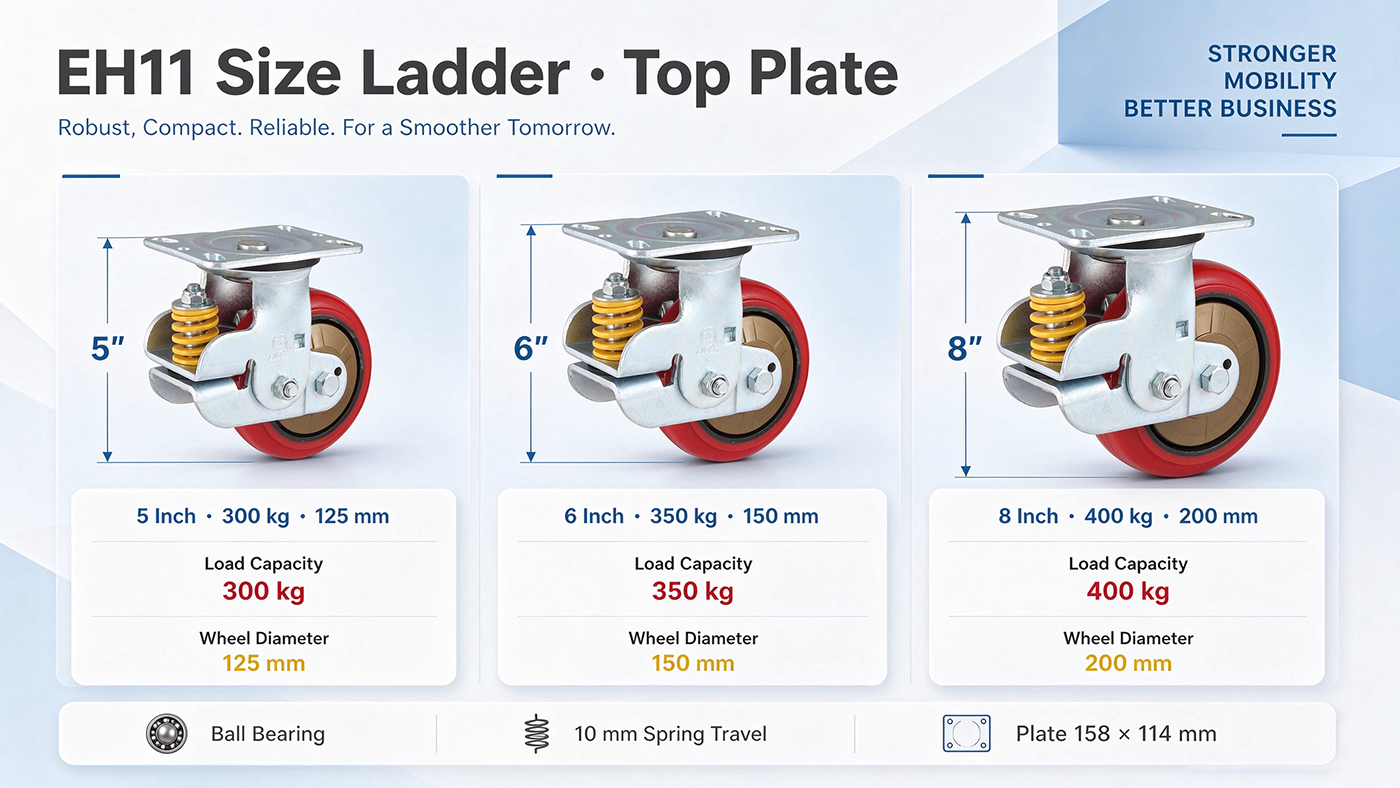
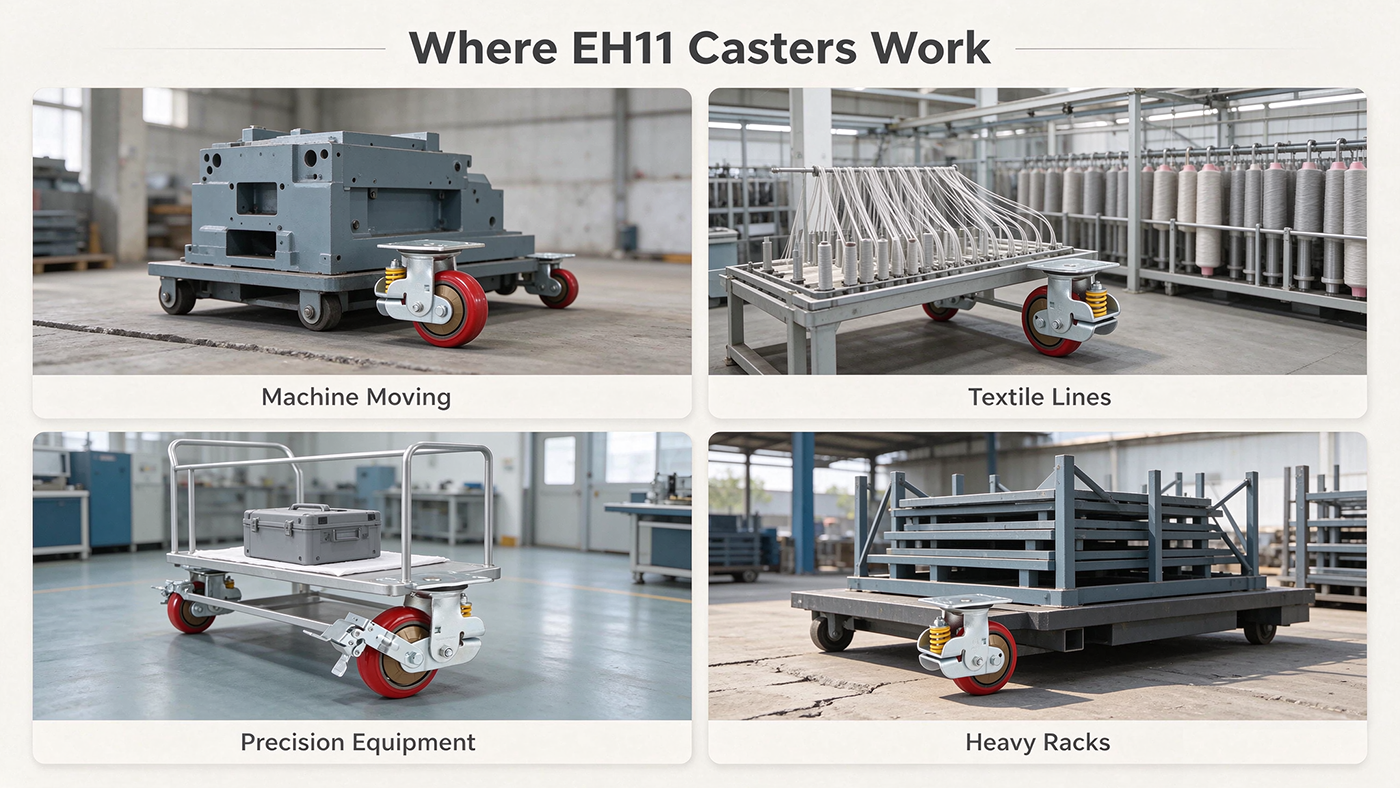
The EH11 family is a heavy-duty shock absorbing caster built on a top-plate mounting, ball bearing and welded steel fork, sized 5 to 8 inches for machinery moving carts, textile and fiber lines, and equipment carrying vibration-sensitive goods. These spring loaded castors are specified where a standard caster would pass floor vibration straight into the frame. The 6-inch iron-core polyurethane swivel is the general-purpose model in the range, and the size ladder below carries every mounting dimension from the specification sheet.
Who Makes These
Foshan Global Caster Co., Ltd, Guangdong, China has manufactured casters and wheels since 1988. The plant covers about 156,000 m² with 500-plus staff and in-house stamping, injection moulding and PU pouring, outputting roughly ten million casters a year. The catalogue holds 21,000-plus models, 600-plus of them as standing stock, certified to ISO 9001 and ISO 14001, with over 100 patents. The EH11 line is built on that in-house stamping and moulding, not sourced and relabelled.
Flagship Model: EH11-11-150LS-401
This is the 6-inch (150 mm) swivel, iron-core polyurethane tread in red on a ball bearing, blue-zinc welded steel fork, top-plate mount. It is the size most machine-moving carts and heavy equipment trolleys land on when the route crosses concrete joints, thresholds and uneven warehouse floors and the load cannot take a hard jolt.
| Item | Specification |
|---|---|
| Swivel SKU | EH11-11-150LS-401 |
| Wheel diameter × width | 150 × 48 mm |
| Load capacity | 350 kg per wheel |
| Tread | Iron-core polyurethane, red |
| Bearing | Ball bearing |
| Spring travel | 10 mm |
| Mounting height | 194 mm |
| Swivel radius | 125 mm |
| Top plate | 158 × 114 mm |
| Hole spacing | 128 × 73 mm |
| Hole diameter | 13 mm |
| Rigid counterpart | EH11-11-150LR-401 |
Full Size Ladder — Top Plate
Same heavy-duty shock-absorbing fork family across the range, ball bearing and blue-zinc finish on every size. Each diameter ships as swivel (LS) or rigid (LR) on the same plate footprint. Load figures below are per wheel. The polyurethane tread runs 48 mm wide; the rubber-core treads run 50 mm wide at the same diameter.
| Wheel | Ø × width (mm) | Load / wheel (kg) | Bearing | Mounting height (mm) | Swivel radius (mm) | Spring travel (mm) | Plate (mm) | Hole spacing (mm) | Hole dia (mm) |
|---|---|---|---|---|---|---|---|---|---|
| 5 inch | 125 × 48 / 50 | 300 | Ball | 182 | 112 | 10 | 158 × 114 | 128 × 73 | 13 |
| 6 inch | 150 × 48 / 50 | 350 | Ball | 194 | 125 | 10 | 158 × 114 | 128 × 73 | 13 |
| 8 inch | 200 × 48 / 50 | 400 | Ball | 243 | 163 | 10 | 158 × 114 | 128 × 73 | 13 |
Tread Choices at the Same Size
Within each diameter the same spring fork pairs with five tread families. The floor, noise and abrasion duty drive the choice rather than the price of the bracket:
- Iron-core polyurethane, red (401) — resilient roll on an iron core, protects smooth concrete and epoxy, balances wear and push force. The flagship 6-inch uses this tread.
- Iron-core polyurethane, yellow (403) — same iron-core PU construction in a yellow tread for line identification or customer colour coding.
- Nylon-core premium rubber (606) — rubber over a nylon core for a softer, quieter roll on smooth and semi-rough floors.
- Nylon-core super-quiet rubber (608) — softer rubber tread for areas where rolling noise matters, such as assembly bays and indoor equipment rooms.
- Aluminium-core rubber (614) — rubber over an aluminium core for lighter rolling weight where the load still calls for a rubber tyre.
What You Are Pay For Under the Skin
Coil spring between fork and chassis
The spring sits in the bracket above the wheel. As the caster crosses a joint or a crack, the spring compresses and absorbs the impact energy before it reaches the equipment frame. The 10 mm spring travel is what lets the wheel follow the floor without slamming the load into the stop. Above the rated per-wheel load the spring bottoms out and the caster behaves like a standard wheel, so the rating has to cover the worst corner, not the average.
Ball bearing for easy swivel at heavy loads
The EH11 uses a ball bearing. At this load a ball race turns smoothly and starts rolling easily at walking pace, which matters on a cart that has to be pushed around a machine bay. The welded fork spreads the load across the top plate rather than into a thin stamped bracket.
Plate and hole pattern
The 158 × 114 mm plate spreads the point load across the chassis rail. The 128 × 73 mm hole spacing and 13 mm holes match the heavy-duty plate pattern. Bolt to the frame builder’s tube gauge, not to a tighter torque than the frame itself carries.
Spring-loaded caster, not a gate wheel
The phrase “spring loaded” also appears on heavy gate wheels that hold a gate open or absorb a closing shock. Those are a different product with a different bracket and rating. This page covers industrial shock-absorbing castors for equipment and carts. If your job is a gate or a dock door, tell us the gate weight and opening track before assuming this fork fits.
Worked Load Example
A machine-relocation trolley carries 1,200 kg including its own frame. Four casters: 1,200 ÷ 4 = 300 kg per wheel under even loading. The 5-inch model at 300 kg per wheel sits right at the line, so we would take the 6-inch at 350 kg to leave headroom for an uneven corner, a loaded push over a joint and daily traffic. If the worst corner runs above 350 kg per wheel, move to the 8-inch at 400 kg rather than running four 6-inch wheels past their rating.
If your current standard casters roll fine after three years on a level floor and the load is not vibration-sensitive, you probably do not need a spring-loaded series. The spring adds mounting height and cost, and it only earns its place where bumps actually reach the product.
Where These Belong
- Machine relocation and installation carts carrying heavy equipment across concrete joints and thresholds.
- Textile and fiber lines where the caster must resist thread and fiber wrap around the wheel.
- Precision equipment and instrument carts that cannot take a hard jolt in transit.
- Heavy platform trucks and racks repositioned over uneven indoor and semi-outdoor floors.
When To Pick Something Else
For smooth, level floors with light loads, a medium-duty standard caster covers the job without the added height and cost of the spring. On rough slag or long-distance gravel yards, an iron-core PU tread wears faster than a phenolic or cast-iron tyre; match the tread to the floor first. For washdown or corrosive areas, this blue-zinc line is not the corrosion-resistant answer, and a dedicated corrosion-protected family is the right direction. For outdoor docks exposed to weather, check the bracket finish and tread compound with us before ordering.
FAQ
What does a spring loaded caster actually absorb?
The spring compresses over floor joints, cracks and thresholds, taking the shock off the equipment frame and the load above it. It reduces vibration transfer and impact jolt; it does not lower the static weight the wheel and bearing must carry.
How much spring travel does the EH11 have?
10 mm across the 125, 150 and 200 mm sizes listed here. The spring bottoms out above the per-wheel rating, so the load per corner still has to sit under the rated capacity.
Swivel or rigid on which corners?
Two swivel at the steering end and two rigid at the trailing end for hand-pushed heavy trolleys. Four swivels are used where the cart has to turn in tight cells; pair them with the layout the machine builder specifies.
Does this series have braked versions?
The EH11 shock-absorbing castor range shown here lists swivel (LS) and rigid (LR) top-plate models. A braked shock-absorbing variant depends on the bracket and tread you need; send the load and floor and we confirm whether a brake SKU exists rather than assuming one transfers over.
How do I read the EH11-11 code?
The first digit after the series is the bearing: 1 is ball bearing. The second digit is the bracket finish: 1 is blue zinc. The LS and LR are the shock-absorbing swivel and rigid brackets. The trailing three digits are the tread family.
Can the plate hole pattern be changed?
The 158 × 114 mm plate, 128 × 73 mm spacing and 13 mm holes are the standard pattern. Other hole patterns or mounts go through OEM/ODM; send the drawing and we confirm feasibility before quoting.
Lead time and warranty?
One-year warranty under normal use; standard lead time about 30 days, with 600-plus catalogue models held as stock. We reply with a quote and a 2D drawing for the exact SKU you select.
Send Us the Load and Floor, We Quote the SKU
Tell us the loaded weight, floor material, available mounting height, plate or stem, and whether the load is vibration-sensitive. We reply with the wheel size, the per-wheel rating after margin, and sample SKUs to trial on one cart. If a standard non-spring series covers the job, we say so.
Post time: Nov-23-2026