
Stainless Steel Casters: 304 vs 316, When You Need Them, and What We Supply
Most caster brackets are pressed from zinc-plated steel. That works in a dry warehouse, but the day you wash a cart down with hot water, or roll it through a chemical plant, or leave it outside by the coast, zinc plating starts to fail — white rust on the swivel raceway, orange streaks on the bracket, and eventually a frozen swivel that nobody can turn. When that happens, the question is not whether you need a stainless steel caster. The question is whether you need 304 or 316, and whether the rest of the wheel (bearing, axle, brake) is also stainless or just the bracket.
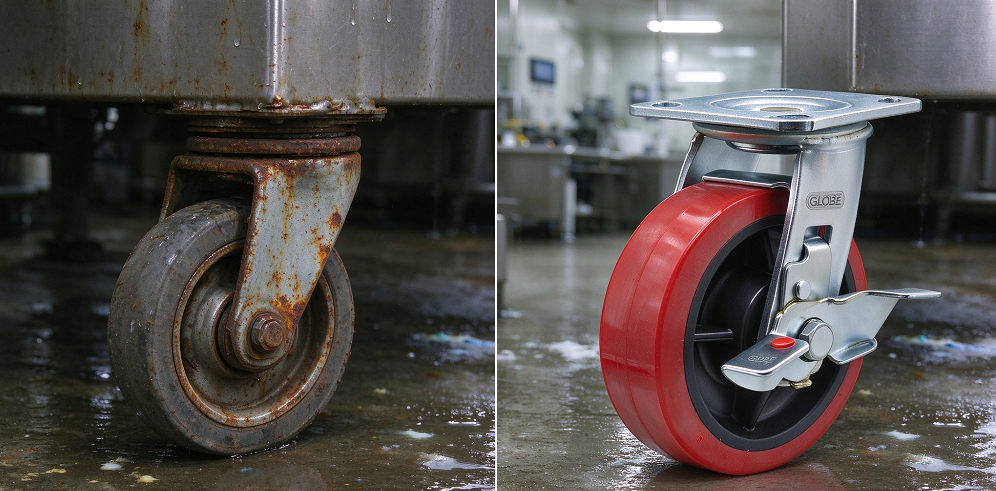
This page explains what a stainless steel caster actually is, the difference between 304 and 316, the situations where paying for stainless is worth it, and what we can supply from our EH8 heavy-duty series — plus where the honest gaps are.
Why Buyers Choose Stainless Steel Casters
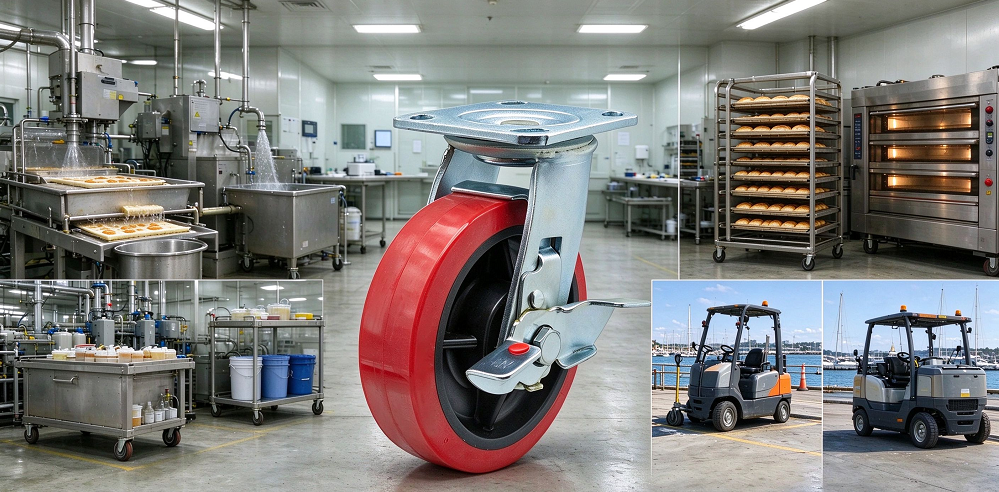
A stainless caster is not a “premium” caster for its own sake. It is the right choice when the operating environment will attack a zinc-plated bracket. The four environments where our customers consistently specify stainless are:
- Food and beverage washdown areas — hot water, detergents, and weekly chemical sanitation cycles eat zinc plating within months.
- Chemical processing and pharma — acid or alkaline vapors, spillage, and strict washdown protocols.
- Coastal and outdoor equipment — salt air corrodes ordinary zinc brackets in one season.
- Medical and cleanroom — where orange rust on a swivel raceway is an immediate contamination fail.
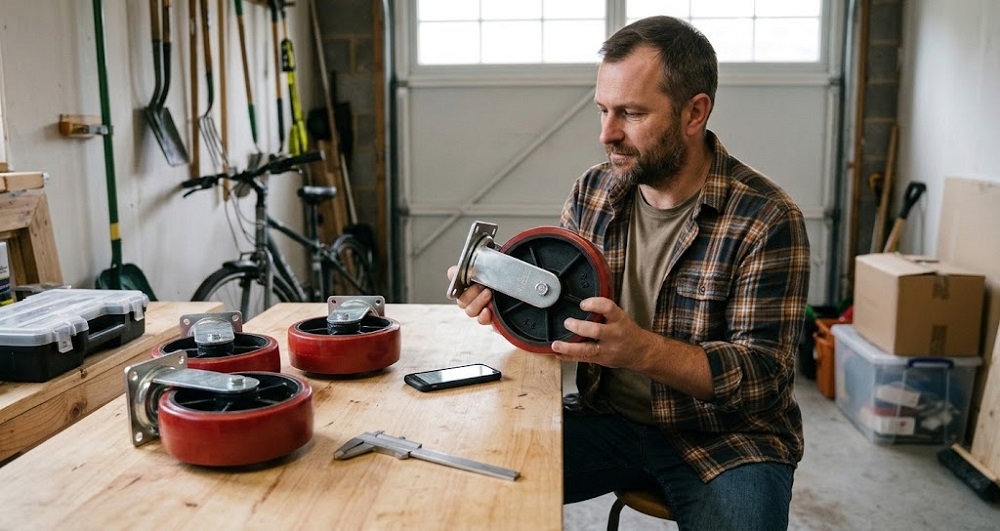
If none of these describe your application, a zinc-plated EH8 wheel at the standard price is the more sensible buy. Stainless costs more and is slightly stiffer to swivel because the material is harder.
304 vs 316 Stainless — What Actually Differs
| Property | 304 Stainless | 316 Stainless |
|---|---|---|
| Standard use | Food washdown, indoor wet areas, cleanrooms | Coastal / marine, chemical splash, chloride exposure |
| Molybdenum content | None | 2–3% (the element that resists chloride pitting) |
| Resists | Water, detergents, most food chemicals | Salt spray, chlorides, bleach, harsh acids |
| Cost | Standard stainless premium | Higher still |
| Our standard offering | Yes — on request, matching EH8 plate layout | On request — quote per project |
The practical rule we tell buyers: if your cart is washed with hot water and detergent inside a food plant, 304 is enough. If it sits by the sea, rolls through bleach, or touches salt brine, step up to 316. Do not pay for 316 just to be safe — the difference is real but not free.
What “Stainless” Actually Covers — Ask the Whole Story
Not every “stainless caster” is fully stainless. This is where buyers get caught:
- Bracket only stainless — the swivel horn and top plate are 304, but the axle bolt, ball bearing and brake spring are still zinc-plated steel. The first thing to corrode is the bearing.
- Bracket and fasteners stainless — axle and washers match, but the ball bearing races are still carbon steel.
- Fully stainless — bracket, swivel raceway, balls, axle, brake pedal and brake spring all stainless. This is what you actually want in a washdown environment.
When you ask for a stainless caster, ask which of these three you are getting. A “stainless bracket” with a carbon bearing will still freeze in six months.
Our EH8 Stainless Option — Reference Dimensions
We build stainless versions of our EH8 heavy-duty series on the same top-plate layout as our standard zinc-plated EH08-11-125S-402. The plate and hole pattern are identical, so a machine designed for the standard plate can switch to stainless without re-drilling. Below are the reference dimensions from our standard EH8 5-inch unit; the stainless version shares this layout.
| Parameter | Standard EH08-11-125S-402 (zinc-plated, for reference) | Stainless version (EH8 series, on request) |
|---|---|---|
| Wheel diameter | 125 mm (5″) | 125 mm (5″) — same layout |
| Wheel width | 45 mm | 45 mm — same layout |
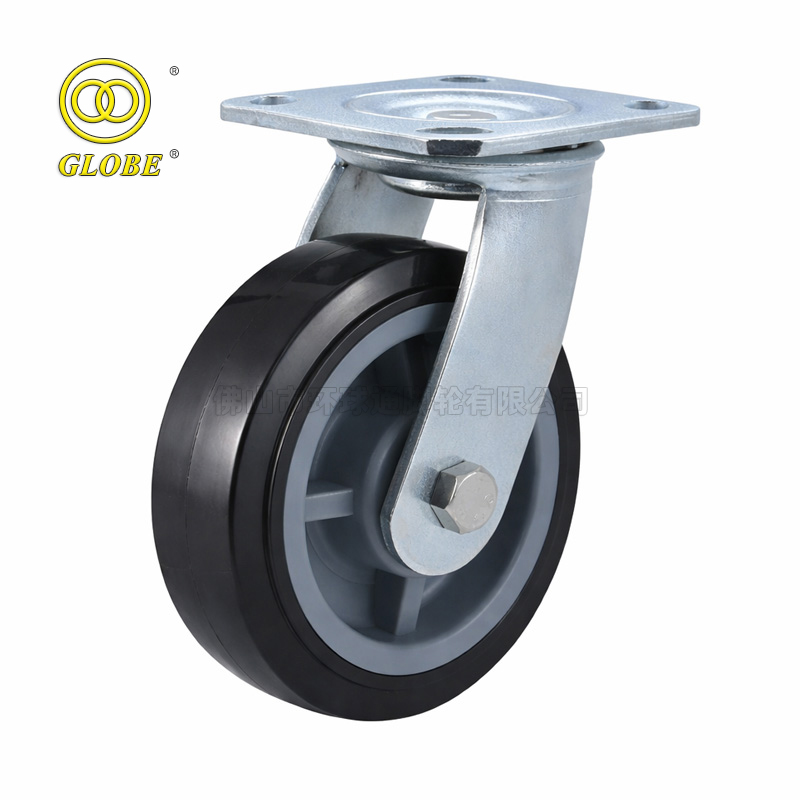
| Tread | Iron-core polyurethane (PU), red | PU as standard; TPR or on request |
| Bearing | Ball bearing, carbon steel races | Stainless ball races available on request |
| Load capacity per wheel | 250 kg | On request (rated per configuration) |
| Mounting height | 165 mm | 165 mm — same layout |
| Swivel radius | 96 mm | 96 mm — same layout |
| Top plate | 114 × 100 mm | 114 × 100 mm — same layout |
| Hole spacing (center-to-center) | 84 × 71 mm | 84 × 71 mm — same layout |
| Hole diameter | 11 mm | 11 mm — same layout |
| Bracket material | Blue zinc-plated steel | 304 stainless standard; 316 on request |
| Picture | 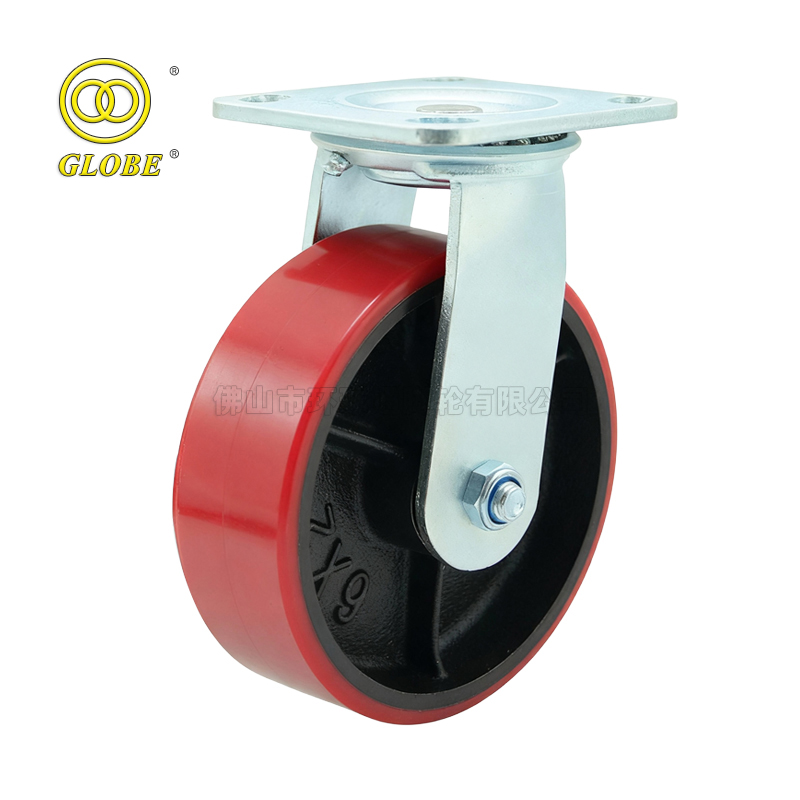 |
 |
Available Bracket Styles — Same Plate, Different Controls
On the same 114 × 100 mm plate, we can supply the EH8 series in four control styles. Mix and match on the same machine — they all bolt into the same holes.
| Code | Style | What It Locks | picture |
|---|---|---|---|
| S | Swivel | Nothing — free swivel | 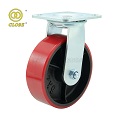 |
| R | Rigid (fixed) | Fixed direction, no swivel | 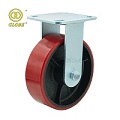 |
| SB | Swivel with metal total lock | Both swivel and wheel | 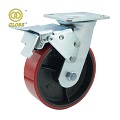 |
| SC | Swivel with side brake | Wheel only, swivel stays free | 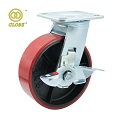 |
All four are available in the stainless build. Tell us which combination you want — for a 4-wheel cart, the standard layout is 2 swivel + 2 rigid, or 2 total-lock swivel + 2 rigid if operators need to lock position.
Typical Applications
- Food processing carts — washdown trolleys, ingredient racks, mobile washing stations.
- Bakery and pastry equipment — proofing racks, oven carts that move between hot and washdown zones.
- Chemical plant carts — sample transport, barrel dollies, station trolleys exposed to splash.
- Coastal equipment — beach cleanup carts, marina maintenance trolleys, outdoor kiosks.
- Pharma and cleanroom — mobile benches, trolley systems where rust particles are a contamination risk.
Installation — The 5 Steps
- Confirm your loaded cart weight and divide by 4 to get load per wheel. Apply the 1.3 safety factor. (Example: a 700 kg cart ÷ 4 = 175 kg per wheel × 1.3 ≈ 228 kg. Our 250 kg/wheel rating covers it.)
- Drill four 11 mm holes on an 84 × 71 mm center-to-center pattern on your 114 × 100 mm plate.
- Bolt the caster plate to the cart frame with M10 bolts and flat washers. Torque to the frame maker’s spec.
- For a 4-wheel cart, fit 2 swivel at one end and 2 rigid at the other — this is the layout that pushes straightest. If you need to lock the cart, use 2 SB (total lock) swivel at the handle end.
- Run a loaded test push before going into service. Check that the swivel turns freely under full load and that the brake pedal engages with a firm click.
Frequently Asked Questions
1. Is a stainless steel caster worth the extra cost over zinc-plated?
Only if your environment attacks zinc. In a dry warehouse, no. In a washdown food plant, on the coast, or near chemical splash, yes — the stainless bracket will outlast a zinc-plated one by years.
2. Do you offer FDA or food-contact certification for the PU tread?
Our red PU tread is commonly used on European food-industry equipment. We do not make a FDA food-contact claim on the tread itself. If your customer requires a certified food-contact material for audit purposes, tell us the standard they are audited against and we will confirm honestly whether our tread meets it or not.
3. Can you supply 316 stainless for coastal / marine use?
Yes, on request. 316 carries a price premium and a slightly longer lead time. Tell us your salt exposure and we will quote 304 and 316 side by side so you can decide.
4. Is the bearing also stainless, or just the bracket?
Standard stainless version: bracket, plate, axle and brake hardware in 304; bearing races are carbon steel. Fully stainless bearing races are available on request. In a washdown environment, specify the fully stainless bearing — otherwise the raceway is the first part to rust.
5. What is the lead time for stainless units?
Standard EH8 units are in stock for the zinc-plated version. Stainless versions are made to order. Typical lead time is on request — send us the quantity and bracket style and we will confirm. We will not quote a number we cannot hold.
About Globe Caster
Globe Caster — Foshan Global Caster Co., Ltd, Guangdong, China — has manufactured casters and castors since 1988. Our 156,000 m² facility runs in-house stamping, injection molding and PU pouring. 600+ standard SKUs in stock, 21,000+ catalog models, ISO 9001 and ISO 14001 certified, exporting to North America, Europe, Southeast Asia and the Middle East. 12-month warranty, 30-day lead time, OEM and private label welcome.
Need a Stainless Steel Caster Quote?
Tell us: your loaded weight per wheel, the washdown or chemical environment, whether you need 304 or 316, and whether you need fully stainless bearings. We will reply within one business day with a quotation and a 2D drawing for your plate layout. Sample units available on request for washdown testing.
Post time: Oct-26-2026