
A loaded cart sits still on paper. You press the pedal. You walk away. Then someone brushes against it and the whole thing pivots on one unlocked swivel — because the brake you fitted only stopped the wheel rolling, not the castor turning.
This is the most common brake mistake we see. “Locking castors” is not one thing. Foot brakes, total locks and directional locks do three different jobs, and choosing the wrong one is why carts still move after you thought you had braked them.
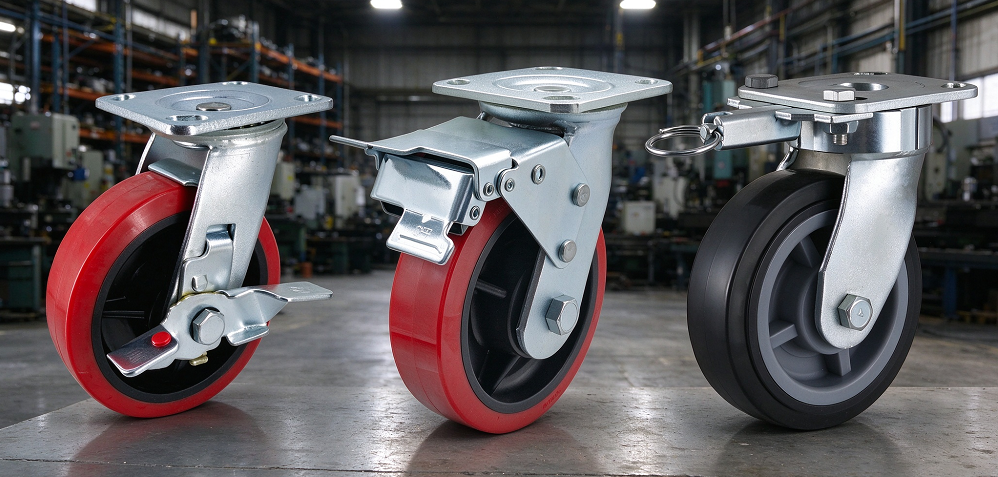
What a Castor Brake Actually Does
A swivel caster has two moving parts.
1.The wheel spins around its axle to roll.
2.The whole fork turns around the kingpin to steer.
A brake can act on either or both.
Industry standard definition:
○ ISO 22883 (current edition) sets the requirements and tests for industrial castors and wheels;
○ The ANSI/ICWM terminology standards define how the industry names each brake type.
The names matter — a customer asking for “braked castors” and a factory hearing “wheel stop” will ship the wrong part.
The Three Brake Types
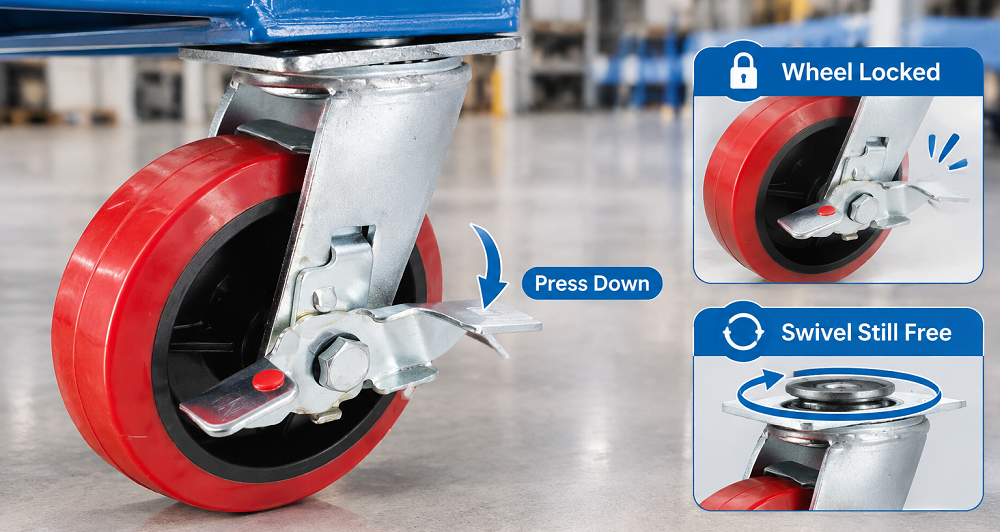
Side brake / pedal lock (wheel only)
You press a cam against the tread or the wheel hub. The wheel stops rolling. The swivel raceway under the fork stays free, so the cart can still rotate in place around that leg. This is the cheapest, lightest-duty brake and it is what most cheap furniture castors use.
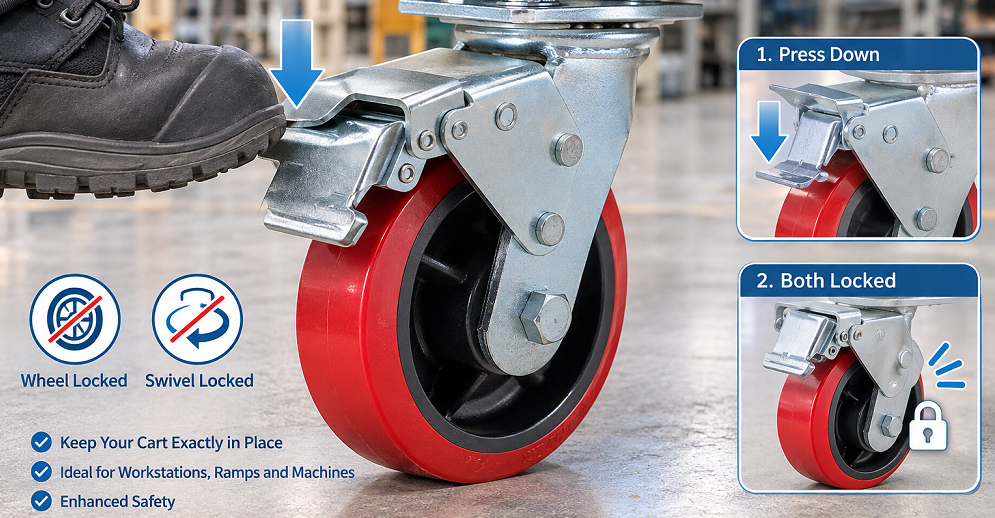
Total lock / double lock (wheel + swivel)
One pedal press locks both the rolling wheel and the swivel fork at the same time. The leg becomes rigid — it neither rolls nor turns. This is the brake you want when a cart must stay exactly where it is at a work cell, on a slight ramp, or beside a machine.
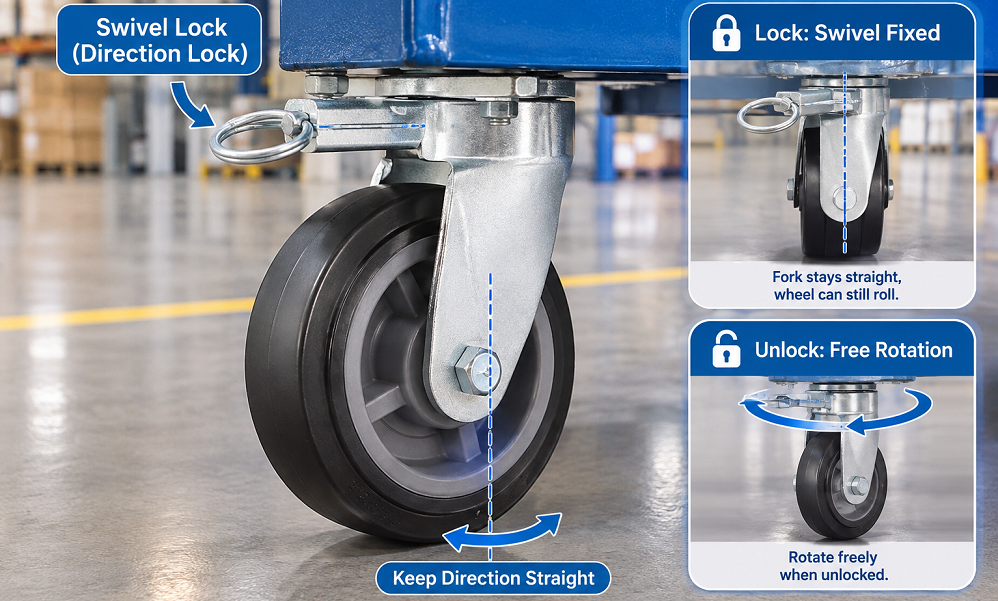
Directional lock (swivel lock only)
This one deliberately does not stop the wheel. It pins the swivel fork straight ahead so the castor behaves like a rigid. Use it on a cart that gets towed along a long straight line and would otherwise wander and “crash-steer”. Unlock it later to turn the cart.
| Brake type | Locks wheel roll? | Locks swivel turn? | Best for |
|---|---|---|---|
| Side / pedal brake | Yes | No | Light carts on flat floors, occasional parking |
| Total / double lock | Yes | Yes | Work-cell carts, slight ramps, keeping position loaded |
| Directional lock | No | Yes (to straight-ahead) | Towed straight-line runs, anti-wander |
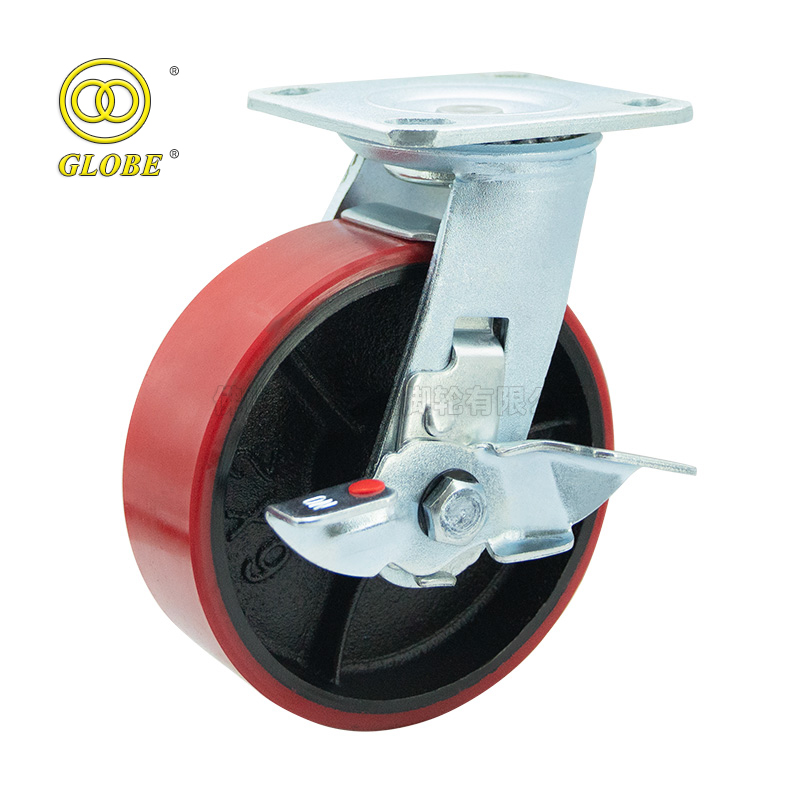
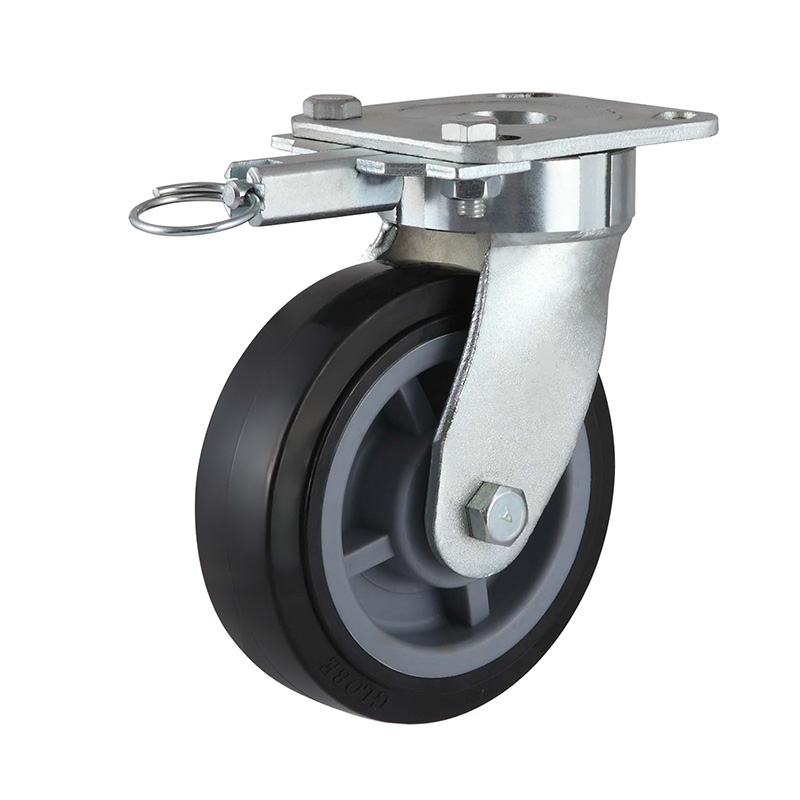
How To Tell Which One You Have
● Look at the pedal. If pressing it jams the tyre against a fixed stop, it is a side brake — try twisting the fork by hand after you brake; if it still rotates, you have just confirmed the limit.
● A total lock has the pedal acting through a linkage that also drops a pin or wedge into the swivel raceway; braked, the whole leg feels solid.
● A directional lock is usually a small side lever, not a pedal — flip it and the fork clicks straight but the wheel still rolls freely.
Common Mistakes
1.Putting side brakes on all four swivels and calling it locked. On a sloped or bumped floor the cart still slews. If you need the cart to stay put, fit total locks — not four weaker wheel-only brakes.
2. Braking the trailing rigid corners. Rigid casters do not swivel, so a brake on them stops roll but adds nothing to positioning. Brakes belong on the swivel legs where control matters.
3. Using brakes as a tow-line solution. On a tugged line you do not want every cart braked — you want the swivels locked straight (directional lock). A total-locked cart on a tow line will fight the tractor.
4. Assuming a braked caster holds on an incline. Brake ratings are for holding a stopped cart on a shallow grade, not for parking loaded trailers on docks. Check the incline against the caster rating before trusting it.
Worked Example
A work-cell cart weighs 200 kg loaded, on four plate castors.
○ Per wheel: 200 ÷ 4 = 50 kg.
○ A medium ED01 plate family at 80 kg per wheel covers it.
Fit two swivels with total locks at the steering end and two rigid casters at the trailing end. Press the two pedals at the cell — both roll and swivel lock, the cart cannot slew, and when it is time to move you flip both pedals and push. The total-lock version of that 100 mm swivel is built on the same bracket as the standard swivel; the side-brake version on the same bracket exists as a lighter-cost option for flat-floor work.
When You Do Not Need Brakes
▲ If your cart is always moving on a flat level floor and never parked beside a machine, skip brakes — they add a pedal to break and a place for swarf to catch.
▲ If you only need straight-line towing, a directional lock on the swivels beats total locks.
▲ And if the floor has any real slope, do not solve it with a stronger pedal: solve it with a wheel lock rated for that grade, or a chocked stand. A brake is a parking aid, not a hill-holder.
Who Makes These
Foshan Global Caster Co., Ltd, Guangdong, China has manufactured casters since 1988. The plant covers about 156,000 m² with 500-plus staff and in-house stamping, injection moulding and PU pouring, outputting roughly ten million casters a year. The catalogue holds 21,000-plus models, 600-plus of them as standing stock, certified to ISO 9001 and ISO 14001, with over 100 patents. The EK01 line is built on that in-house stamping and moulding, not sourced and relabelled.

FAQ
Is “brake” the same as “lock” on a caster?
Not always. A side brake locks the rolling wheel only; a total lock also locks the swivel. Ask which one the supplier means before ordering.
Do I need brakes on every caster?
No. On a 4-caster cart, braking the two swivels is usually enough; rigid legs already resist steering.
Can I add a brake to a caster I already have?
Only if the bracket was engineered for that linkage. A brake is not an accessory bolted on after purchase.
What does “total lock” actually pin?
Both the wheel roll and the swivel rotation, so the locked leg cannot move in any direction.
Send the cart weight, floor, maximum ramp, and whether the cart gets pushed or towed. We reply with which brake type goes on which corner, the per-wheel rating, and sample SKUs. If a cheaper side brake covers your job, we say so.
Post time: Nov-10-2026