
A workbench has to stand still while someone leans on a vise, and roll away to another bay when the line changes. The casters decide whether it does both. Pick a wheel that will not hold position and the bench rocks under load; pick one that will not turn freely and moving it is a fight. Either complaint lands on the bench maker, not on the wheel supplier they bought from once.
This account follows how an overseas workbench and workstation manufacturer built a repeatable set of workbench casters for its own product range, from enquiry through factory visit, sample fitting, local testing and SKU-level confirmation. The same process applies to tool stands, assembly stations and packing tables.
About the Customer
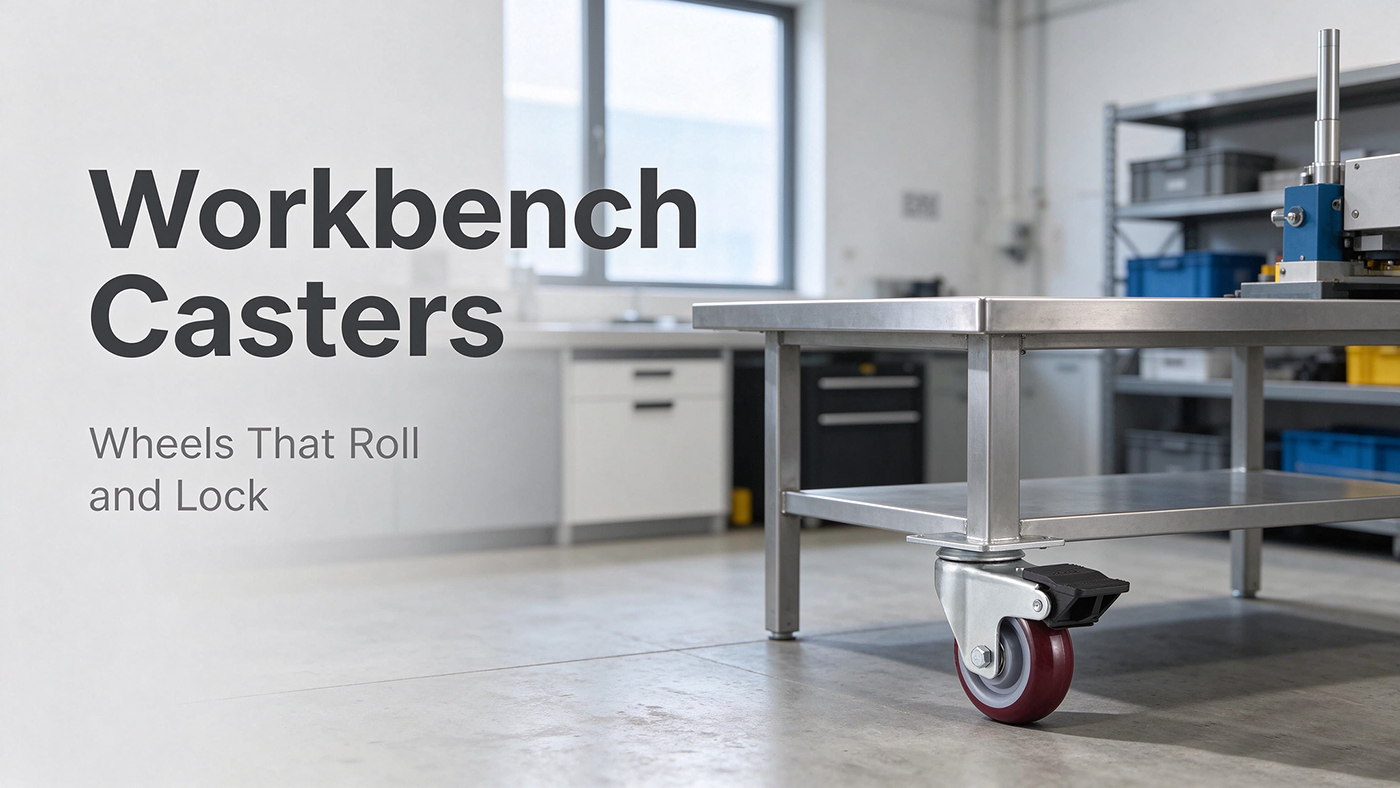
The customer makes fixed-height and modular workbenches, tool trolleys and assembly workstations, sold under its own brand to distributors and industrial end users. The wheels are fitted onto the bench frame before it leaves the factory, so a consistent fit and feel across every unit in a production run matters as much as the caster’s own rating. Some benches travel between bays during the day; most lock in one position and take standing load for hours at a time.
What They Needed
The opening request covered a small family of fittings rather than one model. They wanted:
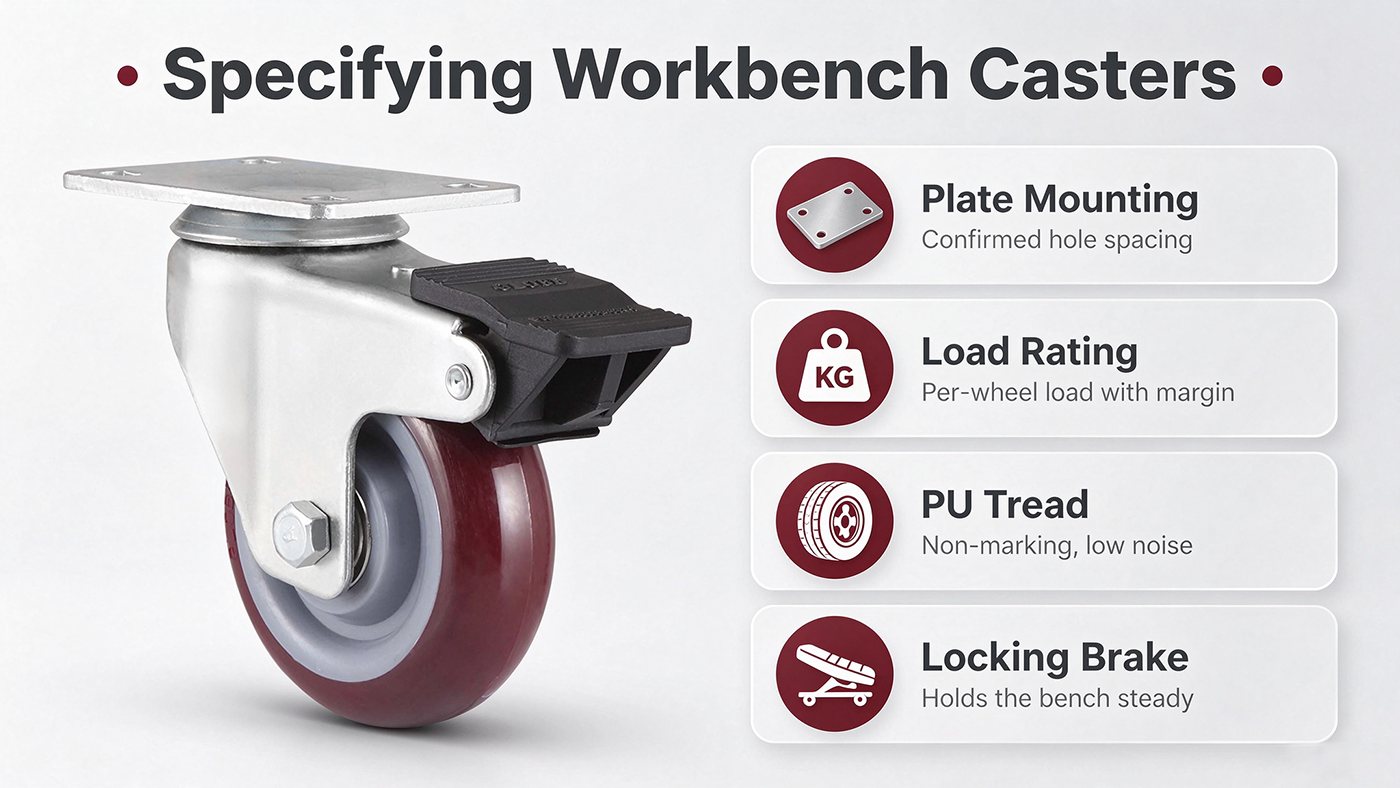
- Mounting that matches the bench frame their own bending and drilling line produces — either a top plate with a confirmed hole spacing, or a threaded stem to the tube size they use.
- Per-wheel ratings sized to each bench’s loaded weight, with margin for a vise, an overhanging drawer or an uneven corner on a concrete or sealed shop floor.
- A tread that does not mark the finished floor and keeps roll noise down where operators work close to the bench.
- A brake that holds the bench steady once locked, with a pedal that is easy to press standing up; a consistent swivel feel across the range.
- Batch-to-batch consistency and packing that fits their own assembly line and export carton flow.
How We Met
The enquiry came through our export channel after the manufacturer compared several suppliers. The first exchange was load and duty information, not a unit price. We asked what the bench carried, how often it moved, the floor surface, the mounting on the frame, the wheel diameter the design allowed, and whether the bench needed to lock in place. A workbench caster chosen on price alone can leave the frame under-bracketed, and a rating on paper does not help if the stem or plate does not fit.
Factory Visit
On the factory visit they walked the internal flow: bracket stamping, injection moulding for nylon and polyolefin wheels, PU pouring and tread bonding, bearing and raceway assembly, final inspection and packing. They could see how a plate is formed, how a resilient tread bonds to its core, and how a finished leg is checked before it goes into a carton.
Foshan Global Caster Co., Ltd, Guangdong, China has manufactured casters and wheels since 1988. The plant covers about 156,000 m² with 500-plus staff and in-house stamping, injection moulding and PU pouring, outputting roughly ten million casters a year. The catalogue holds 21,000-plus models, 600-plus of them as standing stock, certified to ISO 9001 and ISO 14001, with over 100 patents. Wheel and bracket testing follows the basis set out in ISO 22883 (current edition) and the ANSI/ICWM terminology and test framework; these are industry references, not a claim that either standard certifies any single bench.
Choosing Samples
We did not send the widest catalogue. From their bench list we shortlisted swivel and rigid legs for the different frames, brake variants where the bench has to hold position, and treads matched to each floor condition. Heavier stands took a roller-bearing option; lighter benches ran a ball-bearing or bushing leg. Each sample carton carried the diameter, tread, fitting type, bracket finish and brake type, so their engineering team could match it to the frame drawing later.
Testing Locally
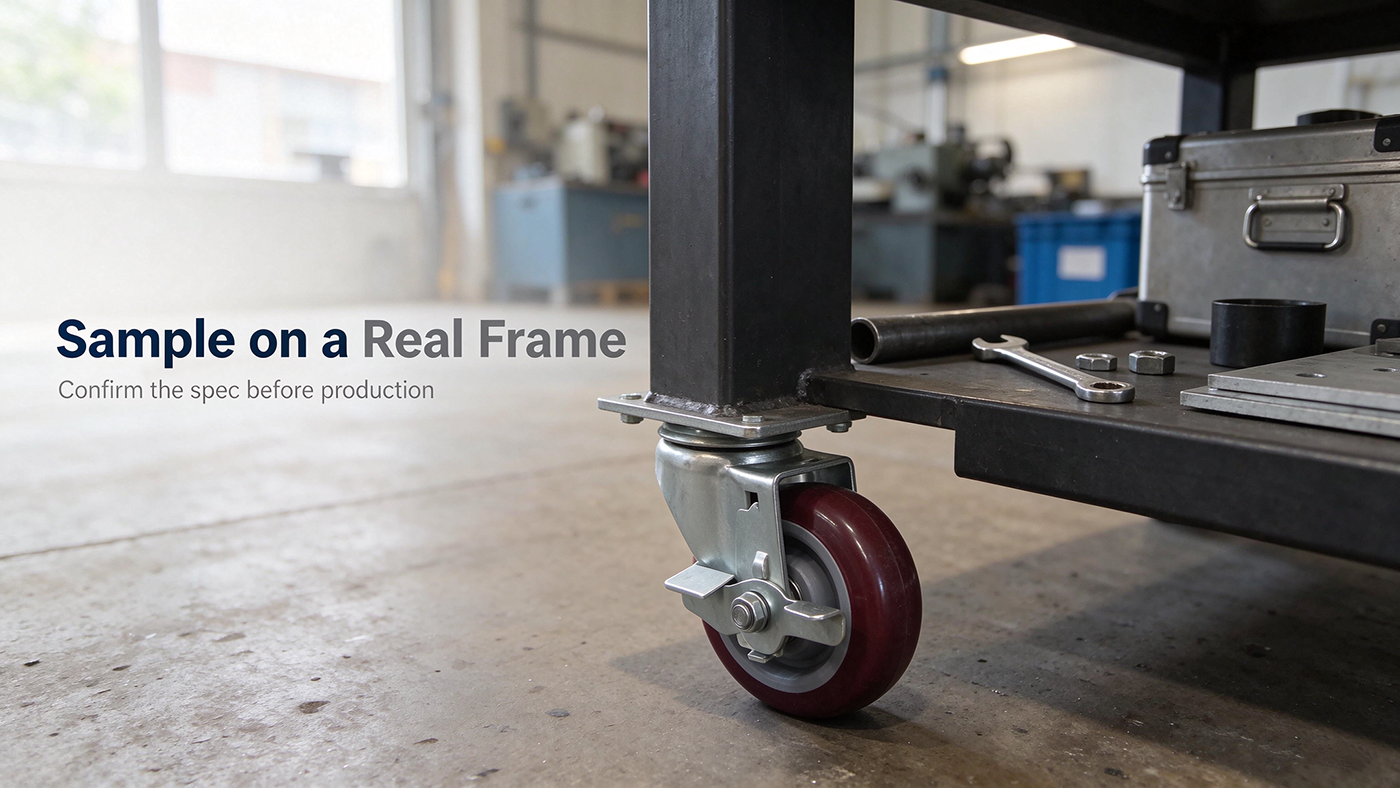
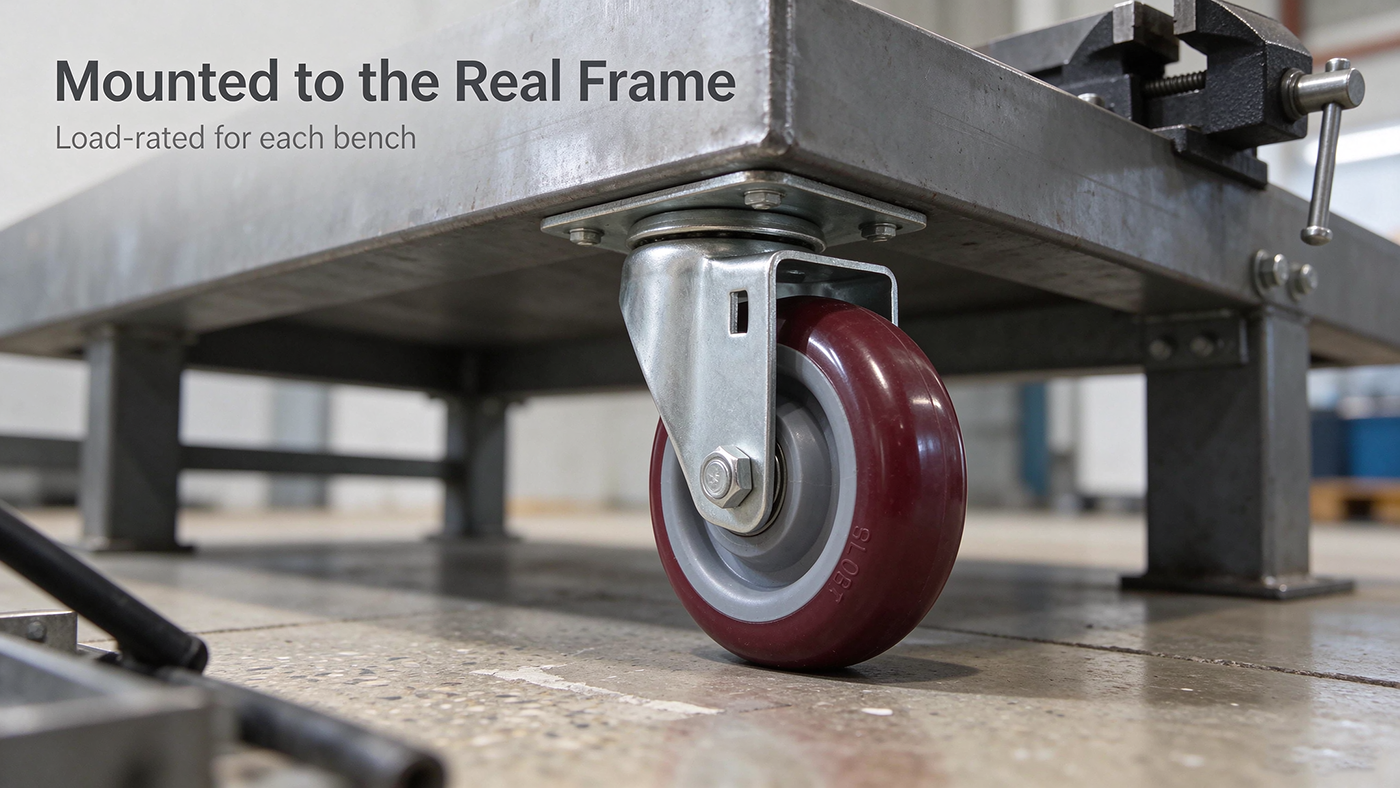
Samples went onto their own production line before any bulk order. Their staff mounted each leg onto a real bench frame, loaded it to working weight, and rolled it on the actual workshop floor. They checked the brake holding, the swivel under load, any floor marking, the push force over the bench’s normal route, and whether the frame rocked after the brake was pressed. That feedback narrowed the shortlist before production quantities were quoted.
SKU-Level Detail Before the First Order
Once samples passed, the details were fixed line by line: wheel diameter and width, tread material, bearing type, bracket finish, swivel or rigid, brake type, plate size and hole spacing, stem diameter and length where a stem fitting is used, axle bore and carton quantity. For an OEM fit the mounting dimensions matter as much as the load rating, because a leg that cannot be bolted to the frame cannot be assembled. Container loading was worked out from the packed carton size, not the bare wheel. Both sides confirmed the written spec and any drawing before production started.
Price Was Important, Not the Only Factor
The manufacturer compared landed cost, not unit price alone. Batch consistency, replenishment lead time and how a shortage on one fitting is handled all feed the real cost of running a product line. A cheaper leg that arrives with the wrong plate hole pattern, or that varies in swivel feel between lots, costs more over the program. We quoted the spec we could repeat, and left room to change tread or bracket rather than compete on the lightest frame.
Why They Kept Buying
Repeat orders came down to three points: the first production lot matched the approved samples, the packing matched their assembly and distribution flow, and the next order could be placed against the same confirmed fitting list without rebuilding the details from scratch. The range then extended to additional bench sizes as their line grew.
What Other Buyers Can Learn
- Rate the wheel to the worst corner. Per-wheel load is not always the total bench weight divided by four. A vise, a loaded drawer or an overhanging top puts more on one corner; check that corner before setting the rating. As a starting arithmetic check, a loaded bench of 240 kg across four legs works out to 60 kg per wheel before any margin is added.
- Fix the mounting before the tread. Plate size, hole spacing and stem diameter decide whether the leg can be assembled. Confirm these against the frame drawing before comparing tread or price.
- Specify the brake for positioning, not just for locking the wheel. A bench that holds standing load needs a leg that stays steady after the brake is pressed. Check rocking under a leaning load, not only whether the wheel stops turning.
- Sample onto a real frame. A caster tested loose on the bench does not show swivel feel under the actual loaded weight or the real mounting angle. Trial on one production unit before bulk.
- Keep a written spec record. A SKU-level list of diameter, tread, bearing, bracket, brake and fitting keeps repeat orders consistent, which is what an OEM product line depends on.
FAQ
Can one bench line mix swivel, rigid and braked casters?
Yes. A bench commonly runs swivel legs at the steering end and rigid legs at the trailing end, with brakes on the corners that need positioning. Each line is confirmed to its own spec before production.
Do you supply workbench castors under our own label?
We support OEM and private-label packing and marking where required. The caster itself, its bracket and its spec remain the confirmed engineering choice; the house label is applied at packing stage.
What information do you need to quote workbench casters?
Loaded bench weight, how often the bench moves, floor surface, mounting type and plate or stem dimensions, available wheel diameter, and any brake or finish requirement. A photo or drawing of the current frame helps.
Should a light bench step up to a heavy-duty caster?
No. An over-specified hard wheel adds push force and noise for no benefit. Match the duty to the load; if a medium or light-duty leg covers the bench, that is the better call.
What is the lead time and warranty?
Standard lead time is around 30 days and the warranty is one year; stock models can move faster than a built-to-spec line.
Send Us Your Bench and Frame Details
List the bench types, loaded weight, floor surface, mounting dimensions and brake requirement. We reply with a sample shortlist, a spec sheet after fitting review and packing options. If a standard off-the-shelf leg covers the job, we say so rather than push a custom build.
Post time: Nov-26-2026