A cart that rolls fine at room temperature can go into a drying oven and come back out with a softened tread, a swivel that will not turn, or a brake pedal that has deformed. Heat does not attack one part of a caster; it attacks the elastomer, the bearing lubricant, the plastic brake parts and the bracket one after another. Ordinary casters are not built for that chain of exposure.
High temperature casters are a heat-rated assembly, not a wheel colour or a wheel diameter. The tread, hub, bearing, lubrication, seals and brake hardware are all chosen together for the air temperature and the contact time the cart sees. This page covers what that means, which parts fail first, and where buyers order heat-resistant wheels by mistake.
What Are High Temperature Casters?
A high temperature caster wheel is specified for repeated exposure to heat above the normal indoor working range. The running material keeps its shape and grip at that temperature, the bearing and lubricant still turn, and the brake and raceway parts do not soften or seize during the duty cycle. The rating belongs to the whole leg under heat, not only to the outer tread.
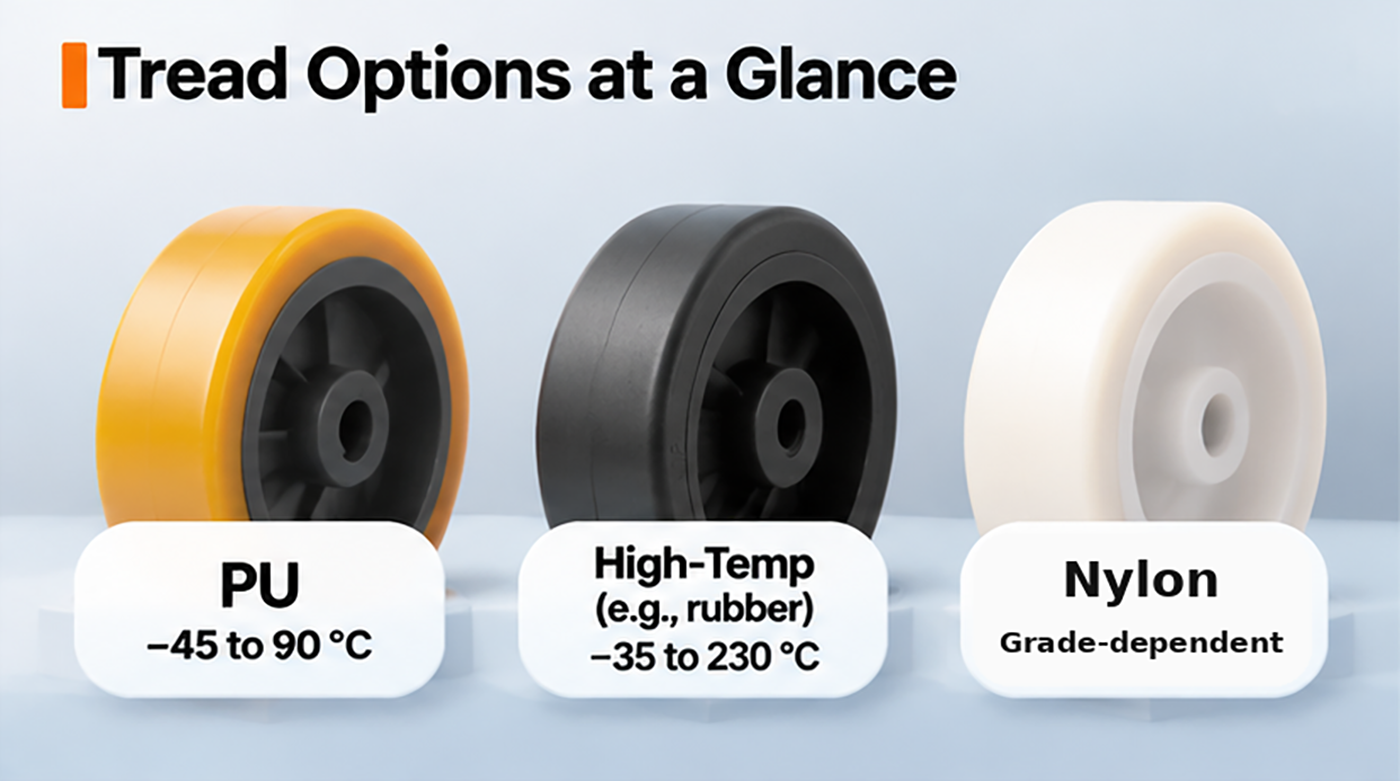
On a catalogue line, ordinary polyurethane and rubber wheels carry a limited working range; a PU tread is typically rated around −45 to 90 °C. A heat-resistant wheel family is built to reach higher, with a rated range around −35 to 230 °C for the high-temperature option. Those ranges are material-level figures; the assembled caster must still be confirmed at the actual oven or line temperature.
ISO 22883 (current edition) sets the requirements and tests for industrial casters and wheels, and the ANSI/ICWM terminology standards define the names the industry uses. High-temperature ratings are normally proven under the supplier’s own heat tests.
Heat-Resistant Tread vs Heat-Resistant Caster
Buyers write these two requests as if they were the same thing. They are not.
- ➤ Heat-resistant tread only — the outer wheel material holds up at heat, but the bearing grease, seals or brake plastic on a standard bracket were not chosen for that temperature. The tread survives; the rest of the leg does not.
- ➤ High-temperature caster assembly — tread, hub, bearing, lubricant, seals and brake hardware are all selected for the heat duty, so the whole cart moves and stops correctly inside the hot zone.
Two more distinctions come up in every hot-duty quote:
- Static heat vs rolling heat: A wheel sitting in an oven at temperature is exposed differently from one rolling through a line with contact friction on the floor.
- Continuous vs intermittent: A cart that dwells in a heated zone for hours needs a continuous rating. A cart that passes through for a few minutes on each cycle can sit on an intermittent rating.
Which Parts Fail First in Heat
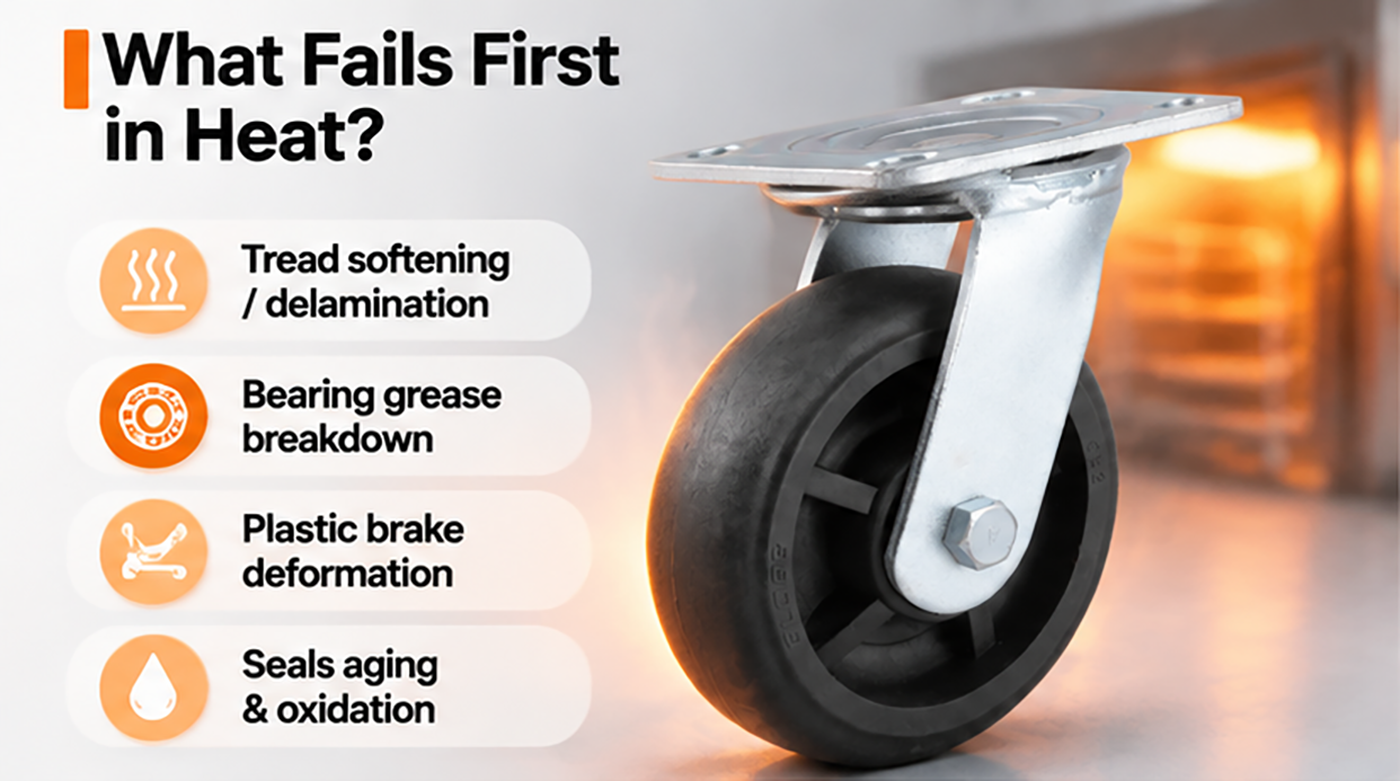
Heat moves outward from the running parts. The first signs usually trace to one of four places:
Tread Options at a Glance
| Tread family | Heat behaviour | Roll / noise | Floor marking | Typical hot-duty role |
|---|---|---|---|---|
| Standard PU | −45 to 90 °C; softens past that | Resilient, quiet | Non-marking | Normal indoor carts |
| High-temp elastomer | Rated around −35 to 230 °C | Firmer roll | Mostly non-marking | Ovens, drying lines |
| Nylon | Stiff plastic; moderate heat | Moderate roll, louder | Can scuff soft floors | Moderate-heat dry duty |
| Phenolic (resin) | Hard, heat/oil resistant | Hard, noisy | Marks soft floors | High-heat, oily shop floors |
| Cast iron / steel | Keeps form at high heat | Hard, loud | Marks polished floors | Foundry, kiln |
What Changes the Heat Rating
- Air and surface temperature: Oven air vs. hot floor contact are different.
- Contact time: Continuous dwell vs. short pass-through.
- Load per wheel: Ratings tighten as temperature increases.
- Environment: Fumes, moisture, and oil affect seals and finishes.
- Bearing & Lubricant: Often the “weak link” before the tread itself.
Common Mistakes to Avoid
- Using room-temperature ratings for oven environments.
- Checking the tread material but ignoring the bearing/grease.
- Treating intermittent pass-through ratings as continuous dwell ratings.
- Leaving standard plastic brake parts in high-heat zones.
- Over-specifying: Buying expensive heat wheels for normal ambient warehouses.
Worked Selection Example
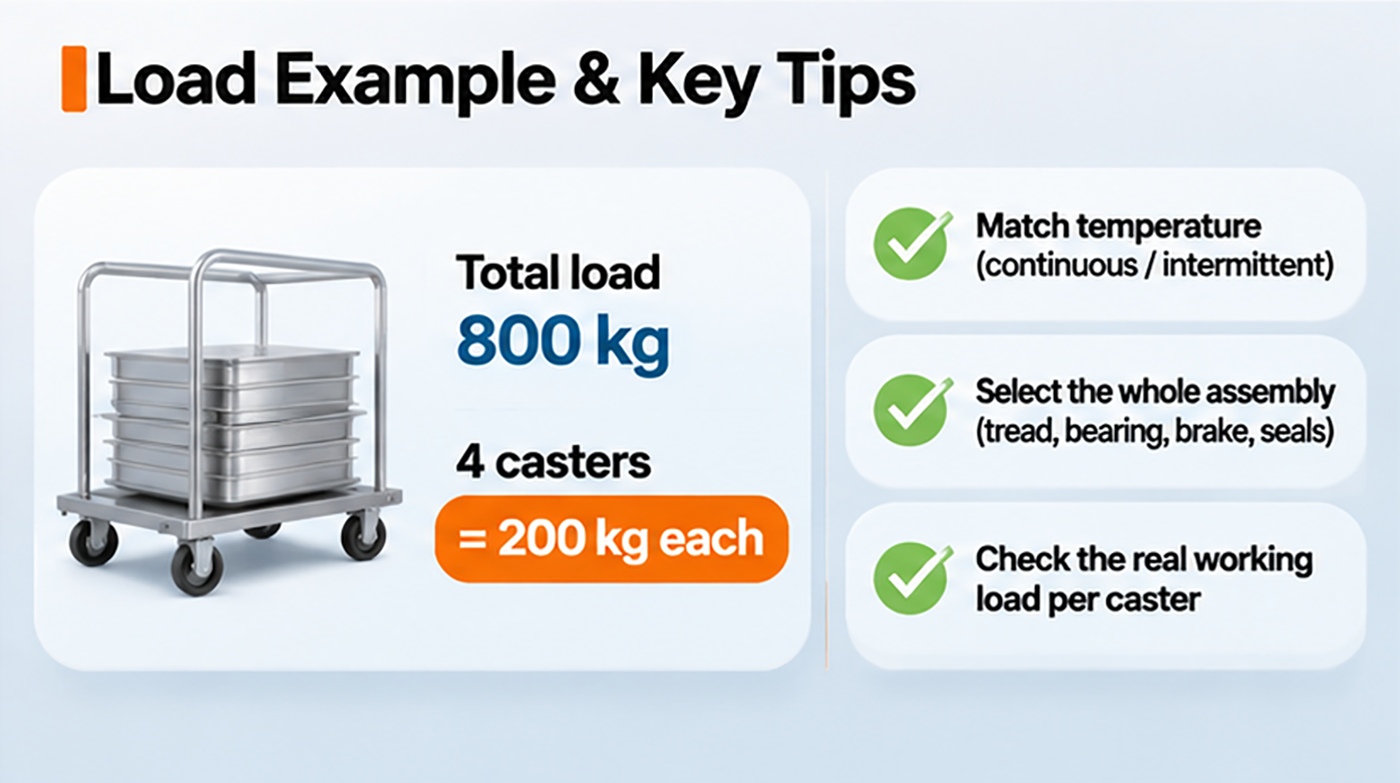
Scenario: A drying-line cart carries 800 kg loaded, on four casters.
Calculation: 800 ÷ 4 = 200 kg per wheel at ambient. However, because the cart dwells in a heated chamber, the 200 kg rating must be confirmed at the chamber temperature, not just from the room-temperature spec sheet.
The selection must include a heat-rated bearing and brake. If it sits inside for hours, you must use the continuous heat rating figure.
What Buyers Usually Ask
A standard polyurethane tread is typically rated around −45 to 90 °C. Above this, the elastomer softens.
No. Heat resistance and load capacity are separate. Load capacity actually decreases as temperature rises.
Heat-resistant elastomers are usually better at protecting floors than metal, but it depends on your specific floor material.
How Globe Caster Builds These Options
Foshan Global Caster Co., Ltd, Guangdong, China has manufactured casters since 1988. With a 156,000 m² plant and 500+ staff, we output roughly ten million casters annually. Our catalogue features 21,000+ models, certified to ISO 9001 and ISO 14001, ensuring that tread, bearing, and brake components are perfectly matched to your specific heat duty requirements.
Send the Cycle and Load, We Match the Heat Rating
Tell us the chamber temperature, dwell time, loaded weight, floor material, and mounting style.
We reply with the tread family, heat-rated per-wheel figure, and sample SKUs for trial.
Post time: Nov-20-2026