
How to Measure Caster Wheels Before You Order a Replacement
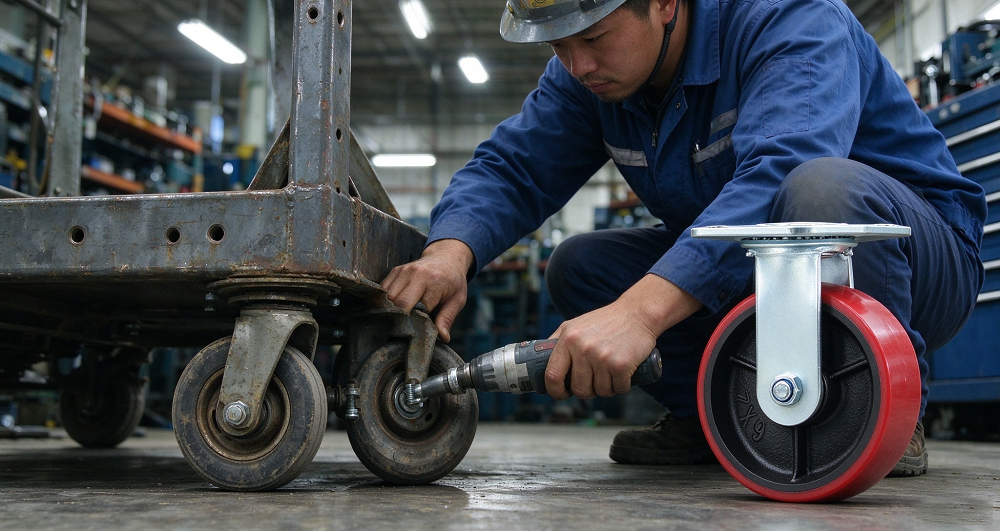
Someone on your shop floor sends a photo of a broken caster and writes “send me the same one.” The photo shows a black wheel and a grey bracket. That is not enough. The wheel looks the same and does not fit, because nobody measured the mounting hole pattern, and the cart sits 8 mm higher than it should.
Replacing casters is a measurement job, not a look-alike job. Buyers in the UK, Australia and parts of Europe search castor wheels — same product, same seven measurements, different spelling. Below are the numbers that actually decide whether a caster fits your frame. We use our own EH8 5 inch range as the worked example, because those are numbers we can stand behind.
The Seven Dimensions That Matter
| # | Dimension | How to measure it | Why it matters |
|---|---|---|---|
| 1 | Wheel diameter | Measure across the tread, not across the core. Turn the wheel so the tread face is vertical. | Determines floor obstacle clearance and overall height. |
| 2 |
Wheel width (tread width) |
Across the tread face at its widest point. | Load spread on the floor and fork gap. |
| 3 | Mounting height | From the underside of the top plate to the floor, on a flat surface. For stem casters, from the top of the stem. | Frame clearance. Get this wrong and the cart tilts. |
| 4 | Plate size | Length × width of the mounting plate, outer edge to outer edge. | Whether the plate sits on the frame member. |
| 5 | Hole spacing | Centre-to-centre of the holes, in both directions. Not edge-to-edge. | The number that makes or breaks a direct swap. |
| 6 | Hole diameter | Measure the hole, not the bolt. | Bolt clearance and plate bearing area. |
| 7 | Swivel radius | From the swivel centre to the furthest point the wheel reaches when turned. | Aisle width. The wheel sticks out further than the plate. |
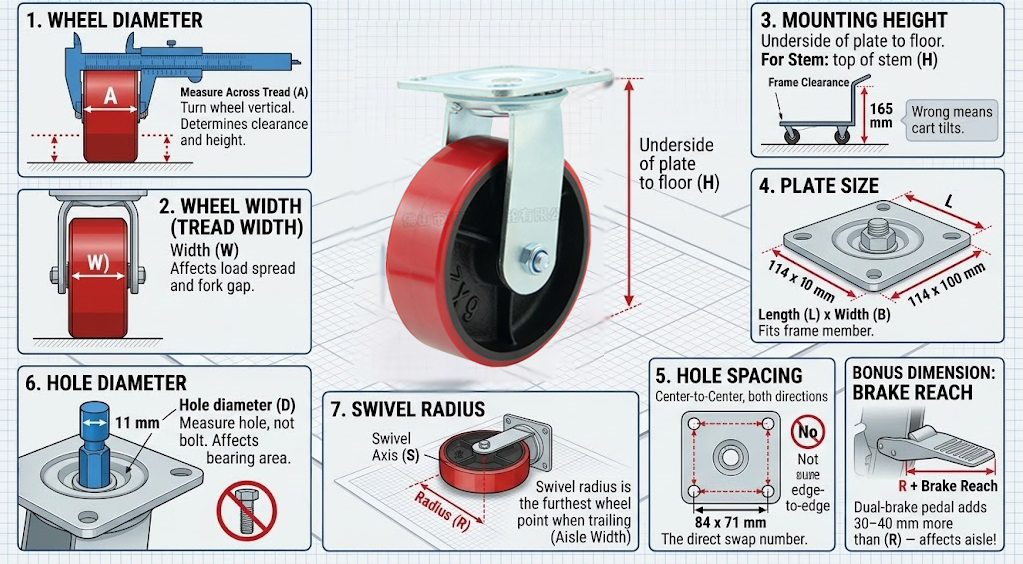
If the caster has a brake, add one more: the brake pedal’s outer reach. A dual-brake caster can extend 30–40 mm further than a free-swivel one, and that changes the aisle.
The Five Mistakes We See Every Week
- Measuring the plate, not the holes. Two casters can share a 114 × 100 mm plate and have different hole patterns. The plate size is cosmetic; the hole spacing is the part that bolts on.
- Measuring hole edge-to-edge. Always centre-to-centre. Edge-to-edge changes with the hole size.
- Forgetting mounting height. A 125 mm wheel on a taller bracket can sit 165 mm high; a different 125 mm wheel can sit 150 mm high. Same wheel, different frame clearance.
- Reading the load rating as the cart’s total weight. The number on the caster is per wheel, on a flat floor, at walking speed. Divide your loaded cart weight by four, then add margin.
- Ignoring the swivel radius. The wheel reaches further out than the plate. Measure it, or the cart will hit the racking on every turn.
What the Standards Say
The vocabulary is standardised.
- ISO 22883 covers requirements and tests for industrial castors and wheels used at walking speed;
- The ANSI/ICWM (MHI) vocabulary standard defines the terms — wheel diameter, mounting height, swivel radius, load rating — the same way across manufacturers.
When you send a drawing, use those words, not “the big one” or “the black one”.
We hold ISO 9001 and ISO 14001. The test standards above are the industry reference; we are not claiming certification against them.
Worked Example: Matching a Replacement
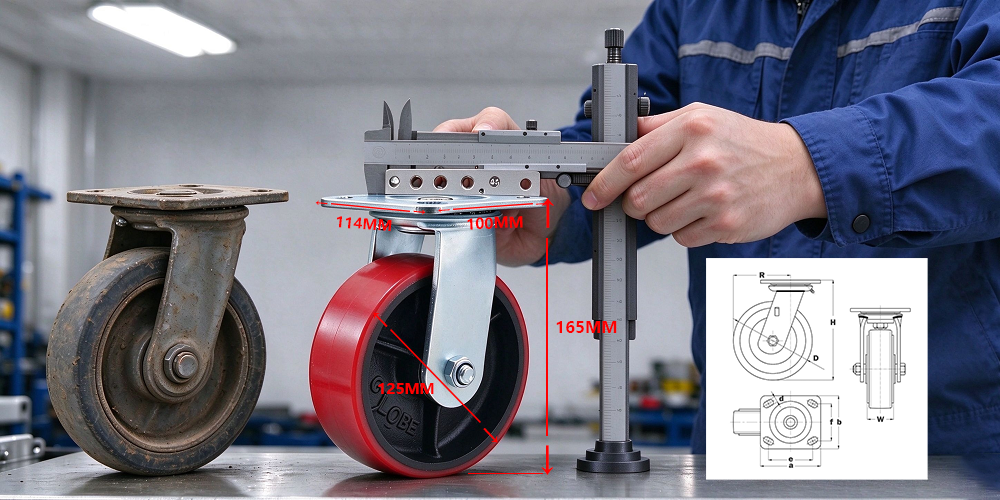
A customer sends back four numbers from a worn caster: wheel 125 mm, width 45 mm, plate 114 × 100 mm, holes 84 × 71 mm centre-to-centre, hole 11 mm, mounting height 165 mm. The cart weighs 800 kg loaded.
That is the EH8 5 inch range. The matching swivel caster is EH08-11-125S-402: 125 mm wheel, 45 mm width, 250 kg per wheel, 165 mm mounting height, 96 mm swivel radius, 114 × 100 plate, 84 × 71 holes, 11 mm holes. The cart at 800 kg needs 200 kg per wheel; 250 kg gives a 1.25× margin. It fits.
If the customer had measured a 96 mm swivel radius but the braked version extends to 132 mm, the braked option would not fit the same aisle — and that is the detail a photo never shows.
What to Send Us
Send a tape-measure photo of the caster on the bench, plus these numbers: wheel diameter, wheel width, mounting height, plate size, hole spacing, hole diameter, and the load you need it to carry. If the mounting is a stem or an insert, send stem diameter and length instead of the plate numbers.
If your frame holes do not match a standard plate, do not tell us “just make it fit”. Send the drawing. We will quote the plate you need, or tell you the nearest standard one that already exists.
When You Do Not Need a Replacement At All
If the wheel rolls but the swivel is stiff, the problem may be a dry raceway or a bent fork, not the whole caster. A new wheel will not fix a bent bracket. Check the fork first. And if the old caster is still holding the load after three years and you are just changing the tread color, you probably do not need to change anything.
About Globe Caster
Foshan Global Caster Co., Ltd, Guangdong, China. Casters since 1988, 156,000 m², 500+ employees, stamping, injection and PU pouring in-house. 600+ SKUs on the shelf, ISO 9001 and ISO 14001. Exports to North America, Europe, Southeast Asia and the Middle East.

Send the Seven Numbers
Measure the seven dimensions above, send them with a photo, and we will match the caster to your frame — or tell you honestly that what you have measured is a custom job and what that costs. Reply within one business day with a quote and a 2D drawing. Email:master@globe-castor.com
Post time: Oct-30-2026