
Industrial Castors (6 Inch Swivel, 410 kg Per Wheel) — EH01 Heavy Plate PU Line
You bolt a cheap swivel castor onto a machine moving cart, load it to the rated line, and the fork wobbles by month three. The tread delaminates on the workshop seam weld, the swivel raceway fills with dust, and the maintenance man starts asking why the cart now takes two people to turn.
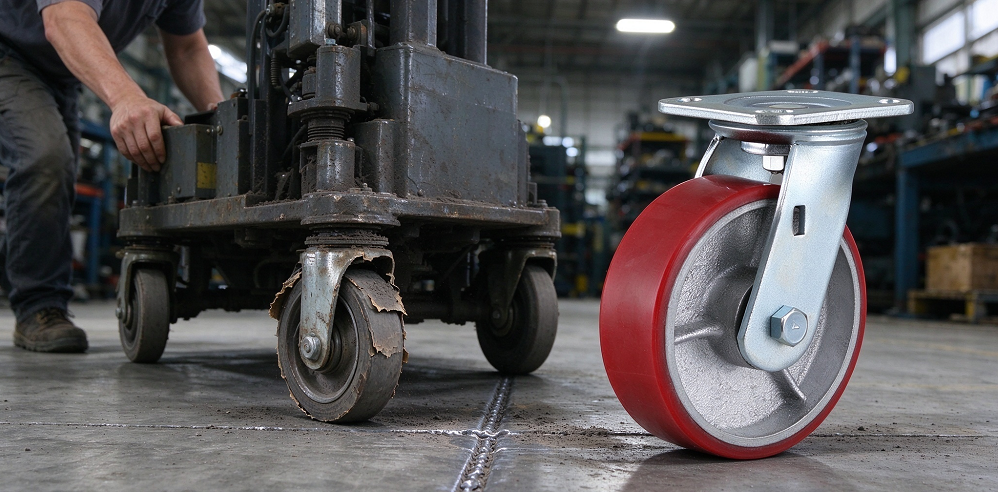
The EH01 top-plate heavy-duty line is where we send customers who actually push loaded industrial castors all shift, not on showroom floors. The range shown below runs 100 to 200 mm wheels on a welded steel fork with ball bearings, 50 mm wide treads, and a 114 × 100 mm plate. This page documents the main swivel model, EH01-11-150S-402, and the size ladder around it, with mounting numbers straight from our specification sheet.
Who Makes This Line
Foshan Global Caster Co., Ltd, Guangdong, China has built casters since 1988. The plant covers about 156,000 m² with 500-plus employees, in-house stamping, injection moulding and PU pouring workshops, roughly ten million casters a year, over 21,000 recorded models with 600-plus kept as stock items, ISO 9001 and ISO 14001 records, and more than 100 patents. Industrial castors from this line ship to North America, Europe, Southeast Asia and the Middle East; standard lead time is about 30 days, and the warranty runs one year under normal use.

Main Model and Size Ladder
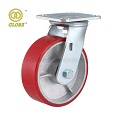
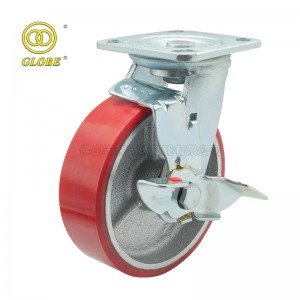
The main offering is the 150 mm (6 inch) swivel castor with an iron-core polyurethane tread and ball bearings, plated blue zinc. Rigid and braked versions share the same fork and plate so a trolley keeps one mounting hole pattern across all corners.
| Picture (EH01-11-150S-402) |
SKU | Role | Wheel Ø × width | Rated per wheel | Mounting height | Swivel radius | Plate | Hole spacing / hole Ø |
|---|---|---|---|---|---|---|---|---|
 |
EH01-11-100S-402 | Smallest swivel, lightest end | 100 × 50 mm (4″) | 280 kg | 145 mm | 80 mm | 114 × 100 mm | 84 × 71 mm / 11 mm |
| EH01-11-125S-402 | Mid swivel | 125 × 50 mm (5″) | 350 kg | 167 mm | 96 mm | 114 × 100 mm | 84 × 71 mm / 11 mm | |
| EH01-11-150S-402 | Main swivel — this page | 150 × 50 mm (6″) | 410 kg | 192 mm | 115 mm | 114 × 100 mm | 84 × 71 mm / 11 mm | |
| EH01-11-200S-402 | Largest swivel, tallest lift | 200 × 50 mm (8″) | 420 kg | 243 mm | 150 mm | 114 × 100 mm | 84 × 71 mm / 11 mm |
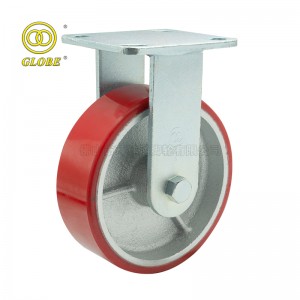
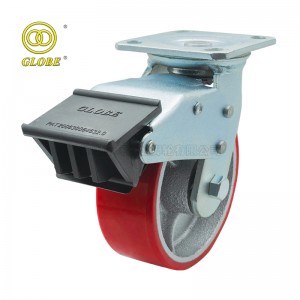
Brake and fixed variants at the 150 mm size use the same plate: EH01-11-150R-402 is the rigid fixed version, EH01-11-150SA-402 adds a nylon twin brake locking swivel and wheel together, and EH01-11-150SC-402 is the side-brake version that stops the wheel while leaving the swivel free. The swivel radius of the braked versions is drawn per drawing on request; the values above are for the plain swivel.For more information, please click here to contact us.
 |
 |
 |
| EH01-11-150R-402 | EH01-11-150SA-402 | EH01-11-150SC-402 |
What the Numbers Mean on Your Cart
A cart on four wheels does not add four ratings together. Take the loaded gross weight, divide by four, then leave margin for starts, stops and one wheel momentarily carrying more on a crack.
Example: a loaded machine-moving cart at 1,000 kg gives 250 kg per wheel before margin.
Applying a 1.3 factor for rough floor and loading points lands at about 325 kg per wheel;
●the 125 mm 350 kg wheel covers it on smooth concrete;
●the 150 mm 410 kg wheel is the safer choice over joints, thresholds and outside slabs.
Rated load values above follow the per-wheel catalog basis; ISO 22883 describes the industrial caster and wheel test framework these ratings sit within as an industry reference. Our own held certifications are ISO 9001 and ISO 14001, and we do not claim a test certification we do not hold.
The Parts That Wear
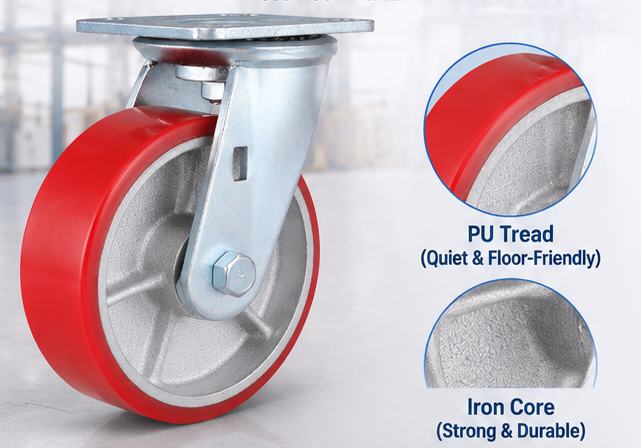
Iron-Core Polyurethane Tread
|
The 402 tread is polyurethane bonded to an iron centre. The PU rolls quietly and leaves less mark than a hard nylon tyre on epoxy or painted floor, while the cast-iron core carries the load a soft solid tyre cannot. For indoor flat floor we also list premium PU, super PU and high-strength PU treads at the same fork; the iron-core version is the default for workshop carts that meet weld seams and steel joints. |
 |
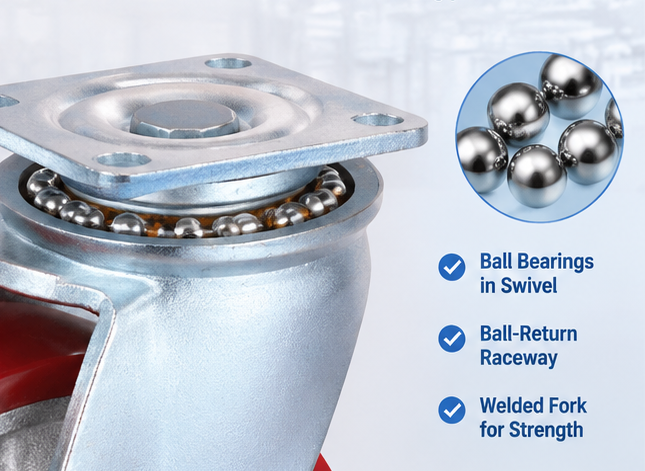
Ball-Bearing Fork and Swivel Raceway
|
Each wheel runs on ball bearings, and the swivel raceway is ball-return. That keeps start-up push force low at the rated load, which is what matters when one operator has to move the cart between stations. The fork is a welded plate steel construction rather than a pressed thin stamping; the wide 50 mm tread spreads ground pressure and resists side load from turning. |
 |
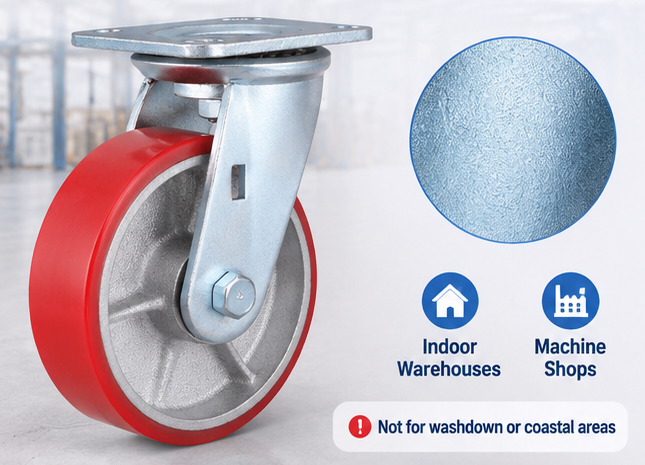
Blue Zinc Plating
|
The bracket is blue zinc plated as standard. That is the right finish for dry indoor warehouses and machine shops. It is not the finish for washdown areas or salt-air coastal exposure; for those environments we steer buyers to a corrosion-rated family instead, because zinc streaks and raceways seize when moisture sits on them season after season. |
 |
Where These Castors Belong
|
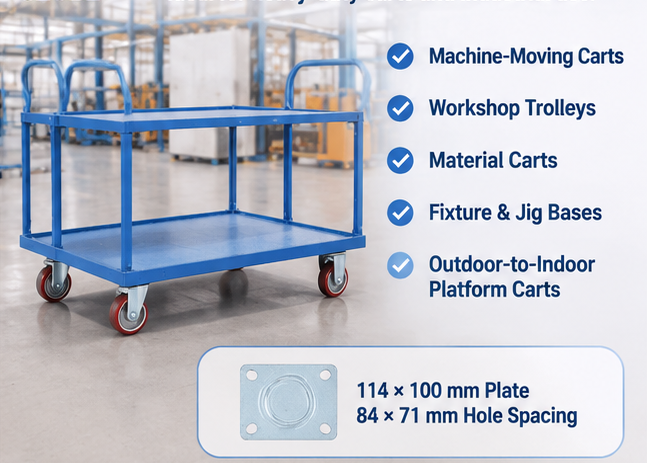
The realistic use cases we quote this line for: heavy machine-moving carts and installation dollies, welded-frame workshop trolleys, tugged material carts on periodic runs, fixture and jig bases, and outdoor-to-indoor platform carts on concrete. The 114 × 100 mm plate with 84 × 71 mm hole spacing is a common heavy-industry pattern; if your frame has a different pattern, we send the drawing first rather than you drilling ours. If your loaded cart sits around 200 kg total, this 50 mm-wide fork is overkill and pushes the price and mounting height up for no gain; size down to a medium-duty plate castor instead. If you roll over loose gravel, cobbles or yard tarmac every shift, a small 100–125 mm wheel will trap itself; step to the 200 mm size or an elastic-rubber tread option and stop trusting polyurethane on broken ground. |
 |
Mounting in Four Steps
1.Fix the load window first. Gross loaded weight, wheel count, floor condition, and one bump or threshold the cart crosses every shift. Pick the per-wheel rating so it clears the divided load with margin, not by matching the nearest number below it.
2.Match corners to the job. Swivel at the steering end, rigid at the opposite end for straight tracking, or two swivel with twin brake plus two rigid on four-corner carts. Do not run four braked swivels unless the operator genuinely locks corners regularly; the extra brake levers get damaged anyway.
3.Check the plate against the frame. Compare 114 × 100 mm outer plate and 84 × 71 mm hole spacing against your existing holes, and confirm 11 mm bolt clearance. Mounting height 192 mm for the 150 mm wheel changes the cart’s working height; re-check door clearance before you cut the frame.
4.Re-torque after the first week. Frame builders know their own tube gauge; tighten to their torque, not to ours. Then walk the line once after the first week of loaded use and check plate bolts and brake function.
FAQ
What is the difference between EH01 and the lighter EH01 narrow-tread branch?
This page uses the 50 mm wide-tread heavy plate line rated 280–420 kg. The catalogue also lists a narrower 32 mm tread EH1 branch at 125–300 kg on a smaller 94 × 67 mm plate. Order against the SKU code, not the family name; the two do not interchange.
Do you supply brake versions?
Yes. Twin nylon brake (SA) locks swivel and wheel; side brake (SC) locks the wheel only. Both share the 114 × 100 mm plate and the 84 × 71 mm hole spacing.
What floor finishes does the iron-core PU suit?
Smooth concrete, epoxy, sealed steel plate and painted workshop floor. It rolls cleaner and quieter than nylon. On rough exterior gravel it will wear the tread faster; state your floor when you ask for a quote.
Can the plate hole pattern be changed?
Standard pattern is 84 × 71 mm centre spacing on the 114 × 100 mm plate, 11 mm holes. Alternative patterns are discussed case by case against our tooling; we will tell you up front if a change means a custom bracket run and its lead time.
What is the warranty and lead time?
One-year warranty under normal use, with batch records traceable back to the stamping and plating lot. Stock sizes move faster; produced sizes quote at about 30 days, subject to the order mix.
Can I get samples before production?
Yes. We recommend one swivel, one rigid and one braked sample of the size you plan to run, tested on your loaded cart before you commit a production quantity.
After-Sales and Replenishment
Reorders repeat against the same SKU code, so the bracket, tread compound and plate pattern do not drift between batches. Transit damage and early-life warranty claims are handled against the one-year terms and the batch record, not negotiated one message at a time. Mixed SKU shipments are packed so each variant can be counted without opening a carton, and OEM labelling is supported on program orders.
Quote the Right Size
Send us the loaded gross weight of the cart, the number of wheels, the floor and any threshold it crosses, the brake you need, and your current mounting hole pattern. We reply with the recommended SKU, the mounting numbers above, a lead time and a 2D drawing scope. If your frame still has the holes from another brand, send those dimensions first — we match them before we quote.
Post time: Nov-05-2026