
Reliable Caster Supplier for Serial Production: From First Sample to Repeat Replenishment
The first order looks easy. The supplier quotes a unit price, sends a sample, and the caster rolls fine in the showroom. The problem shows up on the twentieth batch: one shipment has a different plate hole spacing, another arrives with tyres marked in Chinese cartons the local warehouse cannot scan, and a damaged corner of freight leads to a three-month argument about who replaces the set.
For an equipment maker building trolleys and machines to a monthly schedule, a reliable caster supplier means far more than a low first-piece price.
This article follows one representative OEM sourcing program: an equipment manufacturer sourcing industrial casters (called castors in UK, Australian and South African English) for serial production and spare-parts replenishment. The commercial goal was a repeatable source that holds specification across batches, ships on a set cadence, and handles claims on defined rules rather than goodwill. The mechanics below apply the same way to trolley builders, medical and lab equipment lines, and machinery-mobile-base buyers.
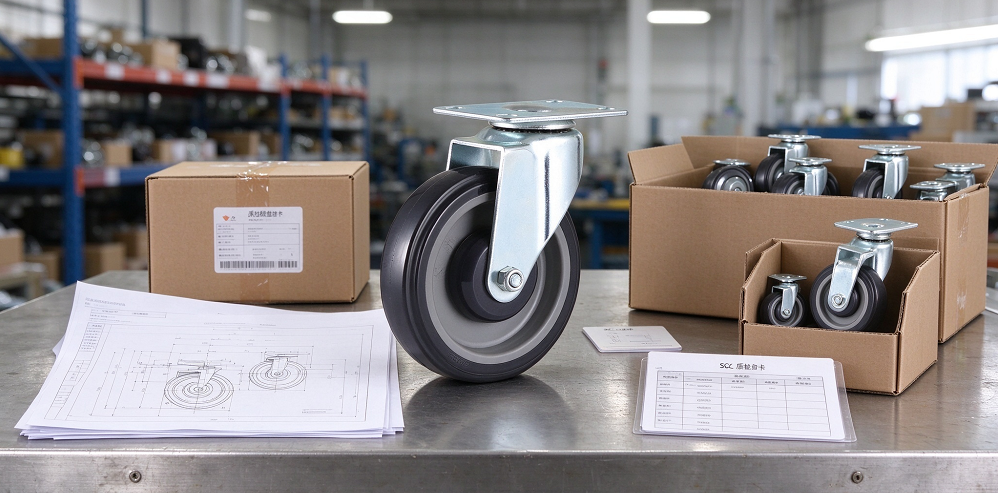
About the Customer
The buyer designs and assembles equipment carts and small mobile machine stands for equipment dealers and end-user workshops. Its production runs repeat models rather than one-off custom machines, so the caster set appears in the assembly bill of materials every month, and spare castors move through its own after-sales channel.
For commercial confidentiality, the customer name, specific country and order quantities are not disclosed. The events summarized here are assembled from the program type rather than named as a single verified account; order sizes, destinations and exact part mix are omitted where a public version would identify the buyer. The SKU data shown later comes from our own specification sheet and can be quoted independently.
What They Actually Needed
The request began with a short inquiry, but the requirements that mattered showed up during engineering exchange:
● Specification held across repeats. Same diameter, tread compound, bearing, mounting pattern and mounting height on every replenishment batch, because the set is fitted by the production line against a fixed hole template.
● Mixed SKU consolidation. A single shipment can carry several caster types for different cart models, each packed and marked separately rather than mixed loose into one carton.
● Documentation for import and internal QA. Mounting dimensions on a drawing, material description, and an outgoing check record per batch; outer carton labels readable to the buyer’s warehouse system.
● Predictable lead time and replenishment rhythm. Stock items for steady models and defined production slots for less common ones, so assembly does not stop waiting on wheels.
● A clear replacement rule for transit damage and warranty failures. One-year warranty policy and batch records make claims traceable instead of negotiable every time.
The cheapest quoted unit did not answer most of these points, and the buyer did not ask about those points on the first email.
How the Program Started
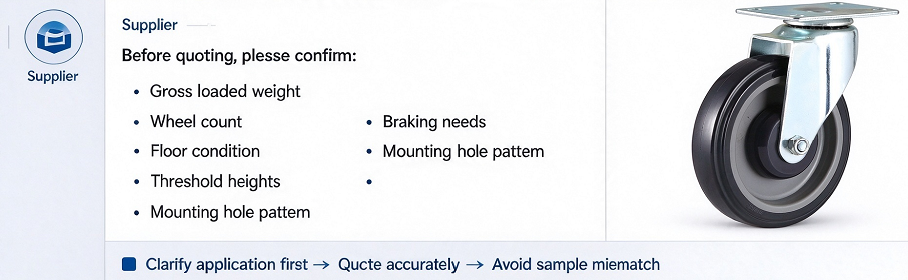
The first contact came through a product inquiry that listed an approximate wheel diameter, load range and floor type. Our reply asked the questions that decide a caster before any price is meaningful: gross equipment weight loaded, four-wheel versus other wheel counts, floor condition and threshold heights, required swivel or fixed mix, braking needs, and the existing mounting hole pattern.
That exchange narrows the proposal fast. A buyer shopping by diameter alone can match a wheel that rolls at the stand but sits too high for the doorway or fails the load window; the engineering questions remove that mismatch before the sample leaves the factory.
Factory Evidence and Production Review
Buyers who cannot travel to Foshan still need evidence that the supplier controls the parts rather than reselling them from a trading desk. Foshan Global Caster Co., Ltd, Guangdong, China runs in-house hardware stamping, injection moulding and PU pouring workshops under the Globe Caster brand, established in 1988.
● Plant area about 156,000 m²;
● 500+ employees;
● Roughly 10,000,000 casters per year;
● 21,000+ recorded models with 600+ kept as stock SKUs;
● ISO 9001 and ISO 14001 records, and 100+ patents on file.
For a program review we provide the records behind the process: bracket stamping and plating batches, tread moulding records, PU pouring batches, and the outgoing dimension check for mounting height, swivel radius and load rating. ISO 22883 describes the industrial caster test basis for rolling and rated-load behaviour as an industry reference; our own held certifications are ISO 9001 and ISO 14001, and we do not claim certification we do not hold.
Regular export destinations for these programs include North America, Europe, Southeast Asia and the Middle East; standard quotation lead time is about 30 days, with stock models moving faster, and warranty covers one year under normal use.For more information, please click here to contact us.

Choosing the Sample Set
Samples were selected against the production line rather than chosen from the showcase bestseller. The main family for the line cart used a medium-duty top-plate swivel caster with polyurethane tread and ball bearing; a second, lower-center option was held for equipment where mounting height was restricted.
| Picture | Representative program SKU | Position in the program | Wheel × tread width | Rated per wheel | Mounting height | Swivel radius | Plate | Bearing / tread |
|---|---|---|---|---|---|---|---|---|
 |
ED01-11-100S-308 | Standard production trolley, main cart model | 100 × 28 mm (4 inch) | 80 kg | 133 mm | 88 mm | 94 × 67 mm | Ball bearing; high-strength polyurethane |
| ED01-11-125S-308 | Heavier cart variant in the same family | 125 × 30 mm (5 inch) | 100 kg | 158 mm | 103 mm | 94 × 67 mm | Ball bearing; high-strength polyurethane |
The plate hole spacing and hole diameter for each SKU are issued on the quotation drawing rather than guessed here; the low-center-gravity option for restricted-height machines belongs to our EF12 family, selected only after the buyer confirmed the actual equipment clearance.
Sample choice followed three rules:
○ Keep the same bearing and mounting system across variants where possible so the assembly tooling does not change;
○ Pick tread compound for the actual floor (hard smooth concrete, epoxy, or outside yard);
○ And include one brake version for the models the operator must park on a slight slope.
Local Testing Before Commitment
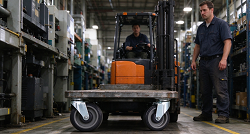
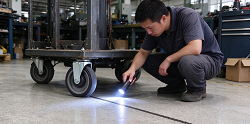
The buyer tested the samples on its own floor before approving them. The checks that mattered were practical ones:
 |
 |
 |
 |
| 1.Push force on a loaded cart |
2.Swivel turn in the existing aisle,brake function on the slope |
3.Trace marks on the finished floor |
4.And whether the plate sat flush against the frame cross member |
Surface treatment was checked for salt-spray or rust concerns only where the local climate demanded it.
A sample that rolls once in a clean room proves nothing. The local trial exposes mounting conflicts that a catalogue table cannot: frame hole positions, fork interference, handle clearance and tread noise on the real floor covering. This is also where a buyer should reject a supplier quietly; if the sample cannot match the drawing numbers on the test bench, later batches will not improve on their own.
The Months of Detailed Program Discussion
After samples passed, the program moved from part list to paperwork and logistics. The working items were:
1. SKU-level bill of materials. Swivel, fixed and brake variants listed per machine model, so every shipment maps to an assembly plan.
Mounting drawing per SKU. Plate outline, hole spacing, hole diameter, mounting height and swivel radius on a 2D drawing for the buyer’s engineering file.
2. Packing plan. Each caster type packed separately with inner marks; outer cartons use consistent shipping marks aligned to the buyer’s warehouse label practice, following the GS1 Logistic Label Guideline convention for carton-level identification where the buyer provided its label format.
3. Container or LCL consolidation. Mixed SKU quantities balanced for carton count, carton weights and total container fit; stock models fill gaps between produced models.
4. Reorder rhythm. Steady models keep a replenishment threshold; slower variants release on a purchase order with a stated lead time, rather than tying up the buyer’s cash in extra stock.
None of these steps appears in a catalogue. They are the work that separates a supplier from a catalogue seller.
Price Was Important but Not the Only Factor
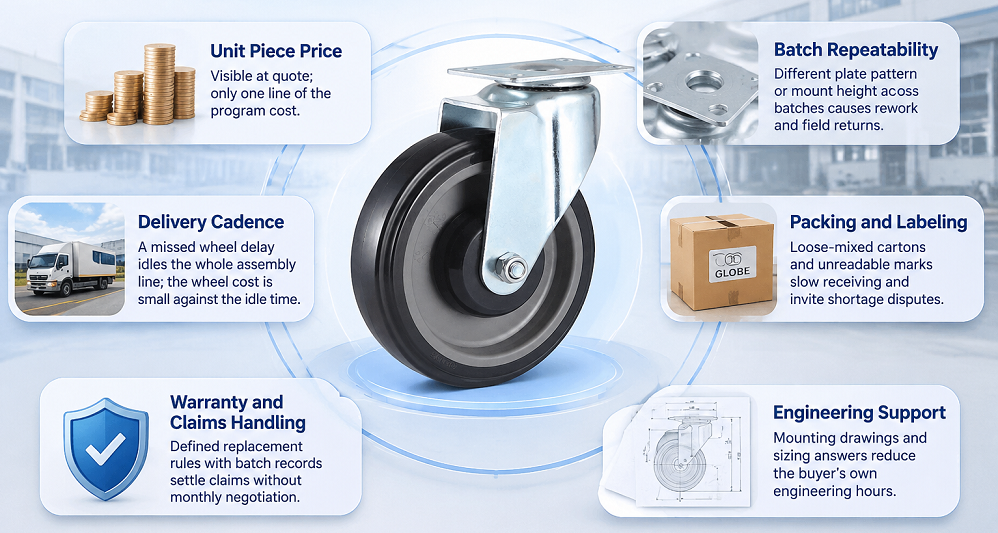
Unit price still matters, but the total landed cost includes more lines: incoming labour to replace mis-drilled plates, rework on a cart that uses the wrong tread, expedited freight when a batch misses the lead time, warranty credit for transit damage, and admin time on labels the warehouse cannot process.
| Decision factor | What a low-quote-only comparison misses |
|---|---|
| Unit piece price | Visible at quote; only one line of the program cost |
| Batch repeatability | Different plate pattern or mount height across batches causes assembly rework and field returns |
| Delivery cadence | A missed wheel delay idles the whole assembly line; the wheel cost is small against the idle time |
| Packing and labeling | Loose-mixed cartons and unreadable marks slow receiving and invite shortage disputes |
| Warranty and claims handling | Defined replacement rules with batch records settle claims without monthly negotiation |
| Engineering support | Mounting drawings and sizing answers reduce the buyer’s own engineering hours on each program |
If your program is a few casters for one repair job, the thin comparison table above is fine; order the lowest price that fits the dimensions. For a serial production line, that comparison will be settled later in rework and stockouts, not on the quotation day.
Why the Program Continued
The buyer renewed because the supplier held the points that quietly fail elsewhere: the sample numbers matched the delivered batch, drawings were kept on file for new machine models, replenishment lead times were predictable, claims were handled against the warranty terms instead of debated case by case, and mixed SKU cartons arrived sorted. None of that requires the lowest factory price on the market; it requires a manufacturer that tracks its own production batches and answers engineering questions in writing.
From First Order to Repeat Replenishment
The first purchase covered validated sample-derived quantities for the production line. Replenishment orders followed against the same SKU list, with stock models bridging production slots and slower variants ordered to schedule. Spare-parts quantities for the buyer’s after-sales network were packed under the same label convention so field service could identify the castor set by carton mark without opening every box.
Running a repeat program also keeps future changes controlled: when a machine model changed frame height, the next SKU change was engineered from the existing drawing set rather than rediscovered from scratch, and the approved tread compound carried over where the floor condition stayed the same.
What Other Buyers Can Take From This Program
- Ask for numbers before the price. Load per wheel, mounting height, plate hole spacing, swivel radius and bearing type; a quote without these cannot be compared.
- Test samples on your own loaded cart. Push force, brake on the slope, marks on the floor and flush mounting matter more than catalogue capacity alone.
- Lock the SKU list before the first production batch. Mixing swivel, fixed and brake types per model prevents line confusion.
- Agree packing and labels in writing. Mixed SKU programs fail at receiving when cartons carry only a factory code the buyer’s system does not recognize.
- Read the warranty and claims rule, not just the quote. A one-year warranty with traceable batch records resolves transit and early-life failures faster than a supplier with no paper trail.
- Match the size to the job. A light cart on smooth indoor floor does not need an over-rated heavy caster; conversely, a rough-yard cart with a small rating accumulates early bearing wear. Reliability comes from fit, not from the biggest number on the page.
Program Support From Globe Caster
For equipment builders and spare-parts programs we can provide sample sets sized to your cart, mounting drawings for each SKU, batch-level outgoing check records, mixed-SKU packing with your carton labels, stock-and-production replenishment planning, and the one-year warranty terms in writing. The catalogue spans light-duty, medium-duty, heavy-duty, low-center-gravity, shock-absorbing and direction-locking families; exports are documented for North America, Europe, Southeast Asia and the Middle East.
Start the Sizing Exchange
Send us the loaded gross weight of the machine or trolley, the wheel count, the floor and any threshold it crosses, the brake requirement, and the current mounting hole pattern if you are replacing an existing caster. We reply with a SKU recommendation, representative dimensions from the specification sheet, a lead time and a 2D drawing request scope. For a single replacement part the process stays short; for a serial production program we work from the SKU list before quoting the full shipment.
Post time: Nov-04-2026