
Shock Absorbing Castors: When Spring-Loaded Caster Wheels Protect the Load
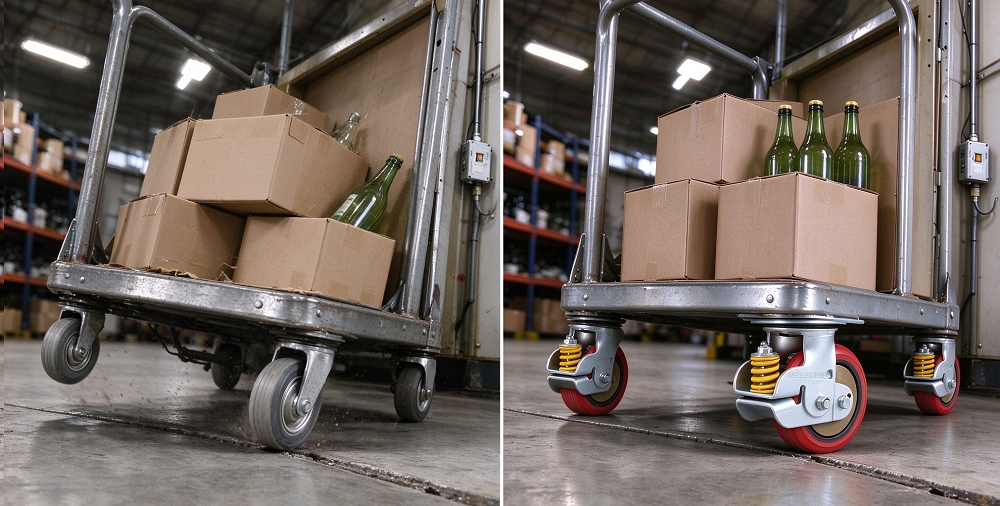
A trolley crosses an expansion joint in the concrete and the whole frame jumps. Bottles bounce on their racks. A cabinet door hangs crooked after six months. Circuit-board boxes arrive with loose connectors. The wheels were not worn out. They were the wrong build for the floor.
Shock absorbing castors exist for exactly this condition: uneven, jointed, outside or impact-prone floors where a rigid fork would transfer every bump straight into the load. Buyers in the UK and Commonwealth markets type castors; the same product shows up as shock absorbing casters on US pages. This piece covers what the spring actually does, where cushion tread is enough, and where a sprung caster adds cost without any benefit.
What Are Shock Absorbing Castors
A standard caster wheel rolls on a fixed-height fork. When the wheel hits a bump or a hole, the force travels through the bracket straight to the frame. A shock absorbing caster puts a compliance element between the axle and the frame so the bump moves the wheel slightly up and down before it reaches the load.
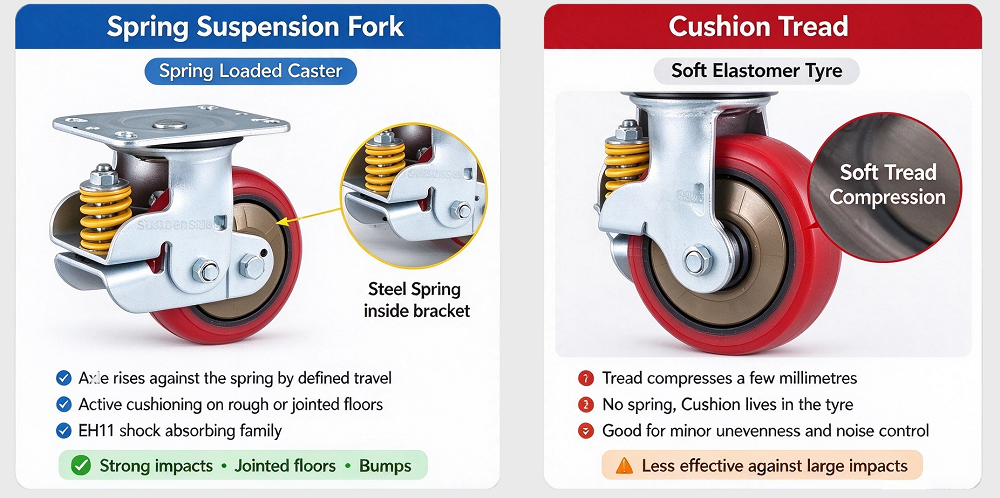
Two construction methods do this in our product range:
- Spring suspension fork (spring loaded caster). A steel spring sits inside the bracket assembly. The axle can rise against the spring by a defined travel on impact. This is active cushioning on rough or jointed floors. Our EH11 shock absorbing family uses this build.
- Cushion tread (soft elastomer tyre). The tread itself compresses a few millimetres — soft rubber, super-quiet rubber or softer polyurethane. No spring. The cushion lives in the tyre, not the fork. Good for minor floor unevenness and noise control, weak against large impacts or hard thresholds.
One loads the frame, one loads the tyre. They solve different problems and they are often mixed up in quotations.
Similar Terms, Different Parts
| Term | What absorbs the impact | Best fit | Weakness |
|---|---|---|---|
| Spring loaded shock absorbing caster (EH11 type) | Steel spring in the fork; defined vertical travel | Jointed concrete, dock plates, rough yard, fragile machinery | Higher mounting height, extra cost, needs a minimum load to compress |
| Cushion / soft tread caster | Soft rubber or softer PU tyre deforming under the contact patch | Smooth floors, noise reduction, floor protection | Little travel; large bumps still hit the bracket; soft tyres wear faster under sharp edges |
| Impact-resistant heavy duty fork | Thicker steel fork built to survive hits, not to soften them | Repeated collisions, pushback and rough handling | Does not protect the load; only the caster itself survives |
| Non-marking tread caster | Light-coloured elastomer with low pigment bleed; not a suspension feature | Epoxy, tile and showroom floors that stain easily | No cushioning value despite the soft-sounding name |
| Quiet / super-quiet rubber caster | Tread compound tuned for low rolling noise | Hospital, office, library and indoor paths | Noise lower does not mean impact energy absorbed |
Why the Bump Actually Hurts
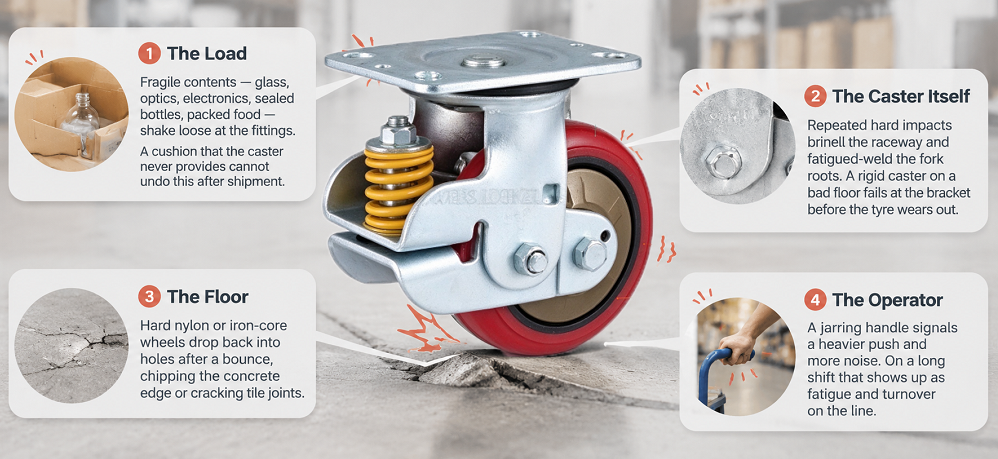
Impact energy on a cart has four common victims:
- The load. Fragile contents — glass, optics, electronics, sealed bottles, packed food — shake loose at the fittings. A cushion that the caster never provides cannot undo this after shipment.
- The caster itself. Repeated hard impacts brinell the raceway and fatigued-weld the fork roots. A rigid caster on a bad floor fails at the bracket before the tyre wears out.
- The floor. Hard nylon or iron-core wheels drop back into holes after a bounce, chipping the concrete edge or cracking tile joints.
- The operator. A jarring handle signals a heavier push and more noise. On a long shift that shows up as fatigue and turnover on the line.
Test Basis and What Standards Cover
- ISO 22883 (current edition) sets requirements and test methods for industrial castors and wheels used at walking speed and light traction, including rolling and operational behaviour.
- The ANSI/ICWM (MHI) terminology standard defines mounting height, swivel radius and rated load terms consistently across suppliers. Neither document gives a single universal spring-deflection number for suspension casters; spring rate and travel remain a manufacturer specification tied to the intended load window.
We hold ISO 9001 and ISO 14001. The standards above are the industry reference for what the words mean; we are not claiming certification against ISO 22883.
What Governs a Sprung Caster’s Actual Performance
- Spring pre-load. The spring does not start moving below its pre-load. A trolley sitting light on the bracket rides nearly solid and pays the price for the suspension without receiving it.
- Travel. The vertical compression available before the spring bottoms out. A small travel cannot handle a big threshold; the wheel rides over the bump but the frame still slams.
- Rated load window. Above the top rating the spring compresses fully and the metal seats on metal; below pre-load it never lifts off its seat. The cart must live in between.
- Tread compound on the sprung fork. Iron-core polyurethane rolls smoothly on concrete; super-quiet rubber adds a second cushioning layer for noise; aluminium-core rubber suits damp, abrasion-heavy paths.
- Wheel diameter. Larger diameters cross gaps and drain channels at lower impact; they also raise the mounting height, which must fit the doorway and the frame design.
- Swivel and rigid mix. A sprung swivel wheel and a sprung rigid wheel on the same axle line must compress in step; mismatched builds cause uneven height and pull to one side.
The EH11 Spring Suspension Family — Real Sizes
The EH11 range is our zinc-plated spring suspension line, ball bearing (code 11), available as sprung swivel (LS) or sprung fixed (LR). Table values come straight from the specification sheet; sizes below 125 mm or above 200 mm are on request.
| Size | Swivel spring SKU | Wheel dia × tread width | Rated load per wheel | Mounting height | Swivel radius | Plate | Hole spacing × hole dia | Spring travel | Picture(5 inch) |
|---|---|---|---|---|---|---|---|---|---|
| 5 inch (125 mm) | EH11-11-125LS-401 | 125 × 48 mm | 300 kg | 182 mm | 112 mm | 158 × 114 mm | 128 × 73 mm; 13 mm holes | 10 mm |  |
| 6 inch (150 mm) | EH11-11-150LS-401 | 150 × 48 mm | 350 kg | 194 mm | 125 mm | 158 × 114 mm | 128 × 73 mm; 13 mm holes | 10 mm | |
| 8 inch (200 mm) | EH11-11-200LS-401 | 200 × 48 mm | 400 kg | 243 mm | 163 mm | 158 × 114 mm | 128 × 73 mm; 13 mm holes | 10 mm |
Tread options for these sizes include iron-core polyurethane in red or yellow, nylon-core premium rubber, nylon-core super-quiet rubber and aluminium-core rubber; the envelope and mounting dimensions stay the same across tread choices.
For suspension requirements we can size the EH11 spring family across the 125, 150 and 200 mm sizes, match tread compound to the floor, and quote the fixed or swivel variant on the actual mounting pattern. Mixed-specification orders are assembled and shipped by sku; factory drawings accompany the quotation.For more information, please click here to contact us.
Common Buying Mistakes
- Ordering springs for a smooth, dry warehouse. On flat epoxy the spring rides at its pre-load seat; you pay extra height and cost and the load feels no difference. A standard heavy duty caster is the right answer there.
- Reading “soft rubber” as “shock absorbing”. The tyre cushions a few millimetres of compression. A 25 mm expansion joint still reaches the fork. Rough floors need the spring, not a quieter tread.
- Ignoring the minimum load. An underloaded sprung caster does not compress; the ride stays hard and the mounting height advantage becomes a liability.
- Using the per-wheel rating without a margin. The rating is a flat-floor, walking-speed dynamic value. Add margin before comparing it with your gross cart weight; do not divide the total and call it done.
- Forgetting the extra mounting height. The 125 mm sprung wheel sits at 182 mm versus a lower standard fork. Doorways, conveyor transfers and rack clearances change with it.
- Mixing sprung and fixed-height wheels on one cart. Heights differ; the loaded cart leans and one set carries more than its share.
- Choosing the softest tread under a sharp-edged load. A soft tyre squirms and wears at the contact patch under concentrated weight. Match tread to floor and load shape first, then cushion type.
Where Sprung Castors Belong — and Where They Do Not
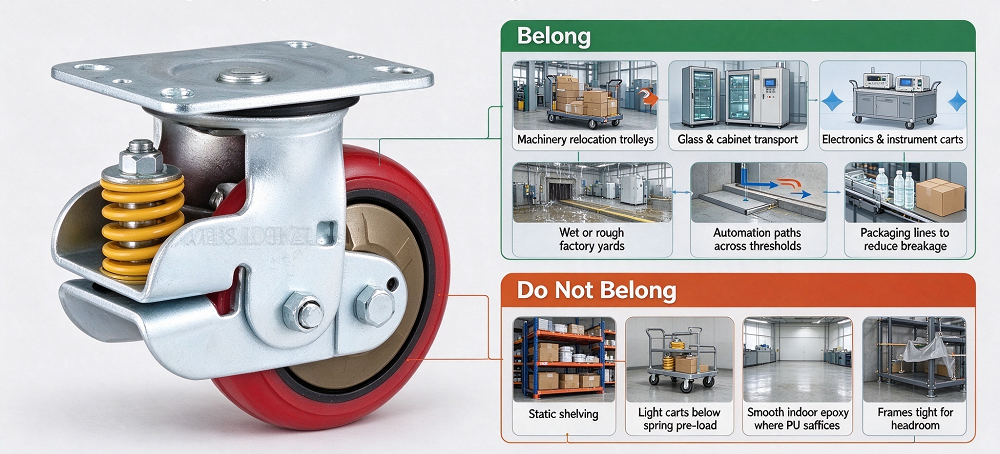
- They earn their place on machinery-relocation trolleys, glass and cabinet transport, electronics and instrument carts, wet or rough factory yards, automation paths that cross door thresholds and expansion joints, and packaging lines where bottle or carton bounce shows up as breakage.
- They do not belong on shelving that never moves, on light carts well below the spring pre-load, on perfectly smooth indoor epoxy where a polyurethane tread caster suffices, or on frames already tight for headroom. If your floor reads level under a spirit level and the load tolerates a bump, a spring caster is extra expense.
How to Select: Steps and Worked Example
- Measure gross cart weight loaded, including the frame itself.
- Divide by the number of wheels (four for the common four-wheel trolley).
- Apply a safety margin before comparing ratings; rough-floor dynamic use needs a wider margin than flat internal use.
- Check the floor and obstacles: gap widths, curb stones, dock plate edges, drainage grates. Larger diameters clear them better.
- Check clearance: mounting height and swivel radius against doorways and aisle width.
- Choose tread for floor protection and noise, spring family for impact.
Example.
- A four-wheel machinery cart loads to a gross 1200 kg and runs outside over jointed concrete.
- Raw per-wheel value: 1200 ÷ 4 = 300 kg. A 1.3× dynamic margin gives 390 kg per wheel.
- The 125 mm sprung wheel rates 300 kg and the 150 mm rates 350 kg; neither clears 390. The 200 mm wheel at 400 kg covers it, but the margin over the 390 requirement is thin. For that weight on outside joints, the next heavier grade should be quoted rather than squeezing the 200 mm into service; we quote that grade on request with the 2D drawing.
How Globe Caster Supports the Selection
Foshan Global Caster Co., Ltd, Guangdong, China. Casters since 1988, 156,000 m² plant, 500+ employees, in-house stamping, injection moulding and PU pouring; ISO 9001 and ISO 14001; 21,000+ recorded models and 600+ stock SKUs; one-year warranty and roughly 30-day standard lead time; exports to North America, Europe, Southeast Asia and the Middle East.

FAQ
Do spring loaded castors roll more easily than standard ones?
No. Cushioning and rolling resistance are separate properties. A sprung fork changes vertical compliance; the tread compound and bearing type decide the push force.
Is a soft rubber caster the same as a shock absorbing caster?
Not the same. Rubber tread compresses locally; a spring fork has defined travel between the axle and the frame. Choose the tread for noise and marks, the spring for impacts.
Do all four wheels need springs?
On a cart meant to protect a fragile load, yes, keep the four wheels at the same build so height and deflection stay matched. Two sprung wheels on a non-sprung pair creates uneven loading.
What happens if the cart is too light for the spring?
The spring stays near its pre-load seat, the wheel barely deflects over bumps, and the cart runs almost as hard as a standard caster while carrying the extra cost and height.
What mounting data should we send for a quotation?
Gross loaded weight, wheel count, floor type and gap sizes, doorway or conveyor clearance, and the existing hole spacing with hole diameter. We reply with a size recommendation and a 2D drawing.
Send the Load and the Floor Condition
Tell us the gross loaded weight, the number of wheels, the floor (smooth epoxy, jointed concrete, outside yard, wet area), and any threshold or gap the cart crosses. Add the existing mounting holes if you are replacing an old caster. We reply within one business day with the rated size, a tread recommendation and a 2D drawing — and we will tell you plainly if your floor does not justify a spring caster.
Post time: Nov-03-2026