
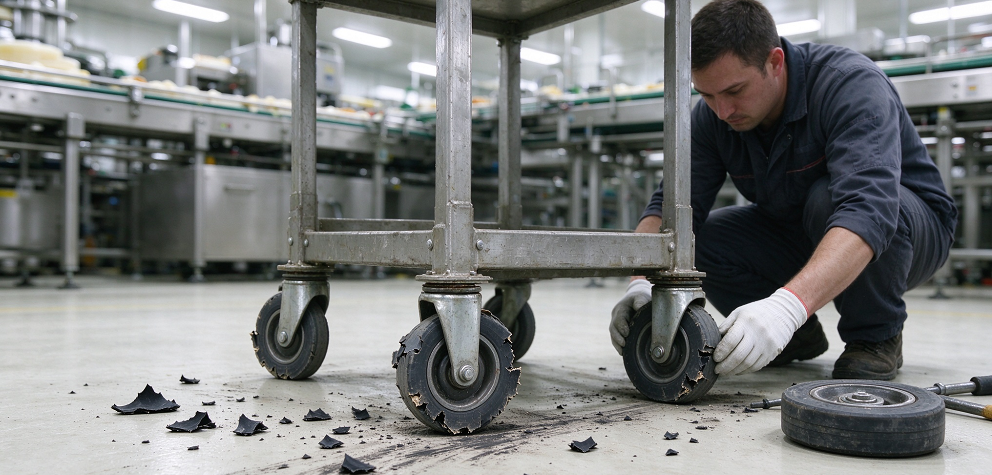
A food-processing plant in our order book ran the same complaint every Monday morning: the line-side ingredient trolley needed new wheels again. Six weeks, four wheels, and a chunk of black nylon sitting in the product zone. The wheels were not cheap wheels. They were the standard OEM hard nylon wheels the trolley came with.
This is the engineering story behind that replacement program — what was actually failing, what we changed, and what the before/after looks like for a buyer comparing castor wheel replacement options. The scene is representative of what we see in food and packaging plants; no client name, audit figure or warranty claim is attached.
The Problem in Numbers
The trolley loaded roughly 240 kg of ingredient totes, ran on sealed epoxy flooring between the prep room and the line, and crossed a stainless threshold roughly 40 mm wide at every trip. Before the upgrade, operations reported:
● Four wheels replaced about every six weeks, as chunks broke out of the tread edge.
● Starting push effort spiked after a weekend stood still — operators pushed harder rather than let the trolley roll.
● Visible nylon debris and occasional black marks on the epoxy, which the plant quality team had to explain on walk-throughs.
Those are the symptoms. The root cause was not a bad wheel. It was three wrong choices stacked together.
Why the Original Wheels Failed
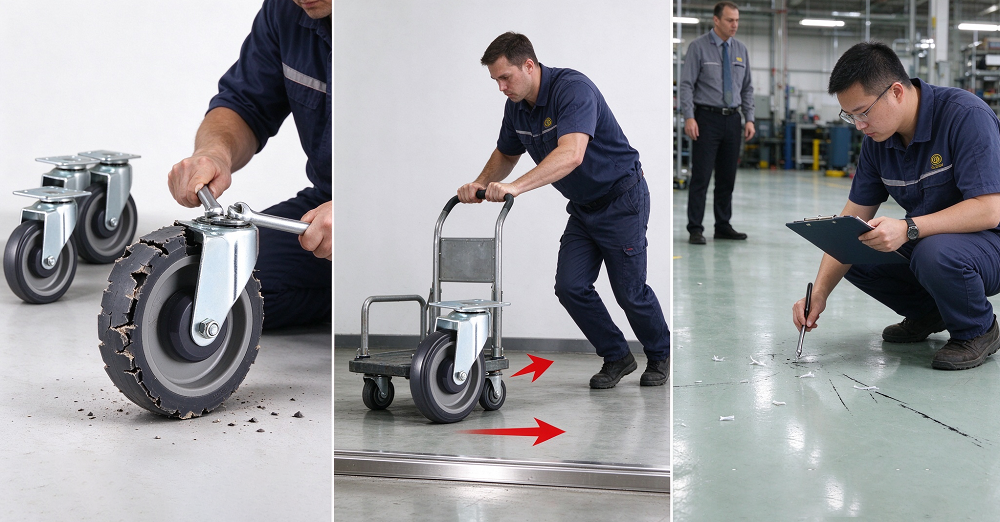
Hard nylon wheels are cheap, chemically resistant and fine on light, dry, smooth carts. On this trolley they lost on three points:
● Hard tread on hard floor. Nylon against sealed epoxy bounces rather than absorbs. Crossing the 40 mm stainless threshold every trip eventually chips the tread edge. Once a chip starts, it grows.
● Plain bore, not a rolling element. The original wheels ran on a plain bore that swallows dust and cleaning splash. After a weekend, the bore drags — that is the push spike operators felt.
● Wheel diameter too small for the threshold. A 100 mm wheel drops into the threshold gap rather than rolling over it. Impact energy goes straight into the tread edge.
A bigger nylon wheel with a better bearing would have bought time. But nylon debris in a food zone is a materials-hygiene question, not just a wear question — the plant wanted the tread material changed, not just upgraded.
What We Changed
We spec’d the replacement around three decisions, each tied to one of the failure points:
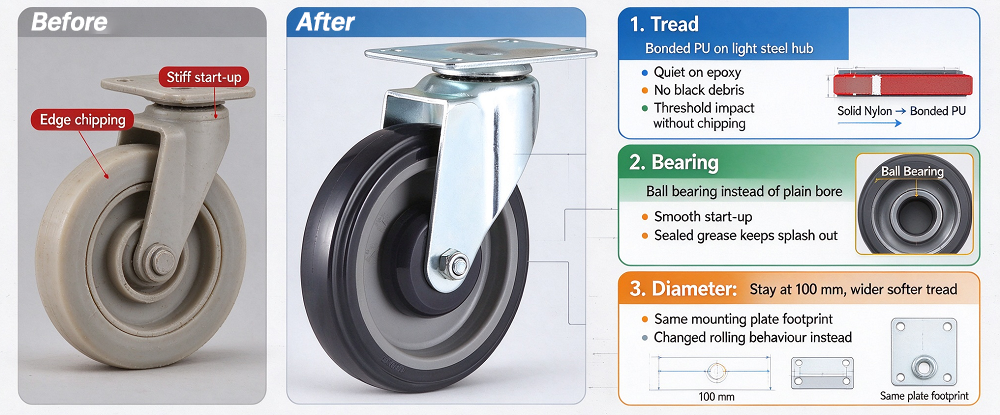
1. Tread: bonded polyurethane on a light steel hub instead of solid nylon. PU rolls quiet on epoxy, does not shed black debris, and takes the threshold impact without chipping the edge. Food washdown is still done by hand and wipe-down, not high-pressure wash, so a blue-zinc bracket was acceptable rather than a full stainless spec.
2. Bearing: ball bearing instead of plain bore. Smooth start-up removes the weekend push spike; sealed grease keeps cleaning splash out.
3. Diameter: stay at 100 mm but run a wider, softer tread. The mounting plate had to match the existing trolley, so we kept the footprint and changed the rolling behaviour instead.
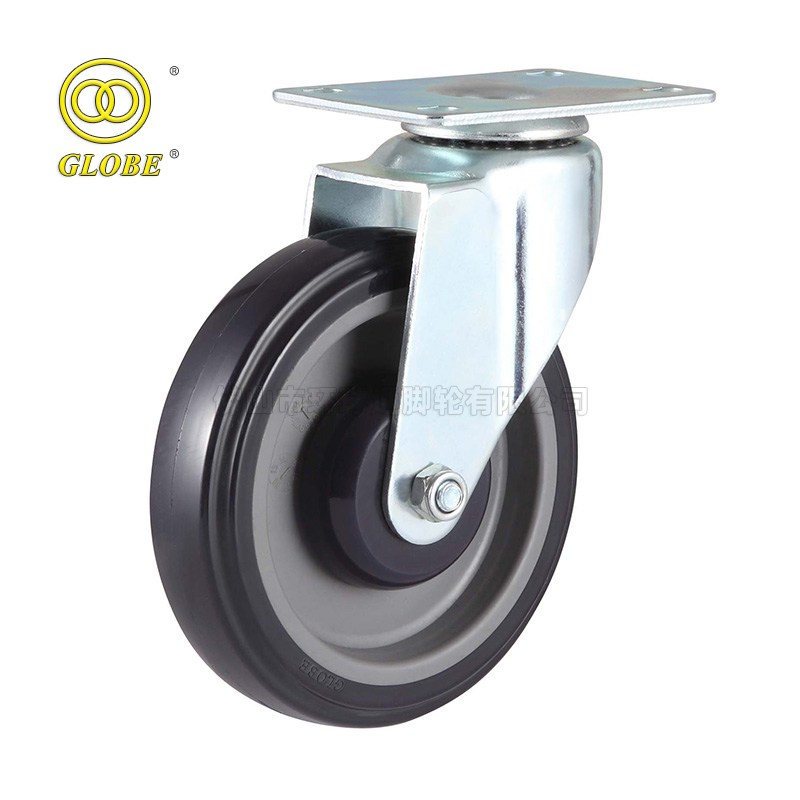
For a trolley at this 240 kg load, four wheels means 60 kg per wheel. With a 1.25 working margin we spec for about 75 kg per wheel. Our ED01 medium plate family clears that comfortably — the ED01-11-100S-308, a 100 × 28 mm wheel on a 94 × 67 mm plate, is rated 80 kg per wheel with 133 mm mounting height and an 88 mm swivel radius. That is the size class this replacement program settled on.For more information, please click here to contact us.
Before / After, at a Glance
| Point | Original spec (OEM) | Replacement spec |
|---|---|---|
| Tread material | Solid hard nylon | Bonded polyurethane tread |
| Bearing | Plain bore, drags after standing | Sealed ball bearing, smooth start |
| Wheel | 100 mm hard narrow tread | 100 mm wider PU tread, same plate footprint |
| Floor marks / debris | Black nylon chips on epoxy | No debris, non-marking on sealed floor |
| Start-up push effort | Spikes after weekend standing | Starts rolling with steady low force |
| Typical tread life | About six weeks before chipping | Expected to extend well beyond six months on the same route |
| Plate / holes | Original trolley mounting | Same 94 × 67 mm plate, no trolley modification |
We do not put a warranty-guaranteed lifetime number on the PU tread for this route. Floor grit, washdown frequency and trolley loading vary plant to plant. The direction is the point: one failure mode per trip, removed.
How We Verified Before Signing the Program
Two sample sets went out before the full order: four swivel and four rigid PU/ball-bearing units in the ED01 class.
The plant ran them on one trolley on the same route for three weeks,:
○ Watched for tread chipping on the threshold;
○ Checked the floor at end of shift;
○ Measured start-up effort by feel against the old wheels.
Only then did we quote the full eight-per-trolley program with spare pairs.
 |
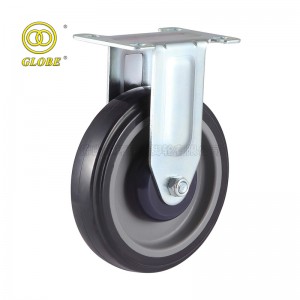 |
| ED01-11-100S-308 | ED01-11-100R-308 |
If your existing brackets are still straight and the plate holes line up, you do not need new brackets at all — changing the wheel assembly is enough. We will tell you that on the quote rather than upselling a full rig.
What Buyers in the Same Position Should Check First
1. Weigh the loaded trolley, divide by four, then add margin before looking at per-wheel ratings.
2. Walk the route and photograph every threshold, joint and patch — most caster failures happen at one obstacle, not over the whole floor.
3. Ask what is actually in contact with the product zone. Black debris on epoxy is a hygiene finding, not just a noise complaint.
4. Send the old wheel drawing or the plate size. If the holes match, a plate change is unnecessary cost.
When This Upgrade Is Not Worth It
If your cart runs on smooth concrete, under 80 kg loaded, and the wheels have lasted years, do not replace them because a sales email landed. Hard nylon is still the right cheap answer for dry, light, smooth work. The upgrade above was worth it because the floor was sealed, the route crossed thresholds, and the debris was a quality issue. Match the fix to the failure.
How Globe Caster Supports Replacement Programs
Foshan Global Caster Co., Ltd, Guangdong, China has manufactured casters since 1988 on about 156,000 m² with 500-plus staff and in-house stamping, injection moulding and PU pouring. For replacement programs we send sample pairs first, keep mixed swivel/rigid/brake SKUs in one shipment, label cartons to your part numbers, and cover a one-year warranty under normal use. Typical lead time is about 30 days, with 600-plus standard models kept as stock.

Send Us the Route, Not Just the Wheel Size
Tell us the loaded trolley weight, the floor, the worst threshold or joint, and what the old wheels are doing (chipping, dragging, marking). We reply with the tread, bearing and plate class we would spec, plus sample SKUs you can trial on one cart. If a cheaper wheel still solves it, we say so.For more information, please click here to contact us.
Post time: Nov-07-2026